Saturday, 9 June 2012

" Canterbury Pilgrimage with machine guns" - 'Cannibals and Missionaries', MM's last novel

A Novel of Terrorism: Cannibals and Missionaries reviewed  by Mary Gordon NYT

 
September 30, 1979

Where are we, then, to place "Cannibals and Missionaries," which its publishers present as "a thriller," in the context of Mary McCarthy's work? She is not the sort of writer who would toss off a book as a lark or a diverting experiment, so why has she done it?
It is clear to me that this, the most political, the least autobiographical of her novels, would have been impossible without her experience of traveling to Vietnam as a reporter. Many of the details of that experience, particularly those about physical fear and communal bonding, find their way into this novel in the accounts of the passengers' ordeal. "Cannibals and Missionaries" is the story, among other things, of a committee of liberals who are hijacked while traveling to Iran to examine the atrocities of the Shah's regime. It speaks, with McCarthy's habitually unsentimental voice, to the problem of witness and political responsibility among nonprofessional men of good will. For McCarthy, terrorism is disturbing in the same way that sexual promiscuity would have been for Emily Bronte: it is political activity without manners, without form; therefore it is incapable of yielding much meaning and is inevitably without hope. In some crucial way, it is not serious: it has no stake in the future.
By a stroke of good fortune for the terrorists in this book, the airplane that they hijack contains not only the liberal committee but also a group of art collectors on an archeological tour. It takes the terrorists a while to realize their luck, but they come to understand that they will be able to put the West in the most vulnerable and humiliating of positions: it will have to prove its devotion simultaneously to Art and Human Life. The terrorists bring the passengers to a deserted Dutch Polder - a model farming community built on land reclaimed from the sea - and say that they will exchange the collect: Helen will be flown out after her Vermeer is flown in; Harold can leave when his Cezannes arrive.
( The Missionaries and Cannibals problem is a classic AI puzzle that can be defined as follows:
On one bank of a river are three missionaries and three cannibals. There is one boat available that can hold up to two people and that they would like to use to cross the river. If the cannibals ever outnumber the missionaries on either of the river’s banks, the missionaries will get eaten.
How can the boat be used to safely carry all the missionaries and cannibals across the river?

The initial state is shown to the right here, where black triangles represent missionaries and red circles represent cannibals.)
It is a fascinating situation, and it gives McCarthy the opportunity to speak of a new and terrible phenomenon: "put a terrorist next to a work of art and you get an infernal new chemistry, as scarifying to 'civilization' as the nuclear arm." And the situation of a hijacking allows the writer delicious opportunity to examine character: it's a kind of Canterbury Pilgrimage with machine guns.
One can imagine McCarthy's glee as she made out the passenger list for this ill-starred flight. She introduces us first to Frank Barber, the Episcopal Rector of St. Matthew's, Gracie Square, whom we hate instantly for his attachment to the woolen hats his family's eggs wear as a sign of the number of minutes they have lived under boiling water. This, and his habit of saying, "darn it," at the breakfast table. Next we meet Aileen Simmons, president of Lucy Skinner College, the kind of woman who was once referred to as a "game girl." She is 50, unmarried, devoted to her students and her Arkansas family, politically responsible, in all her actions moderate, and torture to be in the room with. We encounter Gus Hurlburt, a saintly Missouri Bishop, and Senator Jim Carey (who perforce reminds the reader of another silver-haired, poetic Irish Presidential candidate whom we were once exhorted to keep neat and clean for). Then there is Sophie Weil, a New Journalist (her name is unfortunate, and McCarthy, who translated Simone Weil's "The Iliad, or The Poem of Force," might have thought again). And then Victor Lenz, a badly groomed Middle East scholar who insists upon bringing his cat. They seem at first not a riveting bunch, and one is grateful for the arrival of Henk Van Vliet de Jonge, a Dutch member of Parliament, poetic as the Senator, and handsomer.  
 
We wait impatiently for the hijacking, so we can see these characters tested. Of course, some will behave their worst under the stress of danger and captivity. Aileen's manners and perhaps her morals turn out to be the most shocking. When the hijacking first occurs and it seems that only the committee will be captured, she resents the exclusion of the first-class passengers: "Don't you think you ought to tell those people who they are? It's not fair - honestly, it is - for them to be let go while we sit here with a price on our head because some of us, like the Senator, are celebrities.... It wouldn't hurt those millionaires a bit to be held for ransom."
Aileen is surely one of the most annoying women in recent fiction, with her rouge, her dyed hair, her sense of place, "as though the conviction she had of her importance were a religious matter." The Reverend Frank is almost as grating. His relentless and simplistic optimism is an offense not only against the facts but against the mysteries of the human heart as well. "We will be bigger people for it, if we will only let ourselves.... Through this unforeseen contact with our captors, we can be enlarged."
But there are heroes on the committee, two pure, two motley. The pure are the old Bishop and the young Journalist. The Bishop is perfectly good, an innocent who shares his birthday cake with the hijackers. And Sophie has the passionate engagement that differentiates her from two lesser heroes - Jim and Henk, who view the world with a detached, spectator's irony and who, although they are real forces for good, recognize the limits of their moral natures.
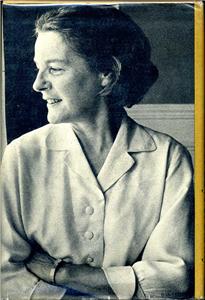
I discovered this photograph of MM on a Spanish website


There are heroes, too, among the terrorists: Ahmed, decent, loyal, innocent as the Bishop; and the Dutch leader of the group, Jeroen, whose doomed life McCarthy examines with great insight. His temperament is artistic: he began his adulthood wanting to "consecrate himself in poverty to the value people called 'art'; by learning, if possible, to make some of it himself." But he gives up sketching in the Rijksmuseum for trade unionism, and then for the Communist Party, which he then rejects for the purer art of terrorism:
"Now art, even the Party kind of making propaganda, lost all interest for him, except in the sense that a deed was a work of art - the only true one, he had become convinced. The deed, unless botched, was totally expressive; ends and means coincided. Unlike the Party's 'art as a weapon,' it was pure, its own justification. It had no aim outside itself. The purpose served by the capture of the Boeing was simply the continuance or asseveration of the original thrust; ransom money, the release of fellow activists, were not goals in which one came to rest but means of ensuring repetition. Direct action had a perfect circular motion; it aimed at its own autonomous perpetuation and sovereignty. And the circle, as all students of drawing knew, was the most beautiful of forms. Thus in a sense he had returned to where he had started: terrorism was art for art's sake in the political realm."


The most important achievement of "Cannibals and Missionaries" is McCarthy's understanding of the psychology of terrorism, the perception, expressed by Henk, that terrorism is the product of despair, "the ultimate sin against the Holy Ghost." Once again, McCarthy is asking the difficult question, confronting the difficult problem. For surely, terrorism threatens us all, not only physically and politically, but morally and intellectually as well. It postulates a system of oblique correspondences, a violent disproportion between ends and means, against which we have no recourse. She comes to terms as well with our peculiar but irrefutable tendency to see human beings as replaceable, works of art unique. For the lover of formal beauty who is also a moralist, it is the most vexed of questions. I'm not sure McCarthy has anything new to say on the subject but she does not imply that she does.
Often, artists have responded to the prospect of atrocity by creating a well-crafted work of art. One thinks of Milton's "On the Late Massacre of the Piedmontese," a perfect Italian sonnet whose hundredth word is "hundredfold." In response to the truly frightful prospect of anarchic terrorism, Mary McCarthy has written one of the most shapely novels to have come out in recent years: a well-made book. It is delightful to observe her balancing, winnowing, fitting in the pieces of her plot.
The tone of "Cannibals and Missionaries" is a lively pessimism. Its difficult conclusion in that to be a human being at this time is a sad fate: even the revolutionaries have no hope for the future, and virtue is in the hands of the unremarkable, who alone remain unscathed.

Mary Gordon is the author of "Final Payments," a novel.

The Problem

The Missionaries and Cannibals problem is a classic AI puzzle that can be defined as follows:
On one bank of a river are three missionaries and three cannibals. There is one boat available that can hold up to two people and that they would like to use to cross the river. If the cannibals ever outnumber the missionaries on either of the river’s banks, the missionaries will get eaten.
How can the boat be used to safely carry all the missionaries and cannibals across the river?

The initial state is shown to the right here, where black triangles represent missionaries and red circles represent cannibals.

Searching for a Solution

This problem can be solved by searching for a solution, which is a sequence of actions that leads from the initial state to the goal state. The goal state is effectively a mirror image of the initial state. The complete search space is shown in figure 1.
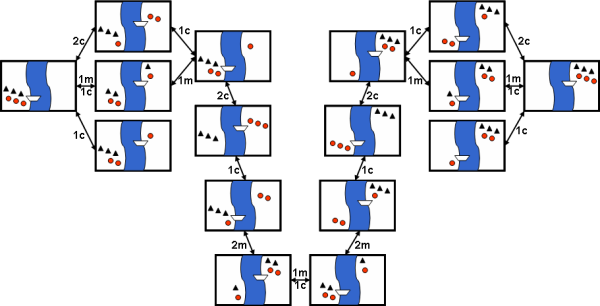
Figure 1: Search-space for the Missionaries and Cannibals problem
Arrows in figure 1 represent state transitions and are labelled with actions, e.g. 2c represents the action of two cannibals crossing the river. The initial state is shown again on the left, whereas the goal state is all the way to the right.

Friday, 8 June 2012

Mary McCarthy in Italy - "There is too much Renaissance in Florence,"


An old postcard of Florence


 Mary McCarthy: summers in Florence:
‘The summers are the worst.  The valley of the Arno is a natural oven, in which the city bakes, almost without relief, throughout July and August.  Venice has the sea; Rome has a breeze and fountains; Bologna has arcades; Siena is high.  But the stony heat of Florence has no extentuation.  Some people pretend that it is cooler in Fiesole or near the Boboli Gardens, but this is not true, or at least not true enough.  For the populace and the tourists, the churches are the only refuge, except for UPIM, the local five-and-ten (a Milanese firm), which is air-cooled, and for an icy swimming pool, surrounded by a flower garden, in the Tennis Club of the Cascine that few tourists hear about and that the native population, on the whole, cannot afford.  The Boboli Garden is too hot to walk in until sunset, which is the time it closes.  In some Italian cities, the art galleries are cool, but the Uffizi, with its small rooms and long glassed-in corridors, is stifling, and the Pitti stands with wings extended in a glaring gravel courtyard, like a great brown flying lizard, basking in the terrible sun.  Closed off, behind blinds and shutters, the city’s inhabitants live a nocturnal life by day, like bats, in darkened rooms, wanly lit for the noon meal by electricity.  At seven o’clock in the evening, throughout the city, there is a prolonged rumble that sounds as if it were thunder; the blinds are being rolled up to let in the exhausted day.  Then the mosquitoes come.

For the tourist, it is too hot, after ten o’clock in the morning, to sight-see, with the windows shut and the wooden blinds lowered, to sleep after lunch, too dark to read, for electricity is expensive, and the single bulb provided for reading in most Florentine hotels and households is no brighter than a votive candle.  Those who try to sight-see discover the traffic hazard.  The sidewalks are mere tilted rims skirting the building fronts; if you meet a person coming towards you, you must swerve into the street; if you step backward onto the pavement to look up at a palace, you will probably be run over.  “Rambles” through Florence, such as the old guidebooks talk of, are a funny idea under present conditions.  Many of the famous monuments have become, quite literally, invisible, for lack of a spot from which they can be viewed with safety.  Standing (or trying to stand) opposite Palazzo Rucellai, for example, or Orsanmichele, you constitute a traffic obstruction, to be bumped by pedestrians, honked at by cars, rammed by baby carriages and delivery carts.  Driving a car, you are in danger of killing; walking or standing, of being killed.  If you walk, you curse the automobiles and motor-scooters; if you drive, you curse the pedestrians—above all, old women, children, and tourists with their noses in maps or guidebooks.’
—from The Stones of Florence (1956)
 
banner


October 25, 1959
... And Here Machiavelli Was at Home
By CARLO BEUF


THE STONES OF FLORENCE By Mary McCarthy 

Few places in the Western world have so persistently been "written about" as has Florence. In Victorian days the City of the Lily was considered a must by all travelers with a claim to "culture"; and a remarkable proportion of them proceeded to air their views about it. The result: a few good books, many mediocre ones and a veritable avalanche of undiluted trash. Mary McCarthy's volume with the Ruskinian title, "The Stones of Florence," belongs to the first category, for Miss McCarthy is not only well versed in the subject but her taste is sure and her style -- cool, astringently witty, yet eloquent -- seems tailor-made for depicting the brilliant, mercurial, skeptical Florentines.
Art criticism, social and political history and chronicle all rolled into one, her book opens with a chapter on present-day Florence. It is not one of the happiest chapters. Like many another tourist, the author falls to complaining of noisy, jam-packed streets, overcrowded hotels, exorbitant prices, the rudeness of waiters and the poor quality of the food. All of which is trivial and rather out of place in a work of this sort. Where food is concerned one surely can find more appetizing fare that "tripe, paunch, and a mixture of cockscombs, livers, hearts and testicles of roosters." What Miss McCarthy has to say about other aspects of Florentine life, on the other hand, is important, often exciting and well worth heeding.
The "esthetes" of yesteryear would have shuddered to hear her refer to Florence as "a terrible city *** of drama, argument and struggle." Yet up to a point this is what Florence was. Whether or not the rebellious Catiline was indirectly responsible for founding Florence, the fact remains that few cities have had a more turbulent history. Machiavelli, Guicciardini, Villani and Varchi tell tales of endless strife between rival factions -- Blacks and Whites, Guelphs and Ghibellines, Cerchi and Donati and so forth and so on. "In ancient and in modern times," writes Giovanni Villani, "it has always happened in Florence that anyone who has made himself head of the people has been humbled by that same people who are never inclined to give due praise or acknowledge merit." Evidently, no public office was a sinecure on the banks of the Arno.
However, these are growing pains of democracy: the hazards to which a people thirsting "for an ideal state" are often exposed. What is worthy of note is that this chronically quarreling folk remained for centuries one of the most prosperous if not the most prosperous in Europe. Their looms turned out more and better cloth than was produced anywhere else; their dyers exercised a virtual monopoly on the market; and their bankers financed half of the kings and governments on the continent.
True, in 1889, the Bardi and Peruzzi were bankrupt by the failure of Edward III of England to repay a huge loan he had made with them, but Miss McCarthy's assertion to the contrary, this financial disaster by no means put an end to Florence as "a world banking power." Indeed, during the following century the Medicis were the greatest bankers on the Continent, rivaled by none except the Austrian Fugger, while for generations to come the florin remained, even as far off as India, the soundest monetary unit. Anyway, it is not to its wealth that Florence owes her enduring glory.
It is impossible adequately to summarize the chapters in which Miss McCarthy analyzes the achievements of Florence in the fields of art, letters and science. "Florentine history, in its great period," she writes, "is a history of innovations," and she goes on to prove it: Dante gave Italy its first important work in the vulgar tongue; a Florentine composed the first opera; literary criticism, in the modern sense, began with Boccaccio; Boccaccio's clinical account of the symptoms of the plague was a pioneer contribution to descriptive medicine; Machiavelli was the first to expose the mechanism of power politics, while the first modern art criticism was written by L.B. Alberti.
As for painting, sculpture and architecture, we only need to remember that Giotto, Leonardo, Brunelleschi, Donatello and Michelangelo were Florentines or born within a few miles of Florence. Miss McCarthy is right in saying that Florentine sculptors carved "the best statues since ancient Greece," and Florentine painters were the most original "until the French Impressionists."
The photographs which illustrate this volume are superb, and though not everyone will go along with all of Miss McCarthy's verdicts (many will boggle at her calling Michelangelo's figures on the Medici tombs "somewhat rubbery"), we must be grateful to her for giving us one of the most lively books on Florence to appear in recent times. Indeed, no student of the Renaissance should be without "The Stones of Florence."

       Rubbery Michaelangelo's
I


Evelyn Hofer (photo contributor to The Stones of Florence)


Thursday, 7 June 2012

The Group" drafted into the service of feminism" says MM

The Lasting Power of the Political Novel  (part 2)


FIRST, there are stories that engage in the highly political art of persuasion, aiming to convince a reader to take certain stands in a national or international debate - the simplest example is ''Uncle Tom's Cabin.'' But here ''The Book of Daniel'' may also be relevant insofar as, at one remove, it can affect a reader's attitude toward the cruise or Pershing missile. A second type of story deals with politicians, examples being ''The Last Hurrah,'' ''All The King's Men,'' Dos Passos' ''District of Columbia'' (whose weakness is to be biased), a good deal of Gore Vidal; I do not think this type is often found in combination with the first, since novels about politicians tend, like their heroes, to a worldly realism that would never change one's voting habits, except maybe to discourage one from voting at all. A third type ponders large political questions - essentially the nature and effects of power. The setting may be a village, a family house, a monastic community, a hospital, an air base, a hiring hall, an imaginary country such as those Gulliver visited or ''Animal Farm''; the politics may be in the play between man and Nature, man and the universe, man and God. This third type, too, being long-sighted, cannot coexist with the first, and not, I think, with the second either; a fascination with the corridors of power is always anecdotal, not reflective. Such anecdotes as appear in ''War And Peace,'' a supreme instance of Type Three, are there for illustrative purposes, to serve as examples in the ancient, rhetoricians' sense of the term. This third and noblest type may be fully represented in our fiction only by ''Moby Dick.''
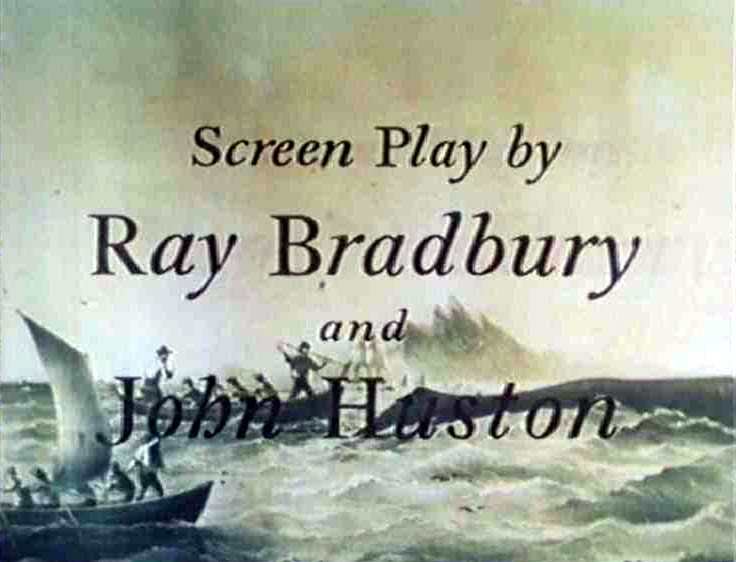
From the film adaptation of Moby Dick - RIP the incomparable Ray Bradbury


What we find most often in American fiction, I believe, is the first type, though we may not recognize it or, when we do, call it propaganda, which for us is a negative word, without any of the original wholesome connotations of missionary work (de propaganda fide, spreading the faith) implicit for the Roman Church. Actually the great majority of novels in this country - maybe everywhere - have been faith- spreaders. Those are the ones we name when we are asked what books have influenced or changed us.
''Main Street'' was such a book, and ''Babbitt'' another. ''Babbitt'' was a generalized warning of what as an American one would not want to happen to oneself. (Type One, as I should have said, includes warnings - all sorts of wake-up calls, sirens, alerts.) When, with ''Elmer Gantry,'' ''Arrowsmith,'' and so on, Lewis ceased to issue those wake-up calls to his fellow-citizens and turned, instead, to cataloguing American social types by professions - preacher, scientist, businessman, social worker - he became a simple indexer, and nobody listened anymore. Surprisingly, though, years after ''Main Street,'' he came out with an explicit warning to the nation under the ironic title of ''It Can't Happen Here.'' It was Lewis doing his bit to alert his readers to the possibility of a native fascism, which of course would look different from Hitler's. The title was misunderstood even at the time, as a reassurance rather than the alarm-bell it was, which is perhaps a fate that lies in wait for such ironically titled, minatory books. Something of the kind happened with Burdick and Lederer's ''The Ugly American'' - a clear lesson in the Do's and the Don't's for the United States in Southern Asia. The ugly American of the title was a homely simple fellow who knew the right way to win hearts and minds; in other words, he was good. But by those who did not read the actual story and doubtless through contamination from Graham Greene's ''Quiet American,'' he was taken to embody the bad side of the U.S.A., to the point where the term ''ugly American'' became proverbial, meaning someone suspected of being a C.I.A. agent or finally just any American on neocolonial soil.
       
Is it an exaggeration to call ''Main Street'' and ''Babbitt'' propaganda? Certainly in 1921, when ''Main Street'' came out, it was understood as a rejection of the values of Main Street, seen as narrow, rectilinear, conformist, deadly dull. And along with that was a notion that Main Street was a mistake, made with good intentions, which could be corrected, or repealed, like the Volstead Act - a product of just such prairie towns. Main Street could not be eternal, written in the natural order of things; thanks to Lewis and his readers, it could be just temporary. It is the underlying sense of something to be corrected in the American heartland that tells us that Lewis's novel is political, in comparison, say, with ''Tess of the D'Urbervilles.'' The wrongs done to Tess by the world surrounding her are infinitely greater than any injury done to Carol Kennicott in ''Main Street,'' who at worst could be said to be suffering from a slight personality impairment due to cultural deprivation. Tess is not a social fact, capable of multiplication to give a satirical picture, but the plaything of a cruel destiny. She is hanged at Winchester, like any common murderess, yet our knowledge that she is an uncommon, even a superior, person cannot let us fall on the book as a condemnation of capital punishment (see ''The Executioner's Song''), though that could be a side-effect on certain readers of a passionate response to the book. That she is not changed - coarsened - by her misfortunes (as in real life she almost surely would be) is the clue to the suprapolitical dimension of Hardy's story. Politics, the art of the possible, hopes to change the rules of society (or restore a former good order in the place of a bad); at the same time, it induces change - for worse as well as better - in individual subjects viewed as samples.
NATURALLY, the propaganda that works on us through fictions does not effect conversions (i.e., transformations) in ways that can necessarily be charted. If our vote on E.R.A. or a nuclear- power amendment is changed by a novel we are reading, that is only the tip of the iceberg. Probably in the 20's there were more converts made to hedonism than to any other faith, and that still may be the ''message'' of the most influential fiction of today, from Mailer to Updike and back, even when the evangel of self-expression is relayed through fears of getting cancer (Mailer) from bottling oneself up. But to go back to 30's fiction, it can be said, surely with truth, that Cesar Chavez's grape and lettuce pickers unions were helped, though with a delay of two generations, by ''The Grapes of Wrath.'' But the Joad family, ''Of Mice and Men,'' even the less accessible ''In Dubious Battle,'' had already had consequences for the national psyche in a less evidently causal way.
That American novels can be and often are political is demonstrable. There was Mailer's second novel, for instance, ''The Barbary Shore,'' laid in Brooklyn with an F.B.I. man for the villain. Not to mention the ''proletarian novels'' of the 30's, or Upton Sinclair, not to mention ''Mr. Sammler's Planet'' and ''The Dean's December.'' Or Bellow's first book, ''Dangling Man,'' the ''alienated'' cry of a character waiting to be drafted. Or his second, ''The Victim'': Isn't any novel about anti-Semitism political and almost any novel about race? Maybe novels about the lot of women, such as ''A Lost Lady,'' were ''domestic'' at the time of writing, but they have been drafted into the service of feminism, along with their modern sisters, ''Fear of Flying,'' and ''The Group.''


In a different vein, we have had the Boston pols of ''The Last Hurrah'' and their descendants in George V. Higgins. Good heavens, I was nearly forgetting ''Gone With the Wind.'' On the conservative side, too, there was Cozzens' ''By Love Possessed'' - a goyish Mr. Sammler. Robert Penn Warren's ''All The King's Men'' was a political novel if there ever was one, being a highly recognizable picture of the career of Huey Long. If Updike's ''Couples'' was decidedly ''domestic,'' what about ''The Coup,'' his study of an African leader? And ''Bech: A Book,'' where literary politics is never far from the other kind.
Most of our war novels have been pacifist in their general slant - enough to count as political. I am not sure of ''The Red Badge of Courage'' or ''A Farewell to Arms,'' but there is no doubt of ''Three Soldiers,'' ''The Naked And The Dead,'' ''From Here to Eternity,'' ''Catch- 22''(!). And the many works of Vietnam veterans such as ''Dispatches'' by Michael Herr.
Anyone who is in the mood can continue the list. To make the point there is no need to seek to prove (as some academic recently did) that ''Moby Dick'' is an allegory of capitalism. What is interesting is that so many of the novels I have been naming have been high on the best-seller lists. The political novel in this country is certainly no fringe phenomenon. And it strikes me that we have almost more than our share of them, in comparison with England and Western Europe, just as we have had more war novels (in fact, a notable case of Type One) than our allies or adversaries, and this despite the fact that we entered both World Wars late and were never exposed to mainland attack or invasion.
In the First War, the English had war poetry, and the Germans had ''All Quiet on The Western Front''; the French had part of Roger Martin du Gard's ''Les Thibaults,'' Henri Barbusse's ''Under Fire,'' and a film, ''La Grande Illusion.'' Out of that war, the English, as far as I remember, produced only a single novel, though that was a masterpiece, first published, in expurgated form, as ''Her Privates We'' and written in fact by an Australian, Frederic Manning. It was reissued uncut a few years ago as ''The Middle Parts of Fortune.'' A curious aspect of this pure and beautiful work, dealing with trench warfare and behind- the-lines billet life on the Somme in 1916, is the absence of politics from it, as remarkable in its way as the same absence in ''The Iliad,'' and I mean politics of any kind - there is neither glorification nor condemnation of war, still less of ''our'' side in contrast to the enemy beyond the barbed wire, and, most unusual of all, no idealization of the class of privates as opposed to the officer class that made up the basic politics of American war fiction. We will not find that neutrality in our war literature, which has a strong accusatory ring; none of our soldier-authors could have written these two sentences (from the prefatory note to ''Her Privates We,'' 1929): ''War is waged by men, not by beasts, or by gods. To call it a crime against mankind is to miss at least half its significance; it is also a punishment for a crime.''
 
EVEN Faulkner's ''A Fable,'' written toward the end of his life, after he received the Nobel Prize, but going back to the First War, is not dispassionate but, rather, hyperbolic about the redeeming mutiny it describes; with a silent admonitory black cross placed by Random House on the jacket, it is a pacifist parable, with funny echoes of ''A Tale of Two Cities,'' on the one hand, and of ''Hinky-dinkey parlay-voo'' (alias ''Mademoiselle from Armenteers, She Hasn't Washed in Forty Years'') on the other. Even though it is not fiction, one ought to mention E. E. Cummings's ''The Enormous Room,'' recounting his imprisonment, with Slater Brown, as a suspected spy in a French internment camp - a peak of imaginative prose writing by an American about the First War. ''A Fable,'' in fact, was Faulkner's third try at rendering some angle of that war; ''Soldier's Pay'' and ''Mosquitoes'' had to do with veterans, a political problem since Caesar's time.


Wednesday, 6 June 2012

The Lasting Power of the Political Novel - part 1


'
 January 1, 1984
 Mary McCarthy
NYT

SOMEONE said the other day that the American novel was, of course, not political: By comparison with the European novel, say Zola and the Russians, our home product was primarily domestic, unconcerned with public affairs. It was a surprise to me to learn that this strange notion was taken for granted - a truism - by common opinion; to me it was a new idea. At once a contrary list sprang into my mind, ''The Bostonians'' and ''The Princess Casamassima'' lining up with Henry Adams's ''Democracy''; behind them Mary McCarthy, the novelist and essayist, most recently published ''Ideas and the Novel.'' marched ''Uncle Tom's Cabin'' (''did much to hasten the American Civil War'' - Oxford Companion to English Literature) and ''The Blithedale Romance,'' Hawthorne's satire on the Brook Farm experiment in communal living; ahead were Dos Passos' ''U.S.A.,'' ''For Whom the Bell Tolls,'' right up to Norman Mailer's ''Why Are We in Vietnam?''


Indeed, Americans, I think, tend to get their political education through fiction - occasionally through poetry, though this is becoming rarer. Today a novel such as E.L. Doctorow's ''The Book of Daniel,'' currently a film, seems to have no other design than to excite a belief in the innocence of the Rosenberg couple or to reinforce a disbelief already held as to the charges against them. I do not know whether the Doctorow book changed anybody's mind on this subject - how could it, seriously, being fiction, deal with a concrete instance of fact? - but fictions do sway us to the right or left, and Americans, I suspect, more than most.
I can cite a case - my own - of a young person's being altered politically by a novel, but I cannot explicate the process, let alone explain it in terms of the author's intention or literary strategies. I believe there is often something accidental in these things, as with love, which gives them a feeling of fatality.
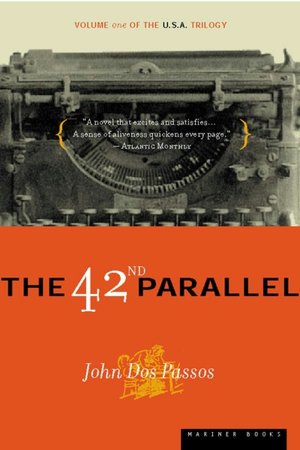
When it happened to me, at the age of 20, it was the first time. I was probably not very susceptible politically; the year I was 15 I had read an entire set of Tolstoy with no effect that I recall on my belief system. I was an atheist, a romantic, and an arch-conservative (except at elections, when I was a Democrat); none of this could have come to me from Tolstoy. The first real dent on my Cavalier- period armor was made in my senior year at Vassar in Miss Peebles's course in Contemporary Prose Fiction, where we studied ''multiplicity'' and ''stream of consciousness'' and were assigned ''The 42nd Parallel'' by Dos Passos as an example of those trends. I fell madly in love with that book - the first volume of the trilogy
that was going to be ''U.S.A.
JDP
' No doubt the fervor of emotion - an incommunicable bookish delight - had been preparing in me for some time through other ''social'' books, just as two mild bee- stings may prepare you for a third that is fatal. I had been telling my friends, and believing, that in politics I was a royalist - an impractical position, I knew, for an American, since we did not even have a kingly line to restore. At the suggestion of one of those anxious friends, I had read Shaw's ''The Intelligent Woman's Guide to Socialism and Capitalism,'' but it rolled right off me, water off a duck's back. Then came ''The 42nd Parallel.'' Though I did not yet realize it, it was the Book of Lancelot for me: ''Quel giorno pi u non vi leggemmo avante'' (That day we read in it no farther) or, putting it in Manzonian terms, ''La sventurata rispose'' - I responded. It was the title, I think, that captured me because I did not understand at first what the author meant by it. Then there was the unusual weaving of forms: the biographies, the newsreels, the Camera Eye (who was the author but treated in a wry, slightly embarrassed manner that I found very sympathetic), and finally the individual stories themselves: Mac, Eleanor Stoddard, J. Ward Moorhouse, Eveline Hutchins. . . . The one I most took to was Mac, who became a Wobbly or at any rate a socialist and was killed young. Best of all, I loved Debs, among the biographies, and disliked J. P. Morgan most.
I do not remember what I thought about a figure like Big Bill Haywood, the I.W.W. leader who finished in Russia; I do remember what I did. I went to the library and looked up every line that Dos Passos had published that was in the card catalogue. I read them all. 
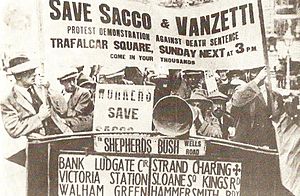
 The last was a pamphlet on the Sacco- Vanzetti case, which I found and read in the library basement, feeling tremendously stirred by Vanzetti's famous words, brand- new, of course, to me, and by the whole story. But we were in 1933, I realized, and they had been executed in 1927. So there was nothing to be done. But I was moved to read up on the Tom Mooney case (he at least was still alive) and to become aware of The New Republic. One thing leading to another, soon after graduation, I was writing little book reviews for The New Republic, then for The Nation, and I never looked back. Like a Japanese paper flower dropped into a glass of water, it all unfolded, magically, from Dos Passos, though he would have been saddened in later years to hear what his energy, enthusiasm, and sheer unwary talent had brought about.
So what do we mean generally when we speak of political novels? Some people - Marxists - will say that all novels are political, especially those, like Jane Austen's, that avoid the subject, thus lending tacit support to the status quo. This may be true, insofar as no experience (even the solitary dialogue with the self) is without a political dimension, and to ignore this is to tell a falsehood. But awareness of that dimension varies greatly from person to person and no doubt from one civilization to another. I would guess that ours, democracy-haunted, equality- haunted, was especially sensitive to the political (i.e., the power games) in personal relationships: See ''The War Between The Tates'' or ''Portnoy's Complaint'' and compare Moravia's ''Io e lui.'' As a nation of lawyers (Tocqueville), we would be bound to have a talent for injustice-collection. But if one forgets these quibbles and thinks of political novels in the common ordinary sense of the word - meaning political parties, voting, legislation, courts of justice, armies - one will nevertheless find that the term ''political'' can refer to several distinct types of story.


To be coninued

Tuesday, 5 June 2012

Miss McCarthy Explains - this war was "not an accident," as Trotsky was fond of saying


May 16, 1971 NYT

Miss McCarthy Explains (Part 2)
Jean-Francois Revel 
Mary McCARTHY (USA)- writer. -  - Clothing, Human being, Interior, Man (all ages), McCARTHY Mary, Necklace, Old age, Seated, Woman (all ages)


You have been here, living in France, for almost 10 years. Has this had any impact on your writing, or what kind of impact could it have in the future?

I think eventually I would lose my subject matter. Of course, this book took a long time to write. I started it way back in '64. Then I had those two Vietnam trips in between. Anyway, aside from that, I don't think the international theme--the confrontation of cultures--exists any more. Not because of formal developments. It no longer has any bearing: maybe air travel killed it.
In my case, living in Paris and writing more or less in the realistic tradition, I couldn't do a novel about French people, because they'd have to talk French. I couldn't even write about English people. I'm incapable of writing at length about anybody except an American, so it's not only a question of being out of touch with the native speech but of being out of touch with the native subject matter. Joyce could write about Dublin while he was in exile because he was not interested in the present. Bloomsday, June 16, 1904, was all the more real to him because of the distance in geography as well as time. But if you're not that type of writer, by staying abroad, you eventually lose your subject matter. Certainly in my case the subject is social--is always social.


Do you plan to go back?

I don't think people's movements should be dictated by artistic needs. It would be horrible, evil, for one to make one's artistic needs the motor of one's life. George Orwell was against it too, on sort of puritan grounds. Maybe I'm a puritan too, I don't know. Of course it's true, about the egotism of writers--this monstrous egotism that we seem to have. Bellow is a most ghastly example of it. I don't think that wives and children and dwellings ought to be sacrificed to the needs of the artist, though there are certainly moods when I feel it. But on the whole I believe in a certain amount of submission to fate and also to chance. All that, too, is part of the natural and the vitality of the natural. Some subject has to propose itself to me--not me proposing myself to the subject. In writing, there has to be some element of the Tolstoyan "I cannot be silent." That's more true, of course, of political polemics; but you don't sit down and decide to write a polemic. You reach the point of saying to yourself: I cannot be silent any longer, about whatever it is.
Somebody wrote rather wittily about a woman poet in America that her only relation to poetry was the desire to write poems. I am rather against the autocratic will. If I moved home to America to pursue my subject matter, the subject would run away from me, I'm sure, as a punishment.


Do you always write your novels slowly? This one was begun in 1964; and "The Group," which was published in 1963, was begun in 1952.

Not always, just those two. "The Group" became a terrible problem--partly a moral problem--not about sex of course. But I began to feel as though I was persecuting those girls and just hammering away at them and knocking their poor heads together and that I ought to stop that, this just could not go on, and so I put it away for several years. I didn't work on it at all and wrote another novel instead and then I went back and reread it and I thought, this isn't so bad, I had been exaggerating. This happened repeatedly during those 11 years, and I did several books in between. Whereas, with this one, Vietnam got in the way. That is, I felt that I could not go on writing about a boy of that age and not do something myself about Vietnam; that the whole book would have been some sort oftrahison if I had just sat on my bottom. I wrote those two books, accomplishing nothing, doing absolutely no good. When Johnson fell out of office, we had one joyous moment of feeling that we had all accomplished something. In any case, after those trips, I felt I was free to go on.


Do you really think that the American writers who wrote about Vietnam didn't accomplish anything?

Well, it's true. I'm so discouraged. I really thought when Nixon first came in that he wanted to get us out of the war, for whatever motives. I think maybe he did; but the office doesn't want to get the President out of the war, which means that I think this war was "not an accident," as Trotsky was fond of saying. It must come out of something very deep that we had not noticed in American life, because it took us all by surprise--this slow involvement in Vietnam, and it took us by surprise about America. A European could say we should have known before, but we were sort of like Peter's mother in imagining that there was this ideal American republic, with some shortcomings. I find the situation extremely alarming now and, I don't know, I see no prospect of getting out of there; and, after all, the war is expanding.
Mary McCARTHY (USA)- writer. - USA. The writer Mary McCARTHY. 1971. - American (nationality), Cigarette, Female personality, Interior, Laughter, Living room, McCARTHY Mary, Portrait, Proper name in caption, Seated, Smoker, United States of America (all), White people, Woman - 45 to 60 years, Writer
With the ever-present Lucky Strike - I love this pic


Monday, 4 June 2012

'Miss McCarthy Explains'...Nature is Dead.... (Part 1)


May 16, 1971 NYT

Miss McCarthy Explains 
Jean-Francois Revel
 
Jean-Francois Revel, author of the recent "Neither Marx nor Jesus" (a great success in France, to be published here in the fall) mandated this interview with Miss McCarthy in her apartment near Gare Montparnasse. "In seven years," M. Revel said, "I had been in Mrs. West's flat [Miss McCarthy is married to James West] only at night, for parties and dinners. It looked strange to me in the daylight--smaller, quiet and provincial." He used a tape recorder, which, he said, gave "a professional, 'technotronic' side to our conversation." M. Revel also pointed out that although he has taken part in many interviews this was the first in which he was the interviewer.]


In your new novel "Birds of America" what made you choose a young boy, an American student, as the main character of the story?

It just sprang like that out of my mind. I sat down and started typing out notes to myself about a new novel, and then notes begin: "On Equality. . . ." They ramble on about the question of equality and suddenly (I've got these notes still) there come the words, "The action should begin with a young man." A student, in Rome, and so on. But the boy just sprang there. In reality he's based on several boys but especially on one I knew here who was going to the Sorbonne. He had a plant that he took for walks. The other thing about him that I never got into the book was that he was very anxious to procure a skull. He's been to an exhibition of engravings by Bresdin at the Bibliothèque Nationale, which made him want to learn to draw, and he decided to start by drawing a skull. He wanted us to tell him how to get one, but I don't think we ever succeeded. We could find skeletons but not skulls. So, anyway, the boy was just there in the middle of the subject.


It is also a kind of philosophical novel. At the end, Immanuel Kant himself speaks to the young boy, Peter, and tells him, "Nature is dead." Is that the philosophical meaning of the novel? Do you think yourself that nature is dead?

It believe it. Moreover, I agree with Kant, if I understand Kant. You remember that quotation at the end about the beautiful things in nature proving that man fits into the world, etc. If nature--in the beautiful form that we normally think of it: that is, the outdoors, plants, farms, forests--if all this were to disappear, which it's doing, there'd be nothing stable left to stand on, no ground for ethics. Then you'd really be in a Dostoevskian position: why shouldn't I kill an old pawnbroker--because there's no longer a point of reference or a court of appeals. Nature for centuries has been the court of appeals. It will decide one way or another. Not always justly, but nevertheless (especially in our Anglo-Saxon tradition--it's very strong in Shakespeare), the appeal is always to this court, to Nature's court. And if this is gone, we're lost. And I think we're lost, I'm not an optimist.


What do you think about the reaction against the ruination of nature? Today people look more and more for natural products, natural life, don't they?


I really believe that Gresham's Law is operative in these things. I don't think there's a natural selective process in masses of people that causes them to choose the better product. Well, I'll take the example of a turkey. I just bought a turkey at the U.S. Commissary. It was a frozen turkey. I don't like frozen food, anyway; but normally American frozen turkeys are better than French fresh turkeys. But I read all this literature on the outside of the turkey, and it explained that this turkey had been "deep based" with vegetable oil. The corpse had been injected (the word "basted" of course is hilarious in this context) with vegetable oil. Now I'm sure that next year or two years from now you won't be able to buy a turkey that this hasn't happened to. And the reason is not that it tastes better--I thought it was rather poor actually--but that you don't have to baste it in the oven. So people would rather have an inferior turkey and not have to work.


take your turkey as a symbol for the biosphere, your conclusion would be that the destruction of nature is inevitable?

I think that's going to happen and I think that in general bad products drive out good.


Nevertheless, your novel is about a culture at least as much about nature. There are not so many birds in it, except at the beginning. Peter seems preoccupied by social, political and literary or artistic matters, isn't he?

Of course, one simple reason is that he's living in the city. There's nature in the beginning; but, after that, once he's living in the city, he isn't much in contact with Mother Nature. What in essence Peter is trying to do is lead a natural life and to try to find some natural life of the mind that would be common to everybody. It would be like an environment that everybody could live in.

J-F R


But isn't the novel essentially about education? About how to become an adult in our time? Peter belongs to an intellectual family. He studies first in America and then in Paris and Rome. Why?

I think I've forgotten. Well, I tell you, what takes place in the main body of the book is the equality theme. Peter keeps drawing up plans to send to General de Gaulle or Kosygin or whoever. He's bitten by the desire to solve the world's problems. But always, underneath this, is the desire to create balance and equality. That is, the plan for making sewer workers the best paid class in society. Which is very rational--it may not be practical but it's the product of rationality or over-rationality. For instance, Peter is struck by all those headless statues, decapitated during the French Revolution, hence his reflections in his letter to his mother, where he says the French Revolution didn't go far enough--that we should chop off the head of language too. Of course, he's right, you know; and at the same time it's impossible. Unless maybe they do it in China. It's the only place in the world where they seem to be trying to create a biological mutation. By the changing of the Chinese language and the destruction of almost all the Buddhist temples and shrines. They'd like to destroy their artistic heritage in the interest of starting over. The clean slate. Well, anyway, Peter's story takes place before the cultural revolution; but the thought of such a purge crosses his mind. He thinks, "I don't know whether I could stand it, but this is what should be done."


The very existence of culture seems to him an obstacle to equality? Or does it?

Yes. At the same time, being intelligent, he sees all the obstacles to any scheme he puts forward. Like when he gets wound up in the question of tipping, seeing all sides. The categorical imperative, as he says, doesn't seem to work very well in that situation.


Of course, but he still behaves like a born aristocrat. He can't stand ordinary people.

I wouldn't say aristocrat. Rather he's a misanthrope. At home, though, he wouldn't be against ordinary people, the people who work in the Portuguese grocery store or the filling station, or the kids who play baseball. And he won't join the beach club. Ordinary people in their natural setting he doesn't object to. He liked grade-school teachers when he was a kid much better than fancy masters in private schools.


But isn't that super-aristocratic behavior? You know, when one loves peasants and fishermen but cannot stand middle-class people? Since we are living in an age where almost everyone is middle-class, isn't that a kind of snobbishness? Take, for example, the visit Peter pays to the Sistine Chapel: he is almost sick because of the many American tourists there. These tourists are, after all, ordinary people; they are the people.


Yes, but my point is that anybody, a grocer-store-keeper, who had any eyes--that is, who had any real reason to be in the Sistine Chapel--would be just as annoyed as Peter by all that mob. The real problem hits him in the Sistine Chapel. Everything breaks down for him, his principles abandon him there. That is the whole point of the Sistine experience. He finally comes out and says, "There ought to be an entrance exam, it's the only way." At that point, he's become reckless and maddened, he expresses his true feeling, and, being Peter, he reasons about it at the same time. But that has been a most conclusive challenge to his principles. It goes back to what he tells his mother in the letter, where he says that art and equality don't mix, that "the world will have to get rid of the people like you, Mother." In the Sistine Chapel they try to mix. It's the opposite of the previous chapter, where he's happy, having fallen in love with the works of Borromini, the 17th-century architect that nobody else cares about seeing. Borromini of course is nature. I mean that Borromini's world is a kind of fantastic forest. So that Peter has solitude, nature, art, contemplation there--everything he likes.
All through this boy there has to be (I don't know why) this paradox of lover-of-solitude and misanthrope who is passionately concerned about equality. This happens to be a regular human type, of course--the misanthrope-philosopher, but I didn't conceive it that way.


So the philosophical lesson would be that nature is dead and that culture must die, for the sake of equality?

But I didn't write the book to make a conclusion like that. Furthermore, the thing he says in his letter--which perhaps is really what's at the bottom of the book--is this feeling about the idea of equality once having been entertained, nobody can get rid of it. This I have thought for years--that once the egalitarian notion was discovered, say some time in the 18th century, there's been a continual flight from it. Eventually we're going to have migration into space to escape equality. At the same time any person with a child's fairmindedness cannot help thinking that equality's a good idea. If we lose this fairmindedness of children, then we become monsters. In the Middle Ages you weren't a monster if you took inequality for granted but now you are.


Why did you make Peter an epitome of Western civilization? His mother is American and a first-class musician, his father is an Italian Jew and a scholar, his stepfather a German physicist, the third husband of his mother is an internationally known art historian.

I don't know why. I know I made Hans a scientist to make an opposition between Peter and science. Maybe some sort of melting-pot idea--I think it's really that. And America, after all, was supposed to be the land of opportunity and, well,the melting pot.


To my mind one of the most lively parts of the book is Peter's French experience. An obvious failure. Is Peter's a representative case of young Americans abroad, as it is now, according to you?

I'm really trying to be faithful to the experience of these kids over here--98 per cent of them feel that--and they're so lonely. It's not Europe, it's France. I met a young Dane the other day who told me he'd lived here as a student and he said, "Exceptionally, I got something out of it; but the loneliness was so terrible." They all say that. This business of going to the same cafe for six months and even the waiter won't speak to you. Henry James had exactly the same experience. When he left Paris, he wrote a letter to his brother William James and said, "It would be ignoble to stay in Paris just for the restaurants." But I think it's gotten worse. I remember, right after the war, in the 40's, when I was teaching, I had students who later came abroad on those Fulbrights and, though they were often very poor, they had a much better time and they enjoyed it in those years.


Are there formal problems for you, a problem of the form of the modern novel?

I think about them in connection with other writers, that is if I'm doing a criticism or a review. But when I'm writing a novel I don't look at it as some event in the history of the novel. The only formal problem I think about when I write is the formal problem of a sentence or a paragraph. I can't write any differently from the way I write.


Do you feel any esthetic pressure on you of the new theories of the novel, or of the well established theories of the new novel?

I do believe in a sort of "Tel Quel" doctrine, that you must listen to the language, that language tells you what you want to say. If some word is sticking out of a sentence, say, and it looks ugly, it is telling you what you don't want to say. Language is continually giving you messages, because language is a repository of everything on the verbal level that's been experienced by human beings.
What you magnanimously call the "Tel Quel" doctrine is that language has no content, no meaning, the content of language is language itself. Do you agree?

That I don't believe. Nevertheless it's obviously not a question of just sitting down and copying something that's out there with the best means in your possession. At least half of it is going to be coming from something that is happening in language, including your own.


There is no plot in your novel. But there are normal sequences which are close to traditional realistic writing. Isn't that so?

Well, actually I think the form of "Birds of America" is rather strange. Because it isn't a realistic novel. Anybody who thought that was a realistic novel would be crazy. Still the oddity is only conveyed by tone--only by tone and not by the exterior formal devices.
That's true. "Birds of America" is no more a realistic novel than is "Lolita," for instance. But there are in it situations and characters, and you always indicate who is talking to whom.

I suppose we all do it less than we used to because of the modern novel, even the people who write traditionally. We indicate who is talking much less than we did, simply by osmosis from the avant-garde novel. The reader also has gotten used to having to work a little harder to identify speakers. In Nathalie Sarraute's novels, it's always clear really who is speaking; but you have to work for it and you sometimes have to do a repeat to be sure. I remember when I first started to read "Ulysses." I got up to, I think it was page 56--I couldn't get any further. And I tried again and it was always page 56. Then suddenly one year I sat down and read the whole thing, and it was no longer difficult, and this was because so much Joyce had gotten in the atmosphere that Joyce himself suddenly became transparent.


Do you think Joyce is really transparent now for the average reader, the public who is not professionally or passionately devoted to literature?

I have a marvelous idea. People do not any longer expect to understand. It's really a very frightening development. They pick up some book and they really think it's all going to be normally unintelligible. This expectation leads to a loss of ability to understand, so when people come to something that is understandable they no longer get it and make the most incredible misreadings. This reading impairment is a product of la nouvelle litterature. Have you given any thought to what it is in people that makes them want a story? Because this is a very deep thing--obviously--and I don't think anybody has ever posed the question, that I know of anyway. I've posed it to myself but not very seriously. It would be a rather interesting subject for speculation and might mean that you could rescue the plot.


Part 2 of this interview tomorrow

Saturday, 2 June 2012

'Crisis of faith for the author' - The Novels That Got Away (part 3)


November 25, 1979

The Novels That Got Away (part 3)
By MARY MCCARTHY 
Post-divorce cartoon showing Parnell using the fire escape to evade detection.


The second episode was to be about Parnell. Here one set of loyalties crisscrossed with a tangled host of others: multiple loyalties, multiple betrayals. Kitty O'Shea betrayed Captain O'Shea with Parnell, then betrayed Parnell with him; at least O'Shea believed that a child she bore while "wedded" to Parnell was his own. Next, O'Shea, having taken money and a Parliamentary seat for his silence, betrayed Parnell to prudish public. The faithful Michael Davitt thereupon deserted the "Chief"; Ireland deserted her Leader, who took ill and died, abandoned by all but "Wifey." As Yeats said it, to the music of a street ballad: "The Bishops and the Party / That tragic story made, / A husband that had sold his wife / And after that betrayed; / But stories that live longest / Are sung above the glass, / And Parnell loved his country, / And Parnell loved his lass."
Yet who betrayed whom and what? Ireland was faithless to Parnell, but wasn't Parnell faithless to the cause of Irish liberty, not to mention Gladstone, in evidently preferring the "lass," who in reality was a 45-year-old married women when the blows began to fall? Moreover, the tragedy had its sordid interludes of trimming, lies and venality: Parnell might have braved the scandal and lived openly with Mrs. O'Shea, maybe married (she had grounds for a divorce), if they had not been waiting for her proper old aunt to die and leave her a large inheritance. Instead, they continued to buy off the untrustworthy Captain O'Shea and were exposed anyway when he upped and filed for a divorce. Only the villain of the piece remained true to his lights. His motives seemed to have been always financial, with revenge as a secondary spur, moving him at long last to action when the main interest was thwarted.
The third episode was hazier in my mind. It would probably have dealt with Wordsworth. The Poet Laureate, Browning's "Lost Leader" ("Just for a handful of silver he left us, / Just for a riband to stick in his coat."): His repudiation of his youth, of the French Revolution, of Annette, the French girl, and the reputed child of their union that he was said to have disowned.
Yet, since I was thinking of a turncoat poet, I am surprised that it did not occur to me to put in Pound, a bona fide traitor to his country, either as a replacement for poor old Wordsworth or as a modern foil to him. The reason may be that a genuine traitor did not interest me. To me, Pound's politics, to which (it must be said) he was faithful, were a silly aberration; in this sphere, I found him simply a curio, not much different from Lord Haw-Haw or Tokyo Rose. I was incapable of taking seriously the pull of Fascist ideology. In a novelist this may not have been a virtue
  
In other words, the novel I believed I was writing had only a remote bearing on the "big" theme I had set myself. This, obviously, was why I could not go further with it. I had no faith in it myself. Yet in any novel (in my experience) there is a crisis of faith for the author. This generally occurs toward the end of Chapter Two, when the first impetus has gone; occasionally in Chapter Three. It happened to me with "The Group," with "A Charmed Life," with "Birds of America." The crisis can last a night or a few hours; with "The Group" it lasted years, during which I put the manuscript aside, thinking I would never go back to it.
There is no use going on till the crisis is resolved. You cannot evade it; you have to face the strong possibility that what you have been carefully writing and rewriting is not a fiction but a hollow lie. If you finally persuade yourself that your suspicions are wrong, you can continue. But another crisis may occur. A moment comes, though, about three-quarters of the way through the book, when you know you are gong to finish it; this is the moment when it has gained your belief.
With the initial crisis, a simple rereading, after an interval, may reassure me. More often, notes to myself in the form of questions and answers are required ("What am I trying to say here?" "What's behind this or that incident?" "What makes me give him red hair?"). In short, there has to be a severe critical effort to get behind or underneath the glassy written surface you laboriously mine your own book for its meaning. It may be that you can find nothing behind or underneath, or else something you do not like. Then you put the book aside. Occasionally, time will disclose to you a meaning or pattern that you failed to find on the first look--time has turned you into a more "objective" reader.
With the public-library novel, this confrontation did not take place. I was too inexperienced. Somewhere in the Dumnorox-Divaciacus part that is, toward the beginning, I got discouraged and stopped, I had looked ahead and was daunted. What I might have noticed, had I paused and asked myself questions, was that this historical farrago was not about treason but about me. The division between the Haeduan brothers was in myself. I was a natural rebel who was also in love with law. This was my autobiography, and it was not going to change.
Ten years passed. Then all of a sudden I found a use for those by that time yellowed pages. They were salvaged, like old dress material, for "The Figures in the Clock," in "Memories of a Catholic Girlhood." That was where they had always belonged, where in fact they came from. From Annie Wright Seminary and my Latin teacher, Miss Mackay, who for semi-fictional purposes now became “Miss Gowrie." For me, at least, this was a happy ending, for Dumnorix and Diviciacus had been resting uneasily all that time in some half- closed chamber of my mind, turning from side to side like Dante's sick man. Now I had done my best to make them comfortable--Caesar and Vercingetorix too.
But as yet I have not found a good place for Parnell.