Monday, 16 June 2014
Tuesday, 10 June 2014
TO THE LIFE OF THE SILVER HARBOR: Edmund Wilson and Mary McCarthy on Cape Cod By Reuel K. Wilson - reviewed by A. Theroux
On the Cape, vows rewritten
Son of Wilson, McCarthy recounts an unhappy marriage
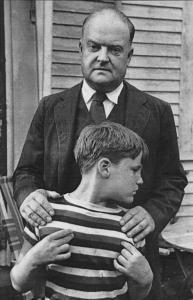
![]() | Reuel and Edmund Wilson at the Wellfleet house, 1949. (Henri Cartier-Bresson, Courtesy of Magnum Photos) |
By Alexander Theroux
January 25, 2009
Edmund Wilson lived in Wellfleet for much of his life, yet wrote little about Cape Cod. Curiously, major writers who have lived in this region have tended to overlook the place. John Dos Passos said nothing of it. Same with Conrad Aiken. "Tough Guys Don't Dance" was Norman Mailer's only book set on the Cape, and he lived in Provincetown for half a century. A good explanation in Wilson's case is that he experienced as much horror as happiness in Wellfleet, as did novelist Mary McCarthy, his third wife - they lived on (and off) Cape Cod together for seven turbulent years, from 1938 to '45.
TO THE LIFE OF THE SILVER HARBOR:
Edmund Wilson and Mary McCarthy on Cape CodBy Reuel K. Wilson
University Press of New England, 200 pp.,
illustrated, $26.95
Drawing on a body of unpublished material by his parents, Reuel Wilson looks back not only on his father's four marriages and his mother's three but also on their compulsive sexual affairs and his unpredictable upbringing, at once bohemian and snobbish. Now 70, he had managed to survive the complicated, emotionally fraught lives of his parents, staying in touch with both of them in a remote way until they died.
Edmund Wilson seemed an incompetent, if sporadically devoted, father. Although overweight and unprepossessing, he was not only a compulsive womanizer but a man who needed to be married. Still, Elena Thornton, his fourth wife, would later remark to stepson Reuel, "All the discipline your father had at his disposal went into his work, with little left to temper his dealings with family members." And a long lifetime of majestic work it was - "To the Finland Station," "Upstate," "Axel's Castle," "Patriotic Gore," seven autobiographical books, six volumes of journals, and on and on.
But Wilson was demanding and eccentric. (He adored women's feet; had a fixation for the color brown, preferring brown drapes, brown houses, and wearing only brown clothes; and enjoyed the company of rats.) In 1937 he met McCarthy, then working for Covici Friede publishers in New York; they married early in 1938, and on Christmas Day that year, Reuel was born.
Seventeen years younger than Wilson, McCarthy had a badly damaged soul herself, for "as a young orphan she was cruelly used by her guardians," notes her son. Wilson quickly found her difficult. He attributed her "hysterical" behavior toward him to her experiences with her sadistic "Uncle Myers." What did she see in that portly, overbearing older man? She seems to have fallen for his commanding literary profile, given her own intellectual ambitions. McCarthy was stunning in appearance and a terrible flirt. Each was a good catch for the other.
Nevertheless, the marriage was rocky from the start. McCarthy was soon subject to Wilson's taunts and combative words and offhand abuse. He struck her at least once, according to their son. Wilson stinted McCarthy with parsimonious caveats. He refused to allow her to maintain a bank account in her own name. She went into psychoanalysis at his urging the first year of their marriage, and spent almost a month at the psychiatric clinic at New York Hospital. (She would later claim that he had committed her against her will.) She got pregnant, miscarried, and was accused by Wilson of aborting the child herself. During the Wellfleet years, 1941 to '44, she began casual liaisons with other men, one with notable French and German translator Ralph Manheim, another with art critic Clement Greenberg. She vamped the ardent Theodore Spencer, a professor of English at Harvard, and then, mocking him, would proceed heartlessly to report the details to others in letters.
While it can be accurately said that Wilson aided McCarthy in her literary endeavors and that she clearly benefited as a writer of fiction from his sustained support, at least during the period he was willing to give it, neither "could peacefully coexist with the other under the same roof," writes Reuel Wilson. They divorced, and by 1946 both had remarried, McCarthy to a "dapper aesthete" nine years her junior named Bowden Broadwater, Wilson to Elena (Mumm) Thornton.
The fact that Wilson and McCarthy were both fiercely competitive and vain in queerly forgiving each other's infidelities surely fostered them. How sad, odd, and ultimately depressing it is to hear their son have to explain many years later that "both partners were capable of two- and three-, and four-timing their spouses or other lovers." McCarthy's posthumous "Intellectual Memoirs," admits her son, was a title "ineptly chosen by the publisher for a book that deals more with sex than intellectual matters." Until she died, in 1989, McCarthy revealingly referred to her domineering husband as the "Minotaur." Wilson, in his son's words, saw each of his many female partners as an "intriguing toy, to be studied and manipulated." It is the wistful acceptance of a son who could do nothing about it then and cannot now.
There seems to be fire missing from Reuel Wilson's history of his parents' time together, his conclusions clinical and abstract. "To the Life of the Silver Harbor" is long on report but rather short on insight. On the other hand, it is fair-minded and remarkably nonjudgmental. Reuel Wilson efficiently evokes the past he knew. He remembers ponds he swam in and rooms he ran through and people he knew who are now long dead, but there remains much in the narrator of the boy who lost his childhood while caught in the hot crossfire of all those bad marriages and transient affairs and being shunted about from the Brooks School to Harvard, from Hyannis to Maine, from one airy house to another dim apartment, from one dipsomaniac blatherer on the beach to another at the Ritz. He knows where all the bodies are buried. But for all he knows, he is forgiving, an intrepid traveler who has sailed through a Scylla of a father on one side and a Charybdis of a mother on the other and somehow managed to survive to tell the tale.
Alexander Theroux is the author of many books, including "Laura Warholic: Or, The Sexual Intellectual."
Thursday, 5 June 2014
Sunday, 18 May 2014
Thursday, 15 May 2014
"One of America’s problems is an inability to see itself." MM on the end of the Vietnam War (final part, from NYRB 1975)
If anything has been added it is the smell of vengefulness associated with the Mayagüezepisode, typical, I fear, of the current mood of this moody nation. It is not proceeding just from the White House and Capitol Hill.
We read that the American people want to forget about Vietnam; they are sick of it. That, obviously, is the opposite of learning a lesson, where a fact or an experience is imprinted on the memory, with cautionary results. I admit that I myself hoped last summer during the House Judiciary Committee hearings that Vietnam and Watergate, between them, would have caused us, at least, to do some self-questioning. The first awful intimation that this was not so came with the orphan airlift. The competition for Vietnamese babies made clear that Americans were still intent on mass demonstration of their essential goodness—a fatal motive in the Vietnamese enterprise, as hospitals, dispensaries, GI-built schools, improved seed strains, toothbrushes, surplus canned goods were strewn over the bombed, defoliated country, proving good intentions. If this sincere delusion had not been persisted in, the war could not have continued. With the orphans, the national heart again began to swell with the familiar philanthropic sentiments; nobody thought to ask what right we had to appropriate these babies, who in fact were part of the Vietnamese patrimony. Again, we were “saving” them, from disease and malnutrition; at the same time, they were little trophies, keepsakes—war loot salvaged from the wreck of the US involvement, so costly to the taxpayer.


The American amour-propre was seriously damaged in Vietnam, and the orphans in the end were insufficient restitution, especially since everybody could not have one. In any case, our generous image, not wholly inexact (Americans are kindly and helpful), is a dangerous reflection of our sense of national superiority, of our having more things to give away, like the ballpoints Nixon used to distribute on the streets of West European capitals, imagining that there was still a hunger for them. The idea that some nations would not want our things or our “know-how”—which made them—is inconceivable to most Americans.
The immense natural wealth of the American continent, ready for exploitation, and the wide internal distribution of that know-how have been a baneful gift. It is not only that the indigenous profit system must keep seeking fresh fields for investment as well as new consumers, but that the feeling of being an enormous creative matrix implies notions of leadership in every sphere of activity: literature and the arts, science, space, communications; democracy is regarded as an American manufacture along with Diners Club cards, happenings, rock music, and what were once called groovy life styles. No American is immune to the conviction of having something to offer the world by virtue of this native plenitude, and rejection (as happened in Vietnam) appears so incomprehensible that quite a few of the GIs who turned against the war turned also and simultaneously against the Vietnamese. Few Americans really drop out; instead they transfer their managerial and entrepreneurial skills, and the burgeoning pride that goes with them, to marginal activities such as the health food network or LSD manufacture, in which again they are “ahead” of other countries.
One of America’s problems is an inability to see itself. Hence the concern even among intellectuals with how the US looks after the defeat and how the defeat has affected our “position” in the rest of the world, as though what has happened were as much a social snub or slap in the face as a true loss. And the concurrent hope that the loss can somehow be turned into a gain, something positive, which would be true if whole peoples were able to revise their unthinking estimate of themselves, that is, break with all their habits.
There is no doubt that Germany was profoundly changed and sobered by the Nazi defeat, but it would take an atomic catastrophe, I often think, for the US to recover from the American way of life—the production-consumption cycle that has become an almost biological fact, resting as it does on rapid obsolescence and replacement. Intermittent elections add to the helpless feeling of stasis and eternal recurrence. You watch the same old candidates—Reagan, Jackson, Kennedy, Humphrey, Wallace—on your new color TV set. Anybody in his right mind would rather have it the other way around: fresh voices and faces on a quavery senior citizen TV screen. But for some un-Marxist reason, the constant restyling of the objects among which we live has no effect on the political superstructure, politicians being sent to the junk heap of history at a much slower rate than cars and ice-dispensers.
I can think of no way in which US political life can now be revitalized. The wistful idea (in which I have fitfully shared) of a “use” to which the Vietnam experience could be put shows that our faith remains a naïve, mechanical utilitarianism, which has no room in it for death in private life or tragedy in politics.


Wednesday, 14 May 2014
"...when the last American was withdrawn, nothing basically changed except the color of the corpses" :MM on the end of the Vietnam war from NYRB
In early May 1975, The New York Review asked some of its contributors to write on the meaning of the Vietnam war and its ending. They were asked to consider the questions of the responsibility for the war; its effect on American life, politics, and culture, and the US position in the world; and the prospects of recovery from it—or any other questions they felt to be important. > —The Editors
Mary McCarthy
The only beneficiaries I can see of the event of April 30 are the Vietnamese. As the end approached, it was hoped, by many Americans and their sympathizers abroad, that some domestic benefit would be noticed. A weight, it was argued, ought to be lifted, of taxation, guilt, and shame, and new priorities could be set for the republic. With Vietnam out of the way, liberty and equality, a package, would no longer have to be viewed as articles for export and promotional salesmanship. The “lesson of Vietnam” would have been learned, both by our leaders and by the citizenry, which had been viewing the instructive spectacle on television.
It is too soon, of course, to be sure that nothing of the kind is happening. Perhaps a subliminal effect has been registered. Yet since so few “lessons” are ever learned in private life, one wonders why the process should be expected to take place in public life, so much less subject to the control of individual conscience and so poorly endowed, comparatively, with the means of reform. In any case, as it seems to me, the time had long passed when an opportunity for “correction of errors” was present and visible to everyone. That time was 1968, when the light had been seen, as Johnson’s “abdication” in the spring had made clear. The war ought to have been terminated then with North Vietnamese cooperation in an American exit. Between April 1968, when the Paris peace talks were agreed upon in principle (though not, in practice, until the fall), and April 1975, when the last American was withdrawn, nothing basically changed except the color of the corpses.
Had the US gone home then seriously, for good, the result would have been the same as what we are seeing now, with the single difference that third-force elements in the South might have been in a stronger position. At home, the time seemed right for reform or renovation; it looked as if a new leaf might really be turned. The Bobby Kennedy candidacy, the Gene McCarthy “children’s crusade,” the youth rebellion on the campuses, all touched off by revulsion from the war in Vietnam, were signs of a change of heart. The first and last signs. The nomination of Humphrey by the Democratic convention that summer demonstrated that inertia had resumed control of US political behavior. The reaction to Vietnam lost its impact, frittered away in fringe manifestations, such as the various mobilization marches—fun and games dampened by tear gas. Despite all the bloody and sensational events in between—Martin Luther King’s murder, Bobby Kennedy’s murder, Kent State, the attempt on Wallace, Watergate, Nixon’s fall—you could almost say that time had stood still during those seven years.


Nothing is worse for a private person than to have seen in a moment of clarity the error of his ways and then failed to alter them; the last state of the man is worse than the first. That is where our country is now, and to blame our leaders, with their professional deformations, for not rising to the occasion offered them by the war’s end, in other words for not being different from what they evidently are, is a stupid exercise, itself the product of fatigue. That Ford and Kissinger, anxious about US “credibility” abroad, inflated the Mayagüez incident in their own minds and action as though it were a missiles confrontation, that Defense Secretary Schlesinger “warns” the North Koreans that the US has “learned the lesson of Vietnam” (does he mean that the next time we will use nukes?) only shows that the bruised leopard cannot change its spots. The acclaim of Congress for the Mayagüez performance is nothing new either—the Tonkin Gulf reflex all over again. And when we now hear that our air force tear-gassed and nearly killed the crew it was bent on retrieving, we remember Têt and the officer explaining, “We had to destroy the city in order to save it.”
Subscribe to:
Posts (Atom)