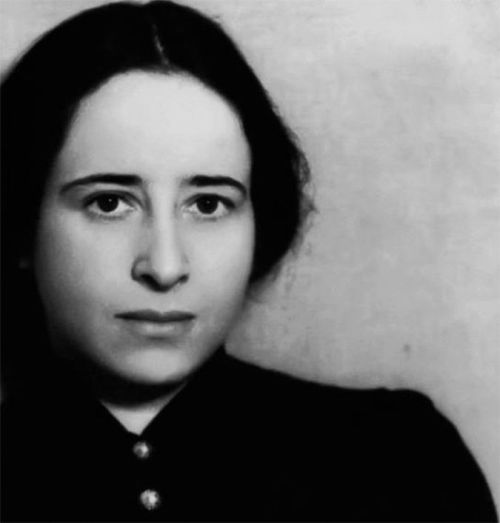
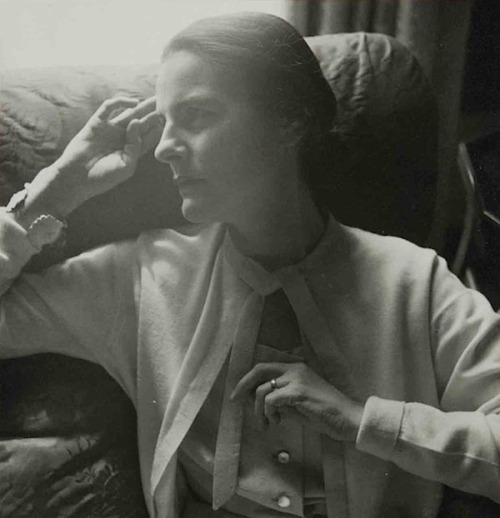
Thursday, 15 August 2013

Hannah Arendt: Banality of evil revisited

Hannah Arendt: Banality of evil revisited

By Naomi LaChance, Berkshire Eagle Staff,
POSTED:   08/14/2013 05:06:14 PM EDT | UPDATED:   A DAY AGO


Click photo to enlarge
Barbara Sukowa plays German-Jewish philosopher Hannah Arendt, the... (Courtesy of Zeitgeist Films)
LENOX -- How do you make a movie about a person who earned her fame by -- of all things -- thinking?
"When you go to a producer and you say you want to make a movie about a philosopher, they don’t start jumping up and down," said "Hannah Arendt" co-writer Pam Katz.
But Hannah Arendt’s story, for Katz and for director and co-writer Margarethe von Trotta, is one entirely worthy of telling. And they are not alone in thinking so. Their 2012 movie "Hannah Arendt" was nominated for six Lola awards (the German Oscar) and was recognized for Best Actress and Best Film. The film is being screened in theaters internationally, including in Lenox at the Berkshire Jewish Film Festival on Monday, Aug. 19.
"She is someone who is so creative, so courageous, so maligned," Katz said.
Arendt’s 1963-64 coverage of Nazi Adolf Eichmann’s show trial in Jerusalem, first published in the New Yorker, was so controversial that journalist Amos Elon called the ensuing response a "civil war" among intellectuals. A German-Jewish refugee herself, Arendt was labled as a self-hating Jew by some, and lauded as a political and ethical genius by others.
Eichmann was in charge of the logistics of mass deportations to extermination camps during the Holocaust. He appeared inarticulate and pathetic to Arendt at the trial, though. She thought he was not the archetypal monster so many at the trial wanted him to be.
Since then, the phrase she coined in the book’s title, "the banality of evil," has remained in the public dialogue, and, Katz and von Trotta say, has been too often misunderstood. A one-phrase summary of the banality of evil would undercut the effort of the film to make it make sense in full and in context.
Katz said a major intention of the biopic, which focuses on Arendt’s coverage of the trial and the ensuing public response, is to clarify what she actually meant by this famous phrase.
"We wanted to remove ‘banality of evil’ from the popular soundbite circuit," she said.
To professor Roger Berkowitz, academic director of the Hannah Arendt Study for Politics and the Humanities at Bard College, the public’s reaction to Arendt’s concept of the banlity of evil supports Arendt’s claim in that they often misinterpret it.
"The entire premise of the banality of evil is that we simplify ideas into a cliche," Berkowitz said.
Since the publication of Arendt’s "Eichmann in Jerusalem," Berkowitz said, many people have done exactly that, reducing the idea into an oversimplified slogan. Arendt, a German Jew, saw firsthand the way that acting without thinking could have dire consequences.
"I insist we think about what she’s really saying," Berkowitz said.
Berkowitz has given talks at screenings of "Hannah Arendt," encouraging discussion. At the Lenox screening, retired Bard professor Suzanne Vromen will lead a post-film question-and-answer session.
She calls it a film about thinking. It is not a documentary but a fictional piece deeply informed by Arendt’s biography.
"As long as you know what is not true," Vromen said, "That’s fine.
All too aware that truth is subjective, the film’s writers meticulously researched her life but told her story in a shape that would help to explain her thesis. The events are sometimes stretched or tinged.
In a culminating scene, Sukowa as Arendt delivers a moving presentation of her thesis to a classroom of rapt students. Katz threaded together the compelling speech from at least five of Arendt’s works, to give what she perceives as the root of the truth to the banality of evil. The words are a composite of Arendt’s work, with Katz’s analysis moving it along.
"People say, ‘I was there when she gave that speech,’" Katz said. "Of course, it doesn’t exist."
In the seven years it took to make the film, Katz and von Trotta read all of Arendt’s published work, met with scholars and spoke with people who knew her. Actress Barbara Sukowa, who plays the title character, read Arendt’s work in both English, the language they were written in, and in Arendt’s native German.
Scenes are spoken in the language they would have been in real life, reflecting Arendt’s statelessness, contributing to a feeling of loss which permeated her work. In one scene, German ex-pats discuss politics in Arendt’s apartment. Arendt’s friend, English-speaking Mary McCarthy, is frustrated that she can’t follow along. Arendt missed the sounds of German, yet it wasn’t safe for her to be in her homeland.
"The movie is extraordinarily faithful to the truth once you define what the truth is," Katz said, adding that everyone has his or her own perception about a person.
Arendt is portrayed in the film as a woman who stands by her thoughts, able to separate emotion from intellect and stand by her ideas.
"For the most part people are really hungry for the debate that Hannah Arendt wanted to provoke," Berkowitz said.
Berkowitz sees her thoughts as pertinent today.
"We live in a world today in which people crave to be a part of movements," he said, citing groups including the Tea Party and the Occupy movement as ways that people are banding together when they feel powerless in traditional avenues for change such as government.
Nazis have become a cliched bad guy in today’s world, but for Arendt, who saw their evil firsthand, covering the Eichmann trial was perhaps her last chance to see a Nazi in person.
"It’s exploring the relationship between the ability to think and the ability to commit evil," Katz said. Arendt hoped that thinking would stop evil.
Margie Metzger, artistic director of Knesset Israel’s 27th annual Berkshire Jewish Film Festival, chose the 14 films screened at the festival from about 100 she watched. She relishes it as an opportunity to give attention to important but unknown films.
"Every time you make an independent film that’s serious, the next step is to marginalize it," Katz said. The film has received attention from people interested in Jews and the Holocaust, in strong women and in philosophers. But she, as well as Meltzer, voiced an interest in making clear that the film is for all audiences: not just Jews, not just intellectuals.
"It’s certainly a Jewish film, but not only," Vromen said.
"I think the woman was brilliant," Metzger said. "I think her take on some things were so controversial. I really like to spark discussions."

Wednesday, 10 July 2013

Dejeuner sur l’Herbe

Dejeuner sur l’Herbe

February 1, 1963

Mary McCarthy


 The Naked Lunch
by William S. Burroughs
Grove Press, 6.00
You can cut into The Naked Lunch at any intersection point,” says Burroughs, suiting the action to the word, in “an atrophied preface” he appends as a tail-piece. His book, he means, is like a neighborhood movie with continuous showings that you can drop into whenever you please—you don’t have to wait for the beginning of the feature picture. Or like a worm that you can chop up into sections each of which wriggles off as an independent worm. Or a nine-lived cat. Or a cancer. He is fond of the word “mosaic,” especially in its scientific sense of a plant-mottling caused by a virus, and his Muse (see etymology of “mosaic”) is interested in organic processes of multiplication and duplication. The literary notion of time as simultaneous, a montage, is not original with Burroughs; what is original is the scientific bent he gives it and a view of the world that combines biochemistry, anthropology, and politics. It is as though Finnegans Wake were cut loose from history and adapted for a cinerama circus titled “One World.” The Naked Lunch has no use for history, which is all “ancient history”—sloughed-off skin; from its planetary perspective, there are only geography and customs. Seen in terms of space, history shrivels into a mere wrinkling or furrowing of the surface as in an aerial relief-map or one of those pieced-together aerial photographs known in the trade as mosaics. The oldest memory in The Naked Lunch is of jacking-off in boyhood latrines, a memory recaptured through pederasty. This must be the first space novel, the first serious piece of science fiction—the others are entertainment.
The action of The Naked Lunch takes place in the consciousness of One Man, William Lee, who is taking a drug cure. The principal characters, besides Lee, are his friend, Bill Gains (who seems momentarily to turn into a woman called Jane), various members of the Narcotic Squad, especially one Bradley the Buyer, Dr. Benway, a charlatan medico who is treating Lee, two vaudevillians, Clem and Jody, A. J., a carnival con man, the last of the Big Spenders, a sailor, an Arab called Ahmed, an archetypal Southern druggist, Doc Parker (“a man don’t have no secrets from God and his druggist”), and various boys with whining voices. Among the minor characters are a number of automobiles, each with its specific complaint, like the oil-burning Ford V-8, a film executive, the Party Leader, the Vigilante, John and Mary, the sex acrobats, and a puzzled American housewife who is heard complaining because the Mixmaster keeps trying to climb up under her dress. The scene shifts about, shiftily, from New York to Chicago to St. Louis to New Orleans to Mexico to Malmo, Sweden, Venice, and the human identities shift about shiftily too, for all these modern places and modern individuals (if that is the right word) have interchangeable parts. Burroughs is fond too of the word “ectoplasm,” and the beings that surround Lee, particularly the inimical ones, seem ectoplasmic phantoms projected on the wide screen of his consciousness from a mass séance. But the haunting is less visual than auditory. These “characters,” in the colloquial sense, are ventriloquial voices produced, as it were, against the will of the ventriloquist, who has become their dummy. Passages of dialogue and description keep recurring in different contexts with slight variations, as though they possessed ubiquity.
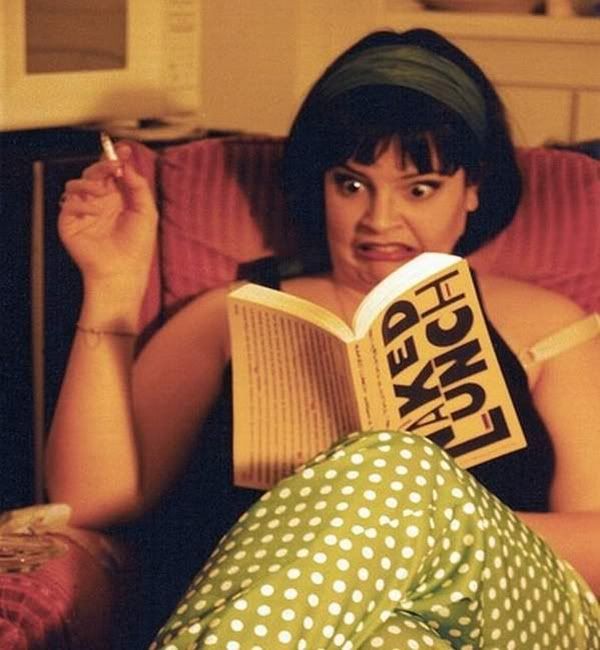

On a level usually thought to be “harmless,” addiction to platitudes and commonplaces is global. To Burroughs’ ear, the Bore, lurking in the hotel lobby, is literally deadly (” ‘You look to me like a man of intelligence.’ Always ominous opening words, my boy!”). The same for Doc Parker with his captive customer in the back room of his pharmacy (“…So long as you got a legitimate condition and an Rx from a certified bona feedy M.D., I’m honored to serve you”), the professor in the classroom (“Hehe hehe he”), the attorney in court (“Hehe hehe he,” likewise). The complacent sound of snickering laughter is an alarm signal, like the suave bell-tones of the psychiatrist and the emphatic drone of the Party Leader (“You see men and women. Ordinary men and women going about their ordinary everyday tasks. Leading their ordinary lives. That’s what we need…”).
Cut to ordinary men and women, going about their ordinary everyday tasks. The whine of the put-upon boy hustler: “All kinda awful sex acts.” “Why cancha just get physical like a human?” “So I guess he come to some kinda awful climax.” “You think I am innarested to hear about your horrible old condition? I am not innarested at all.” “But he comes to a climax and turns into some kinda awful crab.” This aggrieved tone merges with the malingering sighs of the American housewife, opening a box of Lux: “I got the most awful cold, and my intestines is all constipated.” And the clarion of the Salesman: “When the Priority numbers are called up yonder I’ll be there.” These average folks are addicts of the science page of the Sunday supplements; they like to talk about their diseases and about vile practices that paralyze the practitioner from the waist down or about a worm that gets into your kidney and grows to enormous size or about the “horrible” result of marijuana addiction—it makes you turn black and your legs drop off. The superstitious scientific vocabulary is diffused from the laboratory and the mental hospital into the general population. Overheard at a lynching: “Don’t crowd too close, boys. His intestines is subject to explode in the fire.” The same diffusion of culture takes place with modern physics. A lieutenant to his general: “But, chief, can’t we get them started and they imitate each other like a chained reaction?
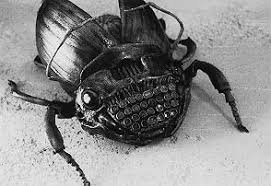
The phenomenon of repetition, of course, gives rise to boredom; many readers complain that they cannot get through The Naked Lunch. And/or that they find it disgusting. It is disgusting and sometimes tiresome, often in the same places. The prominence of the anus, of faeces, and of all sorts of “horrible” discharges, as the characters would say, from the body’s orifices, becomes too much of a bad thing, like the sado-masochistic sex performances—the automatic ejaculation of a hanged man is not everybody’s cantharides. A reader whose erogenous zones are more temperate than the author’s begins to feel either that he is a square (a guilty sentiment he should not yield to) or that he is the captive of an addict.
In defense, Swift could be cited, and indeed between Burroughs and Swift there are many points of comparison; not only the obsession with excrement and the horror of female genitalia but a disgust with politics and the whole body politic. Like Swift, Burroughs has irritable nerves and something of the crafty temperament of the inventor. There is a great deal of Laputa in the countries Burroughs calls Interzone and Freeland, and Swift’s solution for the Irish problem would appeal to the American’s dry logic. As Gulliver, Swift posed as an anthropologist (though the study was not known by that name then) among savage people; Burroughs parodies the anthropologist in his descriptions of the American heartland: “…the Interior a vast subdivision, antennae of television to the meaningless sky…. Illinois and Missouri, miasma of mound-building peoples, grovelling worship of the Food Source, cruel and ugly festivals.” The style here is more emotive than Swift’s, but in his deadpan explanatory notes (“This is a rural English custom designed to eliminate aged and bedfast dependents”) there is a Swiftian factuality. The “factual” appearance of the whole narrative, with its battery of notes and citations, some straight, some loaded, its extracts from a diary, like a ship’s log, its pharmacopeia, has the flavor of eighteenth-century satire. He calls himself a “Factualist” and belongs, all alone, to an Age of Reason, which he locates in the future. In him, as in Swift, there is a kind of soured utopianism.
Yet what saves The Naked Lunch is not a literary ancestor but humor. Burroughs’s humor is peculiarly American, at once broad and sly. It is the humor of a comedian, a vaudeville performer playing in One, in front of the asbestos curtain to some Keith Circuit or Pantages house long since converted to movies. The same jokes reappear, slightly refurbished, to suit the circumstances, the way a vaudeville artist used to change Yonkers to Renton when he was playing Seattle. For example, the Saniflush joke, which is always good for a laugh: somebody is cutting the cocaine/the morphine/the penicillin with Saniflush. Some of the jokes are verbal (“Stop me if you’ve heard this atomic secret” or Dr. Benway’s “A simopath…is a citizen convinced he is an ape or other simian. It is a disorder peculiar to the army and discharge cures it”). Some are mimic buffoonery (Dr. Benway, in his last appearance, dreamily, his voice fading out: “Cancer, my first love”). Some are whole vaudeville “numbers,” as when the hoofers, Clem and Jody, are hired by the Russians to give Americans a bad name abroad: they appear in Liberia wearing black Stetsons and red galluses and talking loudly about burning niggers back home. A skit like this may rise to a frenzy, as if in a Marx Brothers or a Clayton, Jackson, and Durante act. E.g., the very funny scene in Chez Robert, “where a huge icy gourmet broods over the greatest cuisine in the world”: A. J. appears, the last of the Big Spenders, and orders a bottle of ketchup; immediate pandemonium; A. J. gives his hog-call, and the shocked gourmet diners are all devoured by famished hogs. The effect of pandemonium, all hell breaking loose, is one of Burroughs’ favorites and an equivalent of the old vaudeville finale, with the acrobats, the jugglers, the magician, the hoofers, the lady-who-was-cut-in-half, the piano player, the comedians, all pushing into the act.
Another favorite effect, with Burroughs, is the metamorphosis. A citizen is turned into animal form, a crab or a huge centipede, or into some unspeakable monstrosity like Bradley the Narcotics Agent who turns into an unidentifiable carnivore. These metamorphoses, of course, are punishments. The Hellzapoppin effect of orgies and riots and the metamorphosis effect, rapid or creeping, are really cancerous onslaughts—matter on the rampage multiplying itself and “building” as a revue scene “builds” to a climax. Growth and deterioration are the same thing: a human being “deteriorates” or “grows” into a one-man jungle. What you think of it depends on your point of view; from the junkie’s angle, Bradley is better as a carnivore eating the Narcotics Commissioner than he was as “fuzz”—junky slang for the police.
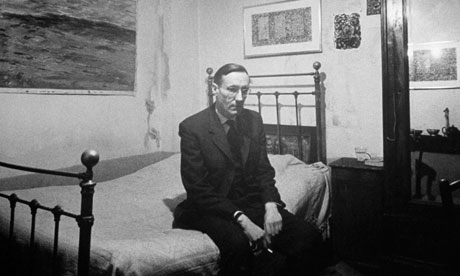


The impression left by this is perplexing. On the one hand, control is evil; on the other, escape from control is mass slaughter or reduction to a state of proliferating cellular matter. The police are the enemy, but as Burroughs shrewdly observes in one passage: “A functioning police state needs no police.” The policeman is internalized in the citizen. You might say that it would have been better to have no control, no police, in the first place; then there would be no police states, functioning or otherwise. This would seem to be Burroughs’s position, but it is not consistent with his picture of sex. The libertarian position usually has as one of its axioms a love of Nature and the natural, that is, of the life-principle itself, commonly identified with sex. But there is little overt love of the life-principle in The Naked Lunch, and sex, while magnified—a common trait of homosexual literature—is a kind of mechanical mantrap baited with fresh meat. The sexual climax, the jet of sperm, accompanied by a whistling scream, is often a death spasm, and the “perfect” orgasm would seem to be the posthumous orgasm of the hanged man, shooting his jissom into pure space.
It is true that Nature and sex are two-faced and that growth is death-oriented. But if Nature is not seen as far more good than evil, then a need for control is posited. And, strangely, this seems to be Burroughs’ position too. The human virus can now be treated, he says with emphasis, meaning the species itself. By scientific methods, he implies. Yet the laboratory of The Naked Lunch is a musical-comedy inferno, and Dr. Benway’s assistant is a female chimpanzee. It is impossible, as Burroughs knows, to have scientific experiment without control. Then what? Self-control? Do-it-yourself? But self-control, again, is an internalized system of authority, a subjection of the impulse to the will, the least “natural” part of the personality. Such a system might suit Marcus Aurelius, but it hardly seems congenial to the author of The Naked Lunch. And even if it were (for the author is at once puritan and tolerant), it would not form the basis for scientific experiment on the “human virus.” Only for scientific experiment on oneself.
Possibly this is what Burroughs means: in fact his present literary exercises may be stages in such a deliberate experiment. The questions just posed would not arise if The Naked Lunch did not contain messages that unluckily are somewhat arcane. Not just messages; prescriptions. That—to answer a pained question that keeps coming up like a refrain—is why the book is taken seriously. Burroughs’s remarkable talent is only part of the reason; the other part is that, finally, for the first time in recent years, a talented writer means what he says to be taken and used literally, like an Rx prescription. The literalness of Burroughs is the opposite of “literature.” Unsentimental and factual, he writes as though his thoughts had the quality of self-evidence. In short, he has a crankish courage, but all courage nowadays is probably crankish.




Tuesday, 9 July 2013

Saying Good-bye to Hannah

cover image


Saying Good-bye to Hannah    

January 22, 1976

by Mary McCarthy


Her last book was to be called The Life of the Mind and was intended to be a pendant to The Human Condition (first called The Vita Activa), where she had scrutinized the triad of labor, work, and action: man as animal laborans, homo faber, and doer of public deeds. She saw the mind’s life, or vita contemplativa, as divided into three parts also: thinking, willing, and judging. The first section, on thinking, was finished some time ago. The second, on willing, she finished just before she died, with what must have been relief, for she had found the will the most elusive of the three faculties to grapple with. The third, on judging, she had already sketched out and partly written; though the literature on the subject was sparse (mainly Kant), she did not expect it to give her much difficulty.
I say “her last book,” and that is how she thought of it, as a final task or crowning achievement, if she could only bring it off—not only filling in the other side of the tablet of human capacities but a labor of love in itself for the highest and least visible of them: the activity of the mind. If she had lived to see the book (two volumes, actually) through the press, no doubt she would have gone on writing, since her nature was expressive as well as thoughtful, but she would have felt that her true work was done.
She would have executed a service or mission she had been put into the world to perform. In this sense, Hannah, I believe, was religious. She had heard a voice such a spoke to the prophets, the call that came to the child Samuel, girded with a linen ephod in the house of Eli, the high priest. One can look on this more secularly and think that she felt herself indentured, bound as though under contract by her particular endowments, given her by Nature, developed in her by her teachers—Jaspers and Heidegger—and tragically enriched by History. It was not a matter of self-fulfillment (the idea would have been laughable or else detestable to Hannah) but of an injunction laid on all of us, not just the talented, to follow the trajectory chance and fate have launched us on, like a poet keeping faith with his muse. Hannah was not a believer in slavish notions of one’s “duty” (which may be why she had so much trouble with the section on the will) but she was responsive to a sense of calling, vocation, including that of the citizen to serve the common life. She was also a very private person, and I think (though we never spoke of it) that The Life of the Mind was a task she dedicated to the memory of Heinrich, a kind of completion and rounding out of their common life.


From amidst the praise for Margarethe von Trotta's film "Hannah Arendt" comes a comment about one particular aspect of the film: "In ... "Hannah Arendt," the political theorist's friendship with the novelist and critic Mary McCarthy gets its first cinematic treatment. The results are not good... Nearly every exchange between the two women is about men and love. It is symptomatic of a trend, I think. We are in a moment of unprecedented popular interest in the matter of female friendship, and this has been greeted as a triumph for feminism. But what we get, for all that, is rather flat portraiture: women giggling about crushes before finding real fulfillment in heterosexual romance and the grail of marriage." Writer Michelle Dean goes on to characterize Arendt and McCarthy as true literary friends, and their friendship as a bulwark against and a balm for reactions against their works; she captures something essential about Arendt-also made clear in the movie-by referring to Arendt as "Hannah Arrogance." The point is that Arendt and McCarthy's special relationship was built around a shared sense of their independence from the male-dominated world of New York intellectuals that turned on Arendt so furiously.

Sunday, 7 July 2013

mmcentenaryblogspot - Stronger than Ever! 80,000 pageviews and 100 posts later we bring you a Magnificent MM Portrait and a catch-up for new readers

Mary McCarthy, 1955 (Cecil Beaton)

Coolheaded but Fiercely Outspoken, Mary McCarthy Never Backed Down from a Fight


She was, as the usually choleric critic John Simon once wrote, a "certifiable femme de lettres, which presupposes more than mere living by the pen. It means a multifariousness of writing skills and commitments...it means influencing public opinion through your writing." Certainly her 1963 novel, The Group, written when she was 51, changed forever the way young women from "good schools" thought about sex. Later, her nonfiction writings on McCarthyism, Vietnam and Watergate cut a wide swathe through the cant of the day.

But let us be frank: Most people remember Mary McCarthy, the prolific novelist and critic, as a writer who was never afraid of a fight.

She knocked J.D. Salinger and Tennessee Williams when they were up. She defended William Burroughs when he was down. She attacked social issues with a cool mind and a sharp tongue, never descending to sentimentality or bending to intellectual fashion. She had so many battles going that she kept a file in her Paris apartment labeled CONTROVERSY. In it, no doubt, were scorched souvenirs from her most famous fight, with another literary grande dame, Lillian Hellman.

"She is a bad writer and a dishonest writer," McCarthy said nine years ago on the Dick Cavett Show. "Every word she writes is a lie, including and and the." Hellman filed a libel suit for $2.25 million but died of a heart attack before the case could be tried. It was not the ending McCarthy had hoped for. "I didn't want her to die," she said. "I wanted her to lose in court. I wanted her around for that."

McCarthy was equally outspoken on larger issues. Cannibals and Missionaries, written in 1979, dealt with terrorism; Birds of America with the destruction of natural beauty. And if her reportage, most notably from Vietnam, was found deeply biased by some critics, well, that too was McCarthy: Morally outraged, she knew no middle ground.

Why was she like this—so ready to take up arms? Her brother Kevin McCarthy, the actor, once asked her. "For the fun of it," she replied, "or maybe a mixture of fun and principle. If nobody will speak out on a subject, I will."

Perhaps the adversity that came so early to Mary McCarthy helps explain why readiness to fight was her natural state. Orphaned at 6, when her parents died in the flu epidemic of 1918, McCarthy was left with her three brothers in the care of a brutally strict great-aunt and great-uncle in Minneapolis. She was beaten when she misbehaved; she was also beaten when she won a prize in an essay contest. "I had no need to ask why," she wrote in her memoir How I Grew. "It was to keep me from getting stuck-up."

She was rescued, after five years, by her maternal grandfather, who sent Mary to a fine boarding school and then on to Vassar, where she quickly made her mark as a writer.

Hers was not a traditional Catholic girlhood. She shaved off half her eyebrows in prep school to cultivate an original look and lost her virginity at 14, in the front seat of a Marmon roadster. After college she married actor Harold Johnsrud and began publishing reviews in the Nation and Partisan Review.

Detractors credited her early success to a love affair with review editor Philip Rahv, and it was true that McCarthy seems to have taken a utilitarian view of men: Rahv was soon discarded for critic Edmund Wilson, 17 years her senior, whom she married in 1938 after divorcing Johnsrud. It was Wilson who encouraged McCarthy to write fiction, pushing her into a room and forbidding her to come out until she finished a piece. It is a tribute to McCarthy's consistency of character that she proceeded to write an unflattering account of her husband. When he saw the final product, McCarthy reported, he was quite furious. "I showed it to you before," said Mary. "But you improved it," said Wilson.

Wilson and McCarthy had one son, Reuel Kimball, now a professor of Slavic languages, and divorced in 1946. Within a month she married writer and teacher Bowden Broadwater. Already she was notorious for sexually frank fiction like The Man in the Brooks Brothers Shirt, which describes a young woman having sex with a stranger on a train. "There was the shock value," recalls novelist Alice Adams. "The effect was liberation." Yet McCarthy was no feminist. Asked in 1984 whether the women's movement had produced any distinguished writing, she replied, bluntly, "No." But she cast the same cold eye on her own work. "I don't particularly like The Group," she said in 1979. "I think it's a bit coarse."

In recent years McCarthy and her fourth husband, James West, a former State Department official, divided their time between Paris and Castine, Maine. Despite her advancing cancer, McCarthy, at the time of her death, was said to be working as intensely as ever. Reporters who visited her used the word journalists employ when describing a personage of a certain age: They said McCarthy had mellowed.

Not likely.


Thursday, 4 July 2013

Thoughts that Changed the World

Thoughts that Changed the World: Vivid Cinematic Essay Examines Hannah Arendt

By Elke Schmitter
 
Her theory of the "banality of evil" made Hannah Arendt both famous and controversial. Now German filmmaker Margarethe von Trotta has given the philosopher an outstanding cinematic portrait.
 
Photo Gallery: A Profile of a Strong Woman
Heimatfilm
 
Can men really be trusted? This classic question is the subject of the opening dialogue in director Margarethe von Trotta's new film "Hannah Arendt," which got its official release in Germany this week after screening at the Toronto International Film Festival and revolves around a less classic question: Was Adolf Eichmann, the organizer of the "final solution of the Jewish question," a monster or an efficient bureaucrat, a pathological creature or the embodiment of the banality of evil? Her theory of the "banality of evil" turned Arendt, a German Jew who became a college professor and distinguished author of philosophical works in the United States, into a controversial international figure in the early 1960s, more ostracized and hated than revered.


"Hannah Arendt"
Barbara Sukowa as Arendt and Janet McTeer as McCarthy star in "Hannah Arendt."
 
 
At the outset of the film, Arendt and her friend Mary McCarthy discuss the question of whether men, especially husbands, can actually be trusted. She hasn't faced the great conflict of her life yet. She is living with her own husband, Heinrich Blücher, in a large, comfortable apartment with a view of the Hudson River, where she often entertains close friends, like McCarthy, a famous author and critic, influential German-born philosopher Hans Jonas, and other so-called New York Intellectuals, the group of left-leaning writers who grew to international prominence at the time. Her circle includes a colorful assortment of German refugees from the Hitler regime, as well as American bohemians and academics: animated, passionately political and sophisticated. They smoke and drink and all speak at the same time, with the vitality of people who love the present all the more because they know that the worst is behind them.
Arendt trusts her husband because she doesn't want to be suspicious. He has been her companion for more than 20 years, since their time in Paris, the city to which she fled from an increasingly anti-Semitic Germany in 1933. She emigrated to the United States with him in 1941, spending the difficult first few years living in a two-room apartment with Blücher and her mother. And it's with him that she is engaged in an ongoing discussion of the things that concern her: the prospects of democracy, the temptation and horrors of totalitarian systems and the question of how modern man can lead a good and therefore meaningful life.
When Blücher, a professor at an out-of-town college, walks into the apartment after returning home from a night that he may not have spent alone, Arendt shouts: "I haven't slept all night!"
"Do we have talk about it right away?" he asks in response, as he hangs up his coat.


Eichmann on Trial
Why, yes, they must. The Israeli intelligence agency has abducted Eichmann from Argentina so that he can be put on trial in Jerusalem. One of Nazi Germany's greatest criminals is going to be called to account. Twelve years after the end of the Nuremberg Trials, the extermination of European Jews is moving toward the center of public consciousness in Israel for the first time and raising serious questions: How could it have happened? What exactly did happen? And what is a suitable punishment for a criminal who organized the murder of millions of people?
The film follows Arendt as she travels to Jerusalem to report on the trial for the New Yorker, which by then had already become America's most intellectually respected publication. She sees Eichmann sitting in a glass box intended to protect him against attacks from those attending the proceedings. She hears the horrific accounts of survivors, and she sees Chief Prosecutor Gideon Hausner "strutting around as if he had to compete with Eichmann for the lead role in a play." The staging of the trial irritates Arendt, and she feels manipulated. "Israel really has to be careful that the trial doesn't turn into a show trial," she says to an old friend, the Zionist Kurt Blumenfeld, who defends the undertaking, saying: "Our young people have refused to confront the 'dark times,' as you call them. Either they're ashamed of their parents for not having fought back or not having defended themselves, or they accuse them of not having behaved honorably … They believe that only criminals or prostitutes could survive the camps."
But Arendt isn't quick to buy into such ideas, instead choosing to delve into the issues herself. Instead, her guiding principle is, "I want to understant." She has traveled to Jerusalem to look a "monster" in the eye, but what she sees is a gaunt old bureaucrat who talks about orders and the discipline of the chain of command, who insists that he never physically harmed a Jew -- which is apparently true -- and who, in a confusing mixture of detailed factual testimony and moralistic statements about honor and oaths, eludes intuitive understanding.
'Sheer Thoughtlessness'
One thing is clear: Eichmann is not insane. Categorizing him as pathological is not a means to understanding him. Besides, as Arendt will later write, he is also "not Iago and not Macbeth … Except for an extraordinary diligence in looking out for his personal advancement, he had no motives at all. And his diligence in itself was in no way criminal; he certainly would never have murdered his superior in order to inherit his post. He merely, to put the matter colloquially, never realized what he was doing."
According to her theory, Eichmann was literally thoughtless. Efficiency and obedience were his guiding principles, which replaced that inner conversation that we call conscience, that intangible space where human beings encounter themselves and responsibility arises. Arendt asked how political systems could have been created in which it is not the traditional notion of evil -- motivated by greed and vanity, revenge and envy -- but "sheer thoughtlessness" that brings the most horrific consequences.
What is the meaning of this "banality of evil," which requires no pathos, sadism or lunacy, which thrives in modern societies, with their extreme technical efficiency and sophisticated division of labor?
It doesn't take much to realize how explosive Arendt's thinking was. The philosopher Günther Anders, Arendt's first husband, applied it to the example of the pilots who bombed Hiroshima, and today it's most clearly evident when we think about the drones that are deployed by the push of a button by someone far away: Who is responsible when people are killed?
Wondrously, director Von Trotta has managed to make a very good film about these questions, which are both dramatic and challenging.
Her methods are as convincing as they are simple. The Eichmann scenes are inserted into the film as original documents, leaving the historical impact of reality untouched. Barbara Sukowa is brilliant as Arendt, a philosopher who embodied self-assurance and the capacity for love, the implacability of thought and the deep need for friendship in equal measure. The choice of an actress who bears no physical resemblance whatsoever to Arendt proves to be a godsend, because it eliminates any empathy kitsch from the start. The short scenes with actors who closely resemble the young Arendt (Friederike Becht) and the philosopher Martin Heidegger (Klaus Pohl), her professor and, for a time, her lover in the German university town of Marburg, confirm this to the most painful of degrees.

Trotta has made an extremely vivid cinematic essay, thrilling in its every minute, deeply moving in its seriousness and suitably unsettling. The scruples that usually accompany such a project are nowhere to be seen. Instead, with the exception of the odd invention of a scene in which Arendt is stalked by Israeli intelligence, they have led to ideal cinematic decisions.
The outstanding book that accompanies the film, "Hannah Arendt: Her Ideas Changed the World," which has just been published in German, mentions the Sassen tapes -- recordings of conversations between Willem Sassen, a Dutch Nazi and journalist, and Eichmann in Argentina. The tapes clearly show that Eichmann was an ardent anti-Semite, incapable of the direct use of force, and yet determined to exterminate the Jewish people. His performance in Jerusalem was a successful deception.
Oddly enough, Arendt didn't think that was possible. She believed what he said, meaning that, in a sense, she trusted him. Her theory of the "banality of evil" is based on a misunderstood, isolated incident. This doesn't change the fact that she transformed the way we think about responsibility and crime, because none of her reflections on this subject ever become irrelevant. Margarethe von Trotta's film spells this out in an unsettling way.
Translated from the German by Christopher Sultan


Wednesday, 3 July 2013

Lost in New York: Hannah Arendt and Mary McCarthy


Lost in New York: Hannah Arendt and Mary McCarthy

McCarthy
The movie Hannah Arendt features two relationships: the title character's love affair with Martin Heidegger and her relationship with everyone who hated her after Eichmann in Jerusalem. But there's another relationship in the movie that doesn't get its full due, even within the movie.
Hannah Arendt's friendship with Mary McCarthy (above) started off badly. One evening at a party, McCarthy, possibly a little drunk and therefore prone to blurt out half-formed ideas, said she felt a bit sorry for Hitler because he really, really wanted the occupied French to like him. Arendt knew that there's no such thing as feeling a small degree of sympathy for Hitler. Arendt never uttered a half-formed idea in her entire life. It was four years before she spoke to McCarthy again.
ArendtWriting in The New Yorker, Michelle Dean objected to Janet McTeer's portrayal of McCarthy as "blowsily silly." Silliness, however, is probably a good cinematic shorthand for how exasperating McCarthy could be. McCarthy's apology that repaired her friendship with Arendt was characteristically flippant. "Let's end this nonsense," she told Arendt. "We think so much alike." The gambit worked. For a long time, Arendt was the only serious person who cared what McCarthy thought about anything. (To this day no one much cares what McCarthy thought.) Arendt let McCarthy read her manuscripts. They corresponded about domestic matters and fascism, common sense and the nature of fiction. Arendt called McCarthy's dreadful novel The Oasis "a delight." Most others in the circle of New York intellectuals in which both McCarthy and Arendt traveled, were repulsed by the novel and its author.
Arendt was more respected than McCarthy, but not more well liked. Stubbornness was a common quality among New York intellectuals of the 1960s. Arendt's, though, was remarkable even in that crowd. Arendt dismissed her male critics as envious of her success. She was probably right, but that didn't endear her to her peers even before Eichmann in Jerusalem was published. Her nickname was Hannah Arrogance.
Perhaps Arendt saw McCarthy as a reliable ally in a world dominated by high-strung men, especially the irascible Saul Bellow, who never did formulate an insult that truly stung Arendt. Maybe McCarthy's brand of silliness, or whatever you want to call it, struck Arendt as more durable than the intense seriousness of Bellow, Lionel Abel, Alfred Kazin, and the other male intellectuals in New York. Absurdity always outlasts criticism.


Tuesday, 2 July 2013

THE FORMIDABLE FRIENDSHIP OF MARY MCCARTHY AND HANNAH ARENDT BY MICHELLE DEAN


 An excellent piece on the complex bond between MM and Hannah Arendt which corrects the nonsense spun by the recent biopic of Arendt - go New Yorker!
JUNE 4, 2013


THE FORMIDABLE FRIENDSHIP OF MARY MCCARTHY AND HANNAH ARENDT

mary-mccarthy-paris-580.jpeg
In the new film “Hannah Arendt,” the political theorist’s friendship with the novelist and critic Mary McCarthy gets its first cinematic treatment. The results are not good. McCarthy, played by Janet McTeer, is blowsilly silly—and though she could be wicked and subversively funny, McCarthy was far from silly. Nearly every exchange between the two women is about men and love. It is symptomatic of a trend, I think. We are in a moment of unprecedented popular interest in the matter of female friendship, and this has been greeted as a triumph for feminism. But what we get, for all that, is rather flat portraiture: women giggling about crushes before finding real fulfillment in heterosexual romance and the grail of marriage. It’s a shame, because many women hunger for models of intellectual self-confidence, and female friendships can be rich soil for them. McCarthy and Arendt’s “love affair”—as their friends described it—was a union of ferocious minds, but it was hardly unusual. Women talk about ideas among themselves all the time. It would be nice if the culture could catch up.
hannah-arendt-table-290.jpeg
To give just a sample of the subjects McCarthy and Arendt talked and wrote to each other about: George Eliot, Cartesianism, Eldridge Cleaver, Kant, G. Gordon Liddy, and Sartre. Both women were members of the Partisan Reviewcrowd, who spent much of their time talking about Stalin and Trotsky. It was at a party at an editor’s house that the friendship hit a snag. McCarthy said she felt almost sorry for Hitler; that he seemed to want the citizens of occupied France to like him struck her as ridiculous. It took four years for Arendt, who’d only narrowly evaded Nazi clutches, to forgive the remark. To her, pity for Hitler was not just absurd but offensive. A truce was struck on the Astor Place subway platform, where Arendt approached McCarthy after a meeting and said, “Let’s end this nonsense. We think so much alike.”
“We think so much alike.” In this magazine, in 1995, Claudia Roth Pierpont called the statement a “richly productive lie.” These days, McCarthy is not recalled as a thinker at all. She’s been portrayed as the woman who insulted Lillian Hellman, on “The Dick Cavett Show”; for people who watch “Mad Men,” she’s the author of the novel (“The Group”) that Betty Draper was reading in the bath. (Larissa MacFarquhar once referred to McCarthy’s novels as “strange failures.”) A recent article in the Times claimed that she was all style. She’s remembered (when she’s remembered at all) as a woman whose talent for insult ultimately did not amount to much, literarily speaking. McCarthy made herself a target of sexist condescension, the thinking goes, by writing primarily of inconsequential things, by being “minor” in her choice of subject. Even those who defend her style as elegant and forceful concede that what she actually said and wrote was, at best, of secondary importance.
Many of McCarthy’s contemporaries suggested, or said flat out, that they didn’t know what Arendt saw in her. But Arendt didn’t find her friend’s intellect so obviously minor. She sent McCarthy manuscripts to consider and edit; their letters are laced not only with gossip and household reports but with arguments about what constitutes fiction, about the reach of Fascism, about individual morality and common sense. In other words, Arendt thought there was more to McCarthy than pure cocktail-party style. And Arendt, as they say, was no dummy.
* * *
The friendship had an element of social strategy to it. It seems no accident, for example, that the subway-platform reconciliation was cemented when Arendt read McCarthy’s novel “The Oasis.” (The novel has long been out of print, but Melville House will reissue it on June 11th.) The book, typical of McCarthy, is a lightly veiled parody of the circles she and Arendt frequented. In it, a group of urban intellectuals starts a utopian colony in New England, which is promptly torn apart by the kind of esoteric infighting that seems to happen when people are united by little but ideology. (In “The Oasis,” the opposing camps are called Purists and Realists.) Frances Kiernan, one of McCarthy’s biographers, has noted that the novel is a bit like “Animal Farm.”
As usual, though, not everyone found McCarthy’s ridicule funny. Some of her friends were good sports about the fun she had at their expense—Dwight Macdonald, in particular, was unruffled. But Philip Rahv, who had been McCarthy’s lover before she married Edmund Wilson, threatened to sue to stop publication (he later backed off). Diana Trilling, the wife of Lionel and another of the small number of women admitted to the circle, went around calling McCarthy a “thug.”
But Arendt liked the book. She said that it was “pure delight…a veritable little masterpiece.” Arendt was not a literary critic, and her opinion might not be convincing to those who find the novel deficient as a work of art. But it can’t be an accident that she was amused by the satire, that she saw herself as standing enough apart from this crowd to make fun of them. And, indeed, Arendt had had her clashes with men, too. As David Laskin’s “Partisans,” a history of New York intellectuals, observed, though she was welcomed as refreshingly “European,” many men thought Arendt was imperious; she was not much concerned with coddling her co-interlocutors. Even to ostensible friends, like Alfred Kazin, she conducted herself in conversation “as if she were standing up alone in a foreign land and in a foreign tongue against powerful forces of error.”
Some referred to her as “Hannah Arrogance.” Others tried to make her out as the silly female they thought McCarthy to be, including Delmore Schwartz, who called Arendt “that Weimar Republic flapper.” Saul Bellow, in particular, was caustic; he told Kiernan that Arendt “looked like George Arliss playing Disraeli.” (Actually, Arendt was considered a great beauty in her youth.) His hostility hardly went unnoticed—“I have the impression he avoids me, and let it go at that,” Arendt remarked after trying to see Bellow in Chicago.
As much as McCarthy and Arendt are retroactively lodged within this circle of men who explain things (the “boys,” in the vernacular of the women’s correspondence), they both understood a more complex reality. They saw that the men’s admiration for them, such as it was, was laced with hostility. To be fair, they didn’t have much good to say about most of the men, either. Of Bellow, for example, McCarthy wrote to Arendt:
I hear that Saul is in poor shape again, attacking what he calls the American Establishment, meaning his critics. He gave a lecture in London and the audience was asked to stay in its seats for ten minutes (or five?) after the lecture was over, so that no one would approach him for his autograph on the way to his getaway car.
Of Kazin, who’d written an attack on McCarthy, Arendt wrote:
These people get worse as they get older, and in this case it is just a matter of envy. Envy is a monster.
For Arendt and McCarthy, their alignment, and their shared position as outsiders, became clear in 1963, when “Eichmann in Jerusalem” (Arendt’s report on Adolf Eichmann’s trial in Jerusalem, which appeared as a five-part series in this magazine) and “The Group” (McCarthy’s novel about eight Vassar graduates making mistakes in New York) were published. The two very different books caused very similar levels of fuss in the literary and intellectual worlds. Both women felt betrayed by hostile reviews in publications run by people they considered friends—Arendt was mauled by Lionel Abel in the Partisan Review, and McCarthy was parodied by Elizabeth Hardwick (using the pen name Xaiver Prynne) in the New York Review of Books, then pilloried again in that publication, by Norman Mailer. They sent each other palliative letters. “That the ‘boys’ have tried to turn against you seems to me only natural,” Arendt wrote, “and I think it has more to do with ‘The Group’ being a best-seller than with any political matters.” McCarthy responded, “It occurs to me that a desire to make a sensation has taken precedence in New York over everything else. The literary and intellectual world is turning into a series of Happenings, like the one at the Edinburgh Theatre Conference where a naked girl was introduced into the auditorium.”
The two women were certainly not the first to enjoy this kind of close intellectual bond. But the particular shape theirs took, that of a bulwark against their naysayers, is worth considering, particularly when so many women still struggle to assert critical authority, to make men listen to their claims about the workplace, art, literature, and politics.
* * *
It would be a mistake to think of Arendt and McCarthy’s alliance as the result of some shared sense of “sisterhood,” in the parlance of the second wave. Neither was particularly sympathetic with what they called “women’s lib.” A graduate supervisor of mine, Jennifer Nedelsky, of the University of Toronto, was a student of Arendt’s in the nineteen-seventies. She remembers riding in an elevator to a seminar with Arendt. On Nedelsky’s coat was a button for the Chicago Women’s Liberation Union. Arendt noticed it, pointed, and, drawing her finger around in slow, disdainful circles, said to Nedelsky, “This is not zerious.”
McCarthy was slightly less disdainful, though she said that Arendt’s views influenced her, and that she was not a feminist. In a 1986 lecture, she admitted, “There are so many kinds of feminists. I’m sort of sympathetic with the wrong kind. That is, with Betty Friedan, and so on. I happen to like her.” (In a letter, she called Germaine Greer “an absurd Australian giantess.” And she periodically conceded to having felt under siege by men, although she insisted that she didn’t feel unfairly targeted as a woman.) It seems clear that McCarthy and Arendt thought of whatever sisterhood they had as a personal affinity, not a political affiliation.
In any event, there is proof that personal affinity triumphed over strategic alliances. Arendt and McCarthy didn’t much like the other women they’d run into in their social world. Diana Trilling complained that they were rude to her, primarily because they classified her as one of “the wives.” Indeed, McCarthy wrote to Arendt that Trilling, who had written to the N.Y.R.B.criticizing McCarthy’s report on Vietnam, “is such a fool, if she didn’t occupy her absurd place in the New York establishment, they would have thrown her letter in the wastebasket.”
And then there was Susan Sontag. When she appeared on the scene, in the early nineteen-sixties, Sontag was immediately enamored of Arendt, who read Sontag’s first novel and enjoyed it. But, later, something soured. “And what about her?” McCarthy teased Arendt in a 1967 letter. “When I last watched her with you at the Lowells’, it was clear that she was going to seek to conquer you. Or that she had fallen in love with you—the same thing. Anyway, did she?” According to Renata Adler, Arendt never cared for Sontag, though history doesn’t record why, not yet.
But you can make too much of Arendt and McCarthy’s feeling no special obligation toward other women. The problem with sisterhood—the idea of a sunny alliance on the basis of a shared feminine fate—has always been that it deprives women of all individual taste, history, and temperament. In short, it can insist that women not be human beings. And if you are like Arendt and McCarthy, if you like to write and argue and criticize, the only basis for the importance of your general claims—those beyond your particular experience—is the fact that you are human, like everybody else. And humans, after all, need friends to act as sounding boards for ideas as much as for gossip. The trick, as Arendt and McCarthy knew, is simply finding the right person for it.
Michelle Dean is a writer and journalist at work on a book about female intellectuals.
Top: Mary McCarthy in Paris in 1971. Photograph by Enrico Sarsini/Time & Life Pictures/Getty. Portrait of Hannah Arendt, 1944. By Fred Stein Archive/Archive Photos/Getty