Tuesday, 21 May 2013

'Fierce & Faithful'? Yes Please! Mary McCarthy Society meeting and panel at American Literature Association Convention Saturday, May 25th 8-9:20 a.m. at the Westin Copley in Boston, MA.


Good Luck Guys!


Mary McCarthy Society meeting and panel at American Literature Association Convention


The Mary McCarthy Society will have its first annual meeting and presentation at the American Literature Association Convention on Saturday, May 25th 8-9:20 a.m. at the Westin Copley in Boston, MA.  Below is the program. Business meeting to follow presentation. Hope you can join us!
Session 14-C Mary McCarthy Reconsidered: A Centennial Celebration
Organized by the Mary McCarthy Society
Chair: Sabrina Fuchs Abrams, State University of New York, Empire State College
1. “The Group at 50,” Sophia Wilson, New York University
2. “Vassar and Beyond: Sources for Reconsidering Mary McCarthy,” Ronald D. Patkus, Vassar College
3. “Weekends at Mary’s,” Eve Stwertka, State University of New York, Farmingdale


THE GROVES OF ACADEME By Mary McCarthy ". . . they had succeeded in leading him up the garden path into one of their academic mazes, where a man could wander for eternity, meeting himself in mirrors. No, he repeated. Possibly they were all very nice, high-minded, scrupulous people with only an occupational tendency towards backbiting and a nervous habit of self-correction, always emending, penciling, erasing; but he did not care to catch the bug, which seemed to be endemic to these ivied haunts."


February 24, 1952banner
When Suspicion Fell on the Impossible Mulcahy

By ALICE MORRIS


Aside from her sheer skill as a writer, her gift for the clean, knife-edged satiric shaft, Mary McCarthy has made her mark chiefly as an analyst of the cerebral fringe. The intellectual and the would-be intellectual in their several callings - this is the company she keeps and on which she casts a cold eye brightly: an eye undimmed and undeterred by the milk of human kindness. Some may deplore her disclosures, others bridle at them; it is difficult to substantiate flaws in them.
The intellectual oasis focused with a serene and expert competence by Miss McCarthy in her new novel, "The Groves of Academe," is a middle-sized experimental college that appears to be a distillation of Sarah Lawrence, Bennington and Bard.
At Jocelyn (not too far from New York and New Haven), the tuition is high, the student body handpicked and heterogeneous, the faculty made up - at a ratio of one instructor to every seven students - of "migrants from the centers of progressive orthodoxy," a loosely knit company in whom the spirit of free inquiry is rife.
Over this uneven assembly presides Maynard Hoar, a buoyant and boyish administrator dedicated to the individual tutorial (as a teaching method) and the liberal view (as a professional stand). "Like all such official types, he specialized in being his own antithesis: strong but understanding, boisterous but grave, pragmatic but speculative when need be. The necessity of encompassing such opposites had left him with a little wobble of uncertainty in the center of his personality, which made other people *** feel embarrassed by him."
This somewhat hodgepodge, avant-garde Jocelyn set-up, Miss McCarthy makes clear as diamonds. The pagan and peripheral atmosphere it fosters is conducive to political ambiguity, to frenzies over gnats (which are mistaken for camels), to fractious breezes and sudden squalls.
The immediate tempest in the Jocelyn teapot blows up over the threatened dismissal from the faculty of Henry Mulcahy, prophet of modern literature and of James Joyce in particular, arch-irreconcilable, and insatiable victim of academic witch hunts, whom Hoar has taken on as a public avowal of academic freedom.
"A tall soft-bellied, lisping man with a tense, mushroom-white face, rimless bifocals, and graying thin red hair," writes Miss McCarthy of Mulcahy, "he was intermittently aware of a quality of personal unattractiveness that emanated from him like a miasma: this made him self-pitying, uxorious, and addicted also to self-love, for he associated it with his destiny as a portent of some personal epiphany *** He carried an ashplant stick, in imitation of Joyce's Stephen Dedalus; subscribed to Science and Society, the Communist scholarly publication; and proclaimed the Irish, his ancestors, to be the ten lost tribes of Israel."
While Mulcahy's incensed colleagues rally to his defense, resign, form deputations, while they freely inquire en masse, in splinter conspiracies and in lonely vigils, Mulcahy himself moves against Hoar with the furious guile of a marmoset attacked by a cobra.
Mulcahy's pettifogging strategy of lies and half-truths, of shifts and reversals, his unscrupulous use of his students and friends, of a domestic misfortune, and of the embarrassing possibility that he is, after all, a card-carrying Communist, are expedients based on a solitary ethic: his right as a man of superior intellect, in his middle years with a family of five, to food, shelter, and a kind of blanket amnesty.
That the calamitous and dogged Mulcahy manages to elicit from the reader (as he does from the more charitable of his disenchanted defenders) a sneaking, if ill-founded, compassion is a tribute to Miss McCarthy's satiric manner, which is based on a stunning, narrowly aimed accuracy rather than exaggeration. While she provides her specimens of men and mores with few softening extra-curriculum features, neither does she deny them their humanity by making caricatures of them
Miss McCarthy's report on the Jocelynians - down to the magnificent lady poet who "turned her whole body from the waist when addressed by a new interlocutor, as though she were an obliging ear-trumpet maneuvering into position to take account of some strange new noise reaching her from afar" - is fierce and faithful. And, for anyone interested in the conduct or our least orthodox campuses, mortally entertaining.
Miss Morris is fiction editor of Harper's Bazaar.

Sunday, 19 May 2013

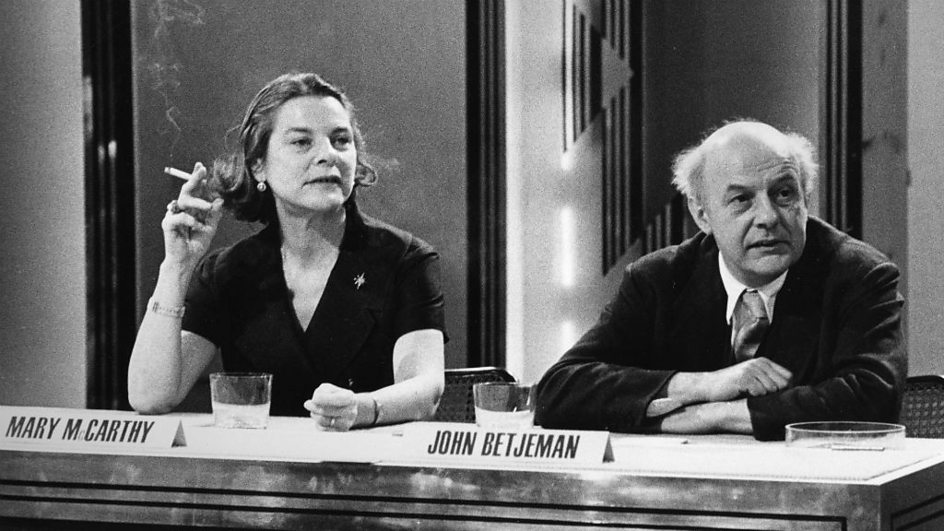
Celebrating 7,000 Pageviews, a rare picture of MM with English poet John Betjeman on BBC Radio gameshow; bonus poem 'Slough' by John Betjeman


Slough

Come friendly bombs and fall on Slough!
It isn't fit for humans now,
There isn't grass to graze a cow.
Swarm over, Death!

Come, bombs and blow to smithereens
Those air -conditioned, bright canteens,
Tinned fruit, tinned meat, tinned milk, tinned beans,
Tinned minds, tinned breath.

Mess up the mess they call a town-
A house for ninety-seven down
And once a week a half a crown
For twenty years.

And get that man with double chin
Who'll always cheat and always win,
Who washes his repulsive skin
In women's tears:

And smash his desk of polished oak
And smash his hands so used to stroke
And stop his boring dirty joke
And make him yell.

But spare the bald young clerks who add
The profits of the stinking cad;
It's not their fault that they are mad,
They've tasted Hell.

It's not their fault they do not know
The birdsong from the radio,
It's not their fault they often go
To Maidenhead

And talk of sport and makes of cars
In various bogus-Tudor bars
And daren't look up and see the stars
But belch instead.

In labour-saving homes, with care
Their wives frizz out peroxide hair
And dry it in synthetic air
And paint their nails.

Come, friendly bombs and fall on Slough
To get it ready for the plough.
The cabbages are coming now;
The earth exhales.


Sunday, 12 May 2013

Bradley Manning, Julian Assange and Mary McCarthy; or Deracinating McCarthy the NYT way

If MM were alive today, would she be an active supporter of Julian Assange and Bradley Manning? Of course she would - no two ways about it. What leads me to this no-brainer ? Her unwavering opposition to US Empire building in Vietnam for one, and her lifelong pursuit of the truth, political and personal for another. Today's Truthout interview with Julian Assange underlines that the tradition of the principled, courageous American dissident, which McCarthy played a leading role in forging, is far from dead.

The Death of Truth: Chris Hedges Interviews Julian Assange

Sunday, 12 May 2013 09:44By Chris Hedges, Truthdig | Interview

Assange, Manning and WikiLeaks, by making public in 2010 half a million internal documents from the Pentagon and the State Department, along with the 2007 video of U.S. helicopter pilots nonchalantly gunning down Iraqi civilians, including children, and two Reuters journalists, effectively exposed the empire’s hypocrisy, indiscriminate violence and its use of torture, lies, bribery and crude tactics of intimidation. WikiLeaks shone a spotlight into the inner workings of empire—the most important role of a press—and for this it has become empire’s prey. Those around the globe with the computer skills to search out the secrets of empire are now those whom empire fears most. If we lose this battle, if these rebels are defeated, it means the dark night of corporate totalitarianism. If we win, if the corporate state is unmasked, it can be destroyed. 


And yet, if NYT's  4 month's late centenary piece is to

 be believed, we should simply be remembering MM 

as an upmarket high brow fashionista


A Woman of Intellect and Style

By CELIA McGEE
Published: October 19, 2012

MARY McCARTHY would have been 100 this year, a milestone commemorated last spring by her alma mater, Vassar College, and again last Tuesday, at the American Library in Paris.Mary McCarthy, the American writer, was known also for her elegant style.


Ms. McCarthy, who died in 1989 at age 77, also created an aura, trading up from her scruffy image at Vassar to an elegant look all her own.
“If you were to make a movie of Mary McCarthy’s life,” the editor William Abrahams told Ms. Kiernan in the early 1990s, “Grace Kelly could have played the part.”
Could we possibly be having a McCarthy Moment in fashion? This season’s little black cutaway dress from Balenciaga? Or that pretty tie-neck blouse from Lanvin (just look at the author’s portrait-sitting with Cecil Beaton)? She visited both design houses and shopped for leather goods at Mark Cross, cashmere at Brooks Brothers, suits at Bonwit Teller and gloves and scarves at Hermès. All last summer we had espadrilles (hers came from Lanvin); this fall features 1940s-ish cropped jackets, and Williamsburg, Brooklyn, is grooving on Peter Pan collars.
“She combined sexy and tailored,” Ms. Kiernan said. “It’s cool now.”
Many female writers whom Ms. McCarthy inspired intellectually reflect her style as well. A. M. Homes’s new McCarthy-ish novel, “May We Be Forgiven,” earned her an austere, short-waisted photo straight out of the McCarthy playbook. The cover art of Susanna Moore’s latest, a World War II novel called “The Life of Objects,” elicits a McCarthy double-take: a woman’s photograph from the ’30s, in profile, naturally, hair in a bun.
Mentioning her name evokes not only the extraordinary number of images of the writer published over the years, but “a literary figure, a political figure, an urbane figure, a very witty figure who had honesty and wasn’t shy about expressing her opinions,” said Ronald Patkus, who organized the Vassar show. “It’s time for people to think about the role she played in the early and mid-20th century.”
Claire Messud, a novelist and critic, refers to the intertwining of Ms. McCarthy’s appearance and pointed intellect as a stance inherited from Edith Wharton and “the glamorous Europeans, like Louise de Vilmorin or the Mitfords or Elizabeth Bowen.”
She added, “McCarthy was probably one of the first female intellectuals I was aware of, and there was this sense of the presentation of yourself as not so much distinctive as elegant, of presenting yourself with respect — self-respect was manifest.”
This packs a particular relevance for young female writers today, said Elissa Schappell, a novelist and a founding editor of the literary magazine Tin House.
“The way she looked had the mark of someone who knows herself,” she said. “Like with her inner life and writing: she could be zingy and ruthless but never sloppy. There was a certain precision and candor, very incisive and sharp. I didn’t know she wore designer clothing, but it doesn’t surprise me. There’s always something very clean, thought-out. The look was very curated.”

The process of re-branding MM has begun. If she can't be ignored or rubbed out of American cultural and political life, then she must be gutted, deracinated and re-packaged as the original Sex in the City girl or some other such moronic nonsense.

 To recall the real MM we need to ask 
 ourselves, what would she be holding now? 

A placard saying 'I'm Bradley Manning' or a  
copy of Vogue?

Tuesday, 2 April 2013

Whores and Rogues - to celebrate 60,000 pageviews, bloggerlees re-visits his precious first published work on Shakespeare's 'Measure for Measure' (which he's pretty sure MM would've approved of - fact!)


Whores and Rogues


moral degeneracy in Shakespeare's Measure for Measure


Richard Lees throws fresh light on Shakespeare’s play by revealing the immediate context of debates about moral depravity in Shakespeare’s London.

Coming across a timeline in York Notes recently, a student in my A2 Lit. class wondered how significant it was that James I had ordered the demolition of London’s brothels a year before the first performance of Measure for Measure. A very good question and one which mainstream criticism, we quickly discovered, wasn't keen to address. Fortunately, a quick internet search threw up a number of interesting websites, which began to answer that specific question, and highlighted fresh social and literary contexts which gave us a completely new perspective on Measure for Measure.

Wrong Side of the River: London’s disreputable South Bank in the 16th and 17th century by Jessica Browner describes how London’s complex economic and social development turned its main southern suburb, Southwark, into a ‘bastard sanctuary’, an area relatively free from the judicial control of the City. Overcrowded and cosmopolitan, the south bank area became notorious for vagrancy and prostitution, as well as the location, after 1599, for most of London’s theatres. According to Browner, Southwark:
grew parasitically, making its living by becoming the pleasure-ground for the more closely regulated community to the north.


Sexual politics in Southwark
Connecting this environment with Measure for Measure is not difficult. Southwark’s ‘moral degeneracy’ was continually denounced by Puritan pamphleteers and preachers, using the kind of arguments and language characteristic of Angelo and others in the play. In terms of legal response, Browner describes ‘the numerous attempts to pass civil laws to condemn and punish sexual laxness’ by both Crown and Parliament. These include James I’s first royal proclamation in 1603, to pull down buildings within three miles of London in order to drive out the ‘idle, indigent, dissolute and dangerous persons’ pestering the city and causing plague. Whores and bawds were usually numbered among such dissolute persons. In this context Measure for Measure must have seemed like cutting edge drama to the Jacobean playgoer. Indeed, the numerous prison scenes in the play may well have struck other chords with contemporary audiences, since the district of Southwark had no less than five prisons, including the Clink, the Compter and the Marshalsea. Clearly, to my group at least, this suggested that Shakespeare’s purpose in exploring the use of legal decrees and institutions, to control and punish ‘immoral’ behaviour, was not simply an abstract discussion of ethical codes, but was, in fact, firmly rooted in the sexual politics of the period.

Close connections
And it seems it wasn’t only Shakespeare who had an interest in dramatising this particular issue. From the evidence of our web search, there appear to be a number of plays by Shakespeare’s contemporaries (and collaborators) with close connections to Measure for Measure. For example, it can be established beyond reasonable doubt that Thomas Dekker’s The Honest Whore (1604) and Thomas Middleton’s A Mad World, My Masters (1606) have significant inter-textual parallels with Measure for Measure. Both Dekker and Shakespeare create similar roles for their Dukes. In Measure for Measure the Duke orders the suburban brothels demolished, as does the Duke in The Honest Whore. Both then go on to visit prisons in disguise, finally to dispense justice and tie up any loose ends, mainly by channeling sexual desire into the socially acceptable institution of marriage. For both writers, the correction of rampant vice and permissive sexuality appears to take two forms: self-regulation and state regulation. For Middleton in A Mad World, setting things straight at the end also involved a comic twist of justice, whereby a morally dissolute male character, Richard Follywit, is forced to marry a prostitute in a final scene, a resolution echoing Lucio’s fate in Measure for Measure.


City comedies
For my class, one of the most interesting contexts to emerge from the articles by Howard and Frassinelli was the existence of a category of seventeenth-century drama that they had not encountered before, namely, the City Comedy, within which Measure For Measure, The Honest Whore, and A Mad World, My Masters can be placed – along with at least a dozen other plays of the period. We discovered a variety of critical definitions for this sub-genre. Brian Gibbins wrote that the city comedy:

may be distinguished from other kinds of Jacobean comedy by their critical and satiric design, their urban setting, their exclusion of material appropriate to romance, fairy tale, sentimental legend or patriotic chronicle

while Jane Howard suggests that:

city comedy focuses attention on...city gallants and the occasional court figure or low-life type such as the prostitute or canting rogue.

Mary Beth Rose comments that city comedy dramatised:

the complex process of conducting economic and social relations in a newly forming urban environment.

Though many city comedies were set outside London – The Honest Whore is ostensibly set in Milan, Measure For Measure in Vienna – Jean Howard argues that:

London is the subtextual referent in nearly all of them...The othering of vice is never fully accomplished...The face of England keeps peeping through...

That both these plays focus on men who succumb to raging desires and passions leads her to consider the needs of their contemporary audiences:

One can only speculate about the historic reasons why watching spectacles of men out of control would have been pleasurable to at least some London playgoers in the period following 1603...it may have been connected to the cultural trauma following the 1603 plague, one of the worst to hit London in the entire Elizabethan and Jacobean period. The spectacle of people given over to moral degeneracy may have had a cathartic effect. Rehearsing vice, the theatre could also stage its punishment; exorcise it.

Taken together, the overall effect that these ‘new’ perspectives might have on our interpretation of Angelo’s hypocrisy, or Claudio’s criminalization or the Duke’s final verdict, has yet to be fully assessed by my students, but most would agree, I think, that the journey which began with a York Notes reference has been a more rewarding contextual experience than, perhaps, the usual debate about biblical concepts of mercy and retribution.

Richard Lees

Thsi article first appeared in emagazine 30. 


Friday, 22 February 2013

Concluding MM's 'General Macbeth' & Beginning bloggerlees on 'Othello'


Macbeth, in short, shows life in the cave. Without religion, animism rules the outer world, and without faith, the human soul is beset
by hobgoblins. This at any rate was Shakespeare's opinion, to which modern history, with the return of the irrational in the Fascist nightmare and its new specters of Communism, Socialism, etc., lends support. It is a troubling thought that Macbeth, of all Shakespeare's characters, should seem the most "modern," the only
one you could transpose into contemporary battle dress or a sport shirt and slacks.

The contemporary Macbeth, a churchgoer, is indifferent to religion, to the categorical imperative or any group of principles that may be held to stand above and govern human behavior. Like the old Macbeth, he'd gladly skip the future life, not only for himself but for the rest of humanity. He listens to soothsayers and prophets
and has been out on the heath and in the desert, interfering with Nature on a grand scale, lest his rivals for power get ahead of him and Banquo's stock, instead of his, inherit the earth-why this
should have seemed such a catastrophe to the real Macbeth, who had no children, is a mystery the scholars never mention. Unloosing the potential destructiveness that was always there in Nature, as Shakespeare understood, the contemporary Macbeth, like the old one, is not even a monster, though he may breed monsters, thanks
to his activities on the heath; he is timorous, unimaginative, and the prayer he would like to say most fervently is simply "Amen."

MM June 1962

The Noble Moor - Othello and Race in Elizabethan London


The Noble Moor – Othello and Race in Elizabethan London

Richard Lees suggests Shakespeare’s complex and sympathetic 

representation of the ‘noble Moor’ is the product of a unique 

moment in England’s involvement in the slave trade.


2007 marked the 200th anniversary of the abolition of the slave trade in the British Empire and, at the time of writing this article, it seemed an appropriate moment to re-consider Othello in relation both to slavery and to Elizabethan representations of black Africans.
Shakespeare lived and worked during the early period of European colonial expansion, when countries like England, France, Portugal and Spain were beginning to carve up the world for their own profit and power, seizing territories in Africa, Asia and, most notably, the ‘new world’ of the Americas. This profit-led expansion would result ultimately in the brutal subjugation of native populations, the ruthless exploitation of natural resources and the systematic destruction of ancient cultures and civilizations on four continents. The economic system which evolved to drive this colonial expansion – the transatlantic slave trade – would lead to the kidnapping, transportation and forced labour of at least 12 million black Africans over a period of 250 years.
Early voyages...
However, when Othello was first performed in 1604, English involvement in the slave trade was in abeyance, a temporary remission which holds the key to understanding how a more ‘sympathetic’ or, at least, a more complex dramatic representation of a black character could have been possible. Four decades earlier, in the 1560s, Sir John Hawkins, one of the Elizabethan seagoing ‘heroes’ of the ‘Age of Discoveries’, led the earliest English slave trading expeditions to Africa – a mixture of public and private enterprise, financed by London merchants and supported by the Queen herself. His first voyage to Sierra Leone in 1562 proved highly profitable: seizing 300 Africans ‘by the sword’, Hawkins crossed the Atlantic and sold his cargo to Spanish traders. Returning to England with prized tropical products such as ginger, sugar and hides, which he sold to London merchants, Hawkins made a fortune.

... and a disastrous expedition
This ‘success’ led to a second expedition, backed by City merchants, noblemen and the Queen, who lent Hawkins a 700 tonne royal ship, the ‘Jesus of Lubeck’. Going back to Sierra Leone in 1564 – the year Shakespeare was born – Hawkins captured 400 black Africans, and made huge profits selling them to the Spanish in the West Indies before returning to England and a knighthood. His third voyage in 1567-68, however, proved a disaster. With six ships, including two royal vessels, he returned to West Africa, seized 500 Africans and a Portuguese slave ship before sailing for the Caribbean. Bad weather forced his ships to take refuge in a Mexican port where they were trapped by a hostile Spanish fleet. Though Hawkins escaped, both royal ships were captured, the human cargo seized and all profits lost; an outcome which effectively ended English involvement in the transatlantic slave trade for over forty years.

The ‘inferior’ heathen
To do what they did, Hawkins and his London backers assumed a doctrine of white Christian supremacy over ‘inferior heathen’ races; an ideology enabling them to capture black Africans, then transport, trade and work them like animals without the slightest moral anxiety. It’s not entirely surprising, then, that literary and theatrical representations of black Africans in Elizabethan culture were generally – though not wholly – negative. Elizabethans may have found travellers’ accounts of African peoples intriguingly exotic, yet the pervading stereotype to emerge from the plays they watched equated blackness with cannibalism, cruelty, animal sexuality and the devil. Dramatic representations were often damning. Muley Hamet in Peele’s The Battle of Alcazar (1589) is closely associated with satanic practices and witchcraft. A black character called Eleazar in Lust’s Dominion is stereotyped as sexually rampant; and in Shakespeare’s Titus Andronicus, Aaron the Moor is motivated by a chilling combination of brutal cruelty and sexual predation.
Some notable exceptions
Yet, not every theatrical characterization re-enforced these negative stereotypes, and depictions of higher status characters were often more positive. King Mullisheg in Heywood’s The Fair Maid of the West is portrayed as generous and gallant, rational and poetic; Greene’s Orlando Furioso and Webster’s The Thracian Wonder both represent Moorish kings as noble and honourable men.
Heroic not barbaric
In Othello, Shakespeare draws immediately on the contradictions in this culture. Iago, Roderigo and Brabantio describe ‘the Moor’ as ugly, barbaric and sexually bestial – the conventional racist stereotype of black Africans that Shakespeare’s audience would have been familiar with. So the delayed appearance of Othello, ‘the noble Moor’, could not have been more dramatic in reversing their initial expectations. Instead of the monster they were encouraged to pre-conceive, Shakespeare presents an articulate and rational Christian, a successful and respected General, and, in the first third of the play at least, a wholly heroic and sympathetic figure.


A drama of isolation
Having thoroughly overturned the racist slanders directed towards Othello’s character, and, by Act 2 Scene 1, having cut short the Venice versus Turkey storyline, Shakespeare begins to explore the social dynamic of what it might be like to be the only black character in an otherwise white world. Othello’s isolation is emphasised casually and continually: everyone refers to him not by his name but as ‘the Moor’, a term both de-personalising and distancing (ie not one of ‘us’), if not quite openly offensive or degrading. Shakespeare fully exploits paradoxes related to the symbolism of black and white with monochromatic religious references almost too numerous to mention, continually reminding the audience that, though deceit and jealousy may provide the motivations driving the play towards its tragic conclusion, colour is the main issue here. With tenuous ties – despite his marriage – to the Venetian aristocracy, Othello’s isolation makes him vulnerable to Iago’s duplicitous manipulation, a disguised antipathy that, with little evidence to the contrary, a modern audience might reasonably consider to be racially motivated.
Shakespeare and race
So, the question arises, why should Shakespeare be interested in exploring issues of racial isolation and victimization? One reason could be that it was something he encountered on a daily basis in the London society around him. Imtiaz Habib, in his landmark study Shakespeare and Race, concludes that Shakespeare’s London was neither wholly English nor wholly white:
We now have documented proof of the residences of black people, which must be reckoned into the colours of Shakespeare’s world, in a very literal sense. Shakespeare knew people of colour. He walked through their neighbourhoods every day.
How had these black Africans come to London? As a direct consequence, it would appear, of those early Elizabethan slavery expeditions: Habib describes how ‘adventurers’ like Hawkins, John Lok and Martin Frobisher brought some of their enslaved African cargo back to London in the 1550s, to form a small population who:
existed initially as a miscellaneous assemblage of exotic, personally possessed decorative fetishes and human curiosities…

The expulsion of the ‘blackamores’
This small population gradually grew over the following 40 years to a point where the Queen herself began to implement policies that, in modern terms, can only be described as institutionally racist. In 1596 she wrote an open letter to the Lord Mayor of London stating that:
there are of late divers blackmoores brought into this realme, of which kinde of people there are already here to manie

The letter re-produced above was written by Elizabeth, in the 1590s. Therein she promulgated the expulsion of the Moors of England from the land of their birth.
ordering that they be deported. A week later she repeated her intention ‘to have those kinde of people sent out of the lande’, commissioning a leading merchant, Casper van Senden, to ‘take up’ certain ‘blackamoores here in this realme and to transport them into Spaine and Portugall’. In 1601, complaining again about the ‘great numbers of Negars and Blackamoores which (as she is informed) are crept into this realm’, Elizabeth made a Royal Proclamation authorizing the deportation of ‘infidels, having no understanding of Christ or his Gospel’. Historically, these expulsion orders represent a kind of xenophobic racist state policy not seen in England since the exiling of Jews at the end of the 13th century.
We can only speculate about the reaction of black Londoners to this form of state persecution, but it isn’t too difficult to picture a vulnerable, fragmented community struggling against a climate of fear and hatred, trying hard to resist an onslaught of bigoted distortions and racial attacks. Embattled by state directives and white society’s growing hostility towards their presence, marginalised black Africans in London must have become increasingly susceptible to exploitation, manipulation and lies.
Habib suggests that Shakespeare’s relationship with black Londoners would have been close, the playwright regularly interacting with the black community while visiting friends, going to pubs and attending theatrical rehearsals and performances. More controversially, Habib believes Shakespeare may have formed a more personal, intimate relationship with a black woman living in Clerkenwell, not far from Shakespeare’s neighbourhood of Cripplegate. Habib points out that, as a sex worker, this black woman could easily have come to know Shakespeare in an area of the city where brothels and theatres flourished side by side.
Race politics and Othello
Viewed beside these intersections of black and white histories, Othello can be interpreted as a play which drew directly from experiences of race politics in Jacobean London, written by someone determined to explode race-hate myths, to represent more positive and multi-faceted images of a noble black African and to explore the consequences of explicit and implicit racist persecution on an isolated individual. However, Habib warns us against seeing Shakespeare as some kind of liberal liberator or social reformer of the theatre: his portraits of black characters remain Westernised, imagined and dramatically realised through European eyes in the language and favoured narrative form of the coloniser. In the end, the fate of his black character re-affirms cultural domination and the pattern of one culture subsuming the other. Iago’s role in this process – reducing the rational black nobleman to tortured wife-killer – remains crucial. By stimulating and controlling Othello’s jealousy – a patriarchal possessiveness that Shakespeare is careful to represent as racially non-specific, with Brabantio and Roderigo both staking claims over Desdemona – Iago propels Othello towards murder and self-destruction, effectively restoring, albeit in tragic circumstances, white supremacy within the Venetian ruling elite. Yet this is not a simple matter of theatrical ethnic cleansing. Look more carefully, Habib suggests, and you will also discover the beginnings of a turbulent, protracted conversation, a ‘difficult negotiation’ that continues into the present:
I can’t say Shakespeare reached a point of closure and an emancipated, enlightened view of people of colour
Habib concludes:
He didn’t. But he did put persons of colour into European culture, there to remain. And that enriches the cultural discourse.
A complex representation
Othello, then, draws from the race culture and politics of its day in a clear and direct manner. Written at a time when English participation in the transatlantic slave trade had been temporarily halted by Spanish market protectionism, Shakespeare fully exploits the unique cultural opportunity to develop a more complex and sympathetic representation of black experience for a predominantly white audience whose sensibilities were not yet closed to such characterizations. In the century to come, such a receptive audience would gradually disappear: as English slave traders developed their own highly profitable market in the North American colonies, enslavement of black Africans became the dominant means of economic production, and with it the full power of racist religious and political ideologies grew to exert a controlling influence over Western culture.

Richard Lees teaches English at South Hunsley School, East Yorkshire.

From emagazine 39, February 2008.


Saturday, 9 February 2013

Mary McCarthy's 'General Macbeth' - part 1


Published in 1962, this is an interesting piece of lit crit from MM, essentially second-guessing the imagined thought processes of the main protagonists as updated middle-class social climbers. Having studied Macbeth a lot, I can't recall any refs to Lady Macbeth being married twice and some of the quotations seem dodgily modernized. Yet MM's argument for the text's contemporary relevance remains consistently strong, at at a time when mainstream lit crit culture was busy mining a deep hole of symbolism. MM's political perspective is considered in relation to the essay's conclusion in part 2.


Mary McCarthy's General Macbeth 


He is a general and has just won a battle; he enters the scene making a remark about the weather. 'So foul and fair a day I have not seen' [I. iii. 38]. On this flat note Macbeth's character tone is set. 'Terrible weather we're having.' 'The sun can't seem to make up its mind.' 'Is it hot/cold/wet enough for you?' A commonplace man who talks in commonplaces, a golfer, one might guess, on the Scottish fairways, Macbeth is the only Shakespeare hero who corresponds to a bourgeois type: a murderous Babbitt [in Sinclair Lewis's Babbitt], let us say.

You might argue just the opposite, that Macbeth is over-imaginative, the prey of visions. It is true that he is impressionable. Banquo, when they come upon the witches, amuses himself at their expense, like a man of parts idly chaffing a fortune-teller. Macbeth, though, is deeply impressed. 'Thane of Cawdor and King.' He thinks this over aloud. 'How can I be Thane of Cawdor when the Thane of Cawdor is alive?' [cf. I. iii. 72-5] When this mental stumbling-block has been cleared away for him (the Thane of Cawdor has received a death sentence), he turns his thoughts sotto voce [under his breath] to the next question. 'How can I be King when Duncan is alive?' The answer comes back, 'Kill him' [cf. I. iii. 137-42]. It does fleetingly occur to Macbeth, as it would to most people, to leave matters alone and let destiny work it out. 'If chance will have me King, why, chance may crown me, Without my stir' [I. iii. 143-44]. But this goes against his grain. A reflective man might wonder how fate would spin her plot, as the Virgin Mary must have wondered after the Angel Gabriel's visit. But Macbeth does not trust to fate, that is, to the unknown, the mystery of things; he trusts only to a known quantity--himself--to put the prophecy into action. In short, he has no faith, which requires imagination. He is literal-minded; that, in a word, is his tragedy.

It was not his idea, he could plead in self-defense, but the witches', that he should have the throne. They said it first. But the witches only voiced a thought that was already in his mind; after all, he was Duncan's cousin and close to the crown. And once the thought has been put into words, he is in a scrambling hurry. He cannot wait to get home to tell his wife about the promise; in his excitement, he puts it in a letter, which he sends on ahead, like a businessman briefing an associate on a piece of good news for the firm.

Lady Macbeth takes very little stock in the witches. She never pesters her husband, as most wives would, with questions about the Weird Sisters: 'What did they say, exactly?' 'How did they look?' 'Are you sure?' She is less interested in 'fate and metaphysical aid' [I. v. 29] than in the business at hand--how to nerve her husband to do what he wants to do. And later, when Macbeth announces that he is going out to consult the Weird Sisters again, she refrains from comment. As though she were keeping her opinion--'O proper stuff!' [III. iv. 59]--to herself. Lady Macbeth is not superstitious. Macbeth is. This makes her repeatedly impatient with him, for Macbeth, like many men of his sort, is an old story to his wife. A tale full of sound and fury signifying nothing. Her contempt for him perhaps extends even to his ambition. 'Wouldst not play false, And yet wouldst wrongly win' [I. v. 21-2]. As though to say, 'All right, if that's what you want, have the courage to get it.' Lady Macbeth does not so much give the impression of coveting the crown herself as of being weary of watching Macbeth covet it. Macbeth, by the way, is her second husband, and either her first husband was a better man than he, which galls her, or he was just another general, another superstitious golfer, which would gall her too.

Superstition here is the opposite of reason on the one hand and of imagination on the other. Macbeth is credulous, in contrast to Lady Macbeth, to Banquo, and, later, to Malcolm, who sets the audience an example of the right way by mistrusting Macduff until he has submitted him to an empirical test. Believing and knowing are paired in Malcolm's mind; what he knows he believes. Macbeth's eagerness to believe is the companion of his lack of faith. If all works out right for him in this world, Macbeth says, he can take a chance on the next ('We'd jump the life to come' [I. vii. 7]). Superstition whispers when true religion has been silenced, and Macbeth becomes a ready client for the patent medicines brewed by the jeering witches on the heath.

As in his first interview with them he is too quick to act literally on a dark saying, in the second he is too easily reassured. He will not be conquered till 'great Birnam Wood to high Dunsinane Hill shall come against him.' 'Why, that can never happen!' [cf. IV. i. 92-4] he cries out in immediate relief, his brow clearing.

It never enters his mind to examine the saying more closely, test it, so to speak, for a double bottom, as was common in those days (Banquo even points this out to him) with prophetic utterances, which were known to be ambiguous and tricky. Any child knew that a prophecy often meant the reverse of what it seemed to say, and any man of imagination would ask himself how Birnam Wood might come to Dunsinane and take measures to prevent it, as King Laius took measures to prevent his own death by arranging to have the baby Oedipus killed [in Sophocles's Oedipus Rex]. If Macbeth had thought it out, he could have had Birnam Wood chopped down and burned on the spot and the ashes dumped into the sea. True, the prophecy might still have turned against him ..., but that would have been another story, another tragedy, the tragedy of a clever man not clever enough to circumvent fate. Macbeth is not clever; he is taken in by surfaces, by appearance. He cannot think beyond the usual course of things. 'None of woman born' [IV. i. 80]. All men, he says to himself, sagely, are born of women; Malcolm and Macduff are men; therefore I am safe. This logic leaves out of account the extraordinary: the man brought into the world by Caesarean section. In the same way, it leaves out of account the supernatural--the very forces he is trafficking with. He might be overcome by an angel or a demon, as well as by Macduff.

Yet this pedestrian general sees ghosts and imaginary daggers in the air. Lady Macbeth does not, and the tendency in her husband grates on her nerves; she is sick of his terrors and fancies. A practical woman, Lady Macbeth, more a partner than a wife, though Macbeth treats her with a trite domestic fondness--'Love,' 'Dearest love,' 'Dearest chuck,' 'Sweet remembrancer.' These middle-aged, middle-class endearments, as though he called her 'Honeybunch' or 'Sweetheart,' as well as the obligatory 'Dear,' are a master stroke of Shakespeare's and perfectly in keeping with the prosing about the weather, the heavy credulousness.

Naturally Macbeth is dominated by his wife. He is old Iron Pants in the field (as she bitterly reminds him), but at home shehas to wear the pants; she has to unsex herself. No 'chucks' or 'dearests' escape her tightened lips, and yet she is more feeling, more human finally than Macbeth. She thinks of her father when she sees the old King asleep, and this natural thought will not let her kill him. Macbeth has to do it, just as the quailing husband of any modern virago is sent down to the basement to kill a rat or drown a set of kittens. An image of her father, irrelevant to her purpose, softens this monster woman; sleepwalking, she thinks of Lady Macduff. 'The Thane of Fife had a wife. Where is she now?' [cf. IV. i. 150-53]. Stronger than Macbeth, less suggestible, she is nevertheless imaginative, where he is not. She does not see ghosts and daggers; when she sleepwalks, it is simple reality that haunts her--the crime relived. 'Yet, who would have thought the old man to have had so much blood in him?' [V. i. 39-40]. Over and over, the epiphenomena of the crime present themselves to her dormant consciousness. This nightly reliving is not penitence but more terrible--remorse, the agenbite of the restless deed. Lady Macbeth's uncontrollable imagination drives her to put herself in the place of others--the wife of the Thane of Fife--and to recognize a kinship between all human kind: the pathos of old age in Duncan has made her think, 'Why, he might be my father!' This sense of a natural bond between men opens her to contrition--sorrowing with. To ask whether, waking, she is 'sorry' for what she has done is impertinent. She lives with it and it kills her.

Macbeth has no feeling for others, except envy, a common middle-class trait. He envies the murdered Duncan his rest, which is a strange way of looking at your victim. What he suffers on his own account after the crimes is simple panic. He is never contrite or remorseful; it is not the deed but a shadow of it, Banquo's spook, that appears to him. The 'scruples' that agitate him before Duncan's murder are mere echoes of conventional opinion, of what might be said about his deed: that Duncan was his king, his cousin, and a guest under his roof. 'I have bought golden opinions,' he says to himself (note the verb), 'from all sorts of people' [I. vii. 32-3]; now these people may ask for their opinions back--a refund--if they suspect him of the murder. It is like a business firm's being reluctant to part with its 'good will.' The fact that Duncan was such a good king bothers him, and why? Because there will be universal grief at his death. But his chief 'scruple' is even simpler. 'If we should fail?' he says timidly to Lady Macbeth [I. vii. 59]. Sweet chuck tells him that they will not. Yet once she has ceased to be effectual as a partner, Dearest love is an embarrassment. He has no time for her vapors. 'Cure her of that' [V. iii. 39], he orders the doctor on hearing that she is troubled by 'fancies.' Again the general is speaking.

The idea of Macbeth as a conscience-tormented man is a platitude as false as Macbeth himself. Macbeth has no conscience. His main concern throughout the play is that most selfish of all concerns: to get a good night's sleep. His invocation to sleep, while heartfelt, is perfectly conventional; sleep builds you up, enables you to start the day fresh. Thus the virtue of having a good conscience is seen by him in terms of bodily hygiene. Lady Macbeth shares these preoccupations. When he tells her he is going to see the witches, she remarks that he needs sleep.

Her wifely concern is mechanical and far from real solicitude. She is aware of Macbeth; she knows him (he does not know her at all, apparently), but she regards him coldly as a thing, a tool that must be oiled and polished. His soul-states do not interest her; her attention is narrowed on his morale, his public conduct, the shifting expressions of his face. But in a sense she is right, for there is nothing to Macbeth but fear and ambition, both of which he tries to hide, except from her. This naturally gives her a poor opinion of the inner man.

Why is it, though, that Lady Macbeth seems to us a monster while Macbeth does not? Partly because she is a woman and has 'unsexed' herself, which makes her a monster by definition. Also because the very prospect of murder quickens an hysterical excitement in her, like the discovery of some object in a shop--a set of emeralds or a sable stole--which Macbeth can give her and which will be an 'outlet' for all the repressed desires he cannot satisfy. She behaves as though Macbeth, through his weakness, will deprive her of self-realization; the unimpeded exercise of her will is the voluptuous end she seeks. That is why she makes naught of scruples, as inner brakes on her throbbing engines. Unlike Macbeth, she does not pretend to harbor a conscience, though this, on her part, by a curious turn, is a pretense, as the sleepwalking scene reveals. After the first crime, her will subsides, spent; the devil has brought her to climax and left her.

Macbeth is not a monster, like Richard III or Iago in Othelloor Iachimo [in Cymbeline], though in the catalogue he might go for one because of the blackness of his deeds. But at the outset his deeds are only the wishes and fears of the average, undistinguished man translated into halfhearted action. Pure evil is a kind of transcendence that he does not aspire to. He only wants to be king and sleep the sleep of the just, undisturbed. He could never have been a good man, even if he had not met the witches; hence we cannot see him as a devil incarnate, for the devil is a fallen angel. Macbeth does not fall; if anything, he somewhat improves as the result of his career of crime. He throws off his dependency and thus achieves the 'greatness' he mistakenly sought in the crown and scepter. He swells to vast proportions, having supped full with horrors.

The isolation of Macbeth, which is at once a punishment and a tragic dignity or honor, takes place by stages and by deliberate choice; it begins when he does not tell Lady Macbeth that he has decided to kill Banquo and reaches its peak at Dunsinane, in the final action. Up to this time, though he has cut himself off from all human contacts, he is counting on the witches as allies. When he first hears the news that Macduff is not 'of woman born' [V. viii. 12-15], he is unmanned; everything he trusted (the literal word) has betrayed him, and he screams in terror, 'I'll not fight with thee!' [V. viii. 22]. But Macduff's taunts make a hero of him; he cannot die like this, shamed. His death is his first true act of courage, though even here he has had to be pricked to it by mockery, Lady Macbeth's old spur. Nevertheless, weaned by his very crimes from a need for reassurance, nursed in a tyrant's solitude, he meets death on his own, without metaphysical aid. 'Lay on, Macduff' [V. viii. 33].

What is modern and bourgeois in Macbeth's character is his wholly social outlook. He has no feeling for others, and yet until the end he is a vicarious creature, existing in his own eyes through what others may say of him, through what they tell him or promise him. This paradox is typical of the social being--at once a wolf out for himself and a sheep. Macbeth, moreover, is an expert buck-passer; he sees how others can be used. It is he, not Lady Macbeth, who thinks of smearing the drunken chamberlains with blood (though it is she, in the end, who carries it out), so that they shall be caught 'red-handed' the next morning when Duncan's murder is discovered. At this idea he brightens; suddenly, he sees his way clear. It is the moment when at last he decides. The eternal executive, ready to fix responsibility on a subordinate, has seen the deed finally take a recognizable form. Now he can do it. And the crackerjack thought of killing the grooms afterward (dead men tell no tales--old adage) is again purely his own on-the-spot inspiration; no credit to Lady Macbeth.

It is the sort of thought that would have come to Hamlet's Uncle Claudius, another trepidant executive. Indeed, Macbeth is more like Claudius than like any other character in Shakespeare. Both are doting husbands; both rose to power by betraying their superior's trust; both are easily frightened and have difficulty saying their prayers. Macbeth's 'Amen' sticks in his throat, he complains, and Claudius, on his knees, sighs that he cannot make what priests call a 'good act of contrition.' The desire to say his prayers like any pew-holder, quite regardless of his horrible crime, is merely a longing for respectability. Macbeth 'repents' killing the grooms, but this is for public consumption. 'O, yet I do repent me of my fury, That I did kill them' [II. iii. 106-07]. In fact, it is the one deed he does not repent (i.e., doubt the wisdom of) either before or after. This hypocritical self-accusation, which is his sidelong way of announcing the embarrassing fact that he has just done away with the grooms, and his simulated grief at Duncan's murder ('All is but toys. Renown and grace is dead, The wine of life is drawn' [II. iii. 94-5], etc.) are his basest moments in the play, as well as his boldest; here is nearly a magnificent monster.

The dramatic effect too is one of great boldness on Shakespeare's part. Macbeth is speaking pure Shakespearean poetry, but in his mouth, since we know he is lying, it turns into facile verse, Shakespearean poetry buskined. The same with 'Here lay Duncan, His silver skin lac'd with his golden blood ...' [II. iii. 111-12]. If the image were given to Macduff, it would be uncontaminated poetry; from Macbeth it is 'proper stuff'--fustian. This opens the perilous question of sincerity in the arts: is a line of verse altered for us by the sincerity of the one who speaks it? In short, is poetry relative to the circumstances or absolute? Or, more particularly, are Macbeth's soliloquies poetry, which they sound like, or something else? Did Shakespeare intend to make Macbeth a poet, like Hamlet, Lear, and Othello? In that case, how can Macbeth be an unimaginative mediocrity? My opinion is that Macbeth's soliloquies are not poetry but rhetoric. They are tirades. That is, they do not trace any pensive motion of the soul or heart but are a volley of words discharged. Macbeth is neither thinking nor feeling aloud; he is declaiming. Like so many unfeeling men, he has a facile emotionalism, which he turns on and off. Not that his fear is insincere, but his loss of control provides him with an excuse for histrionics.

These gibberings exasperate Lady Macbeth. 'What do you mean?' [II. ii. 37] she says coldly after she has listened to a short harangue on 'Methought I heard a voice cry "Sleep no more!'" [II. ii. 32]. It is an allowable question--what does he mean? And his funeral oration on her, if she could have heard it, would have brought her back to life to protest. 'She should have died hereafter' [V. v. 17]--fine, that was the real Macbeth. But then, as if conscious of the proprieties, he at once begins on a series of bromides ('Tomorrow, and tomorrow ...' [V. v. 19ff.]) that he seems to have had ready to hand for the occasion like a black mourning suit. All Macbeth's soliloquies have that ready-to-hand, if not hand-me-down, air, which is perhaps why they are given to school children to memorize, often with the result of making them hate Shakespeare. What children resent in these soliloquies is precisely their sententiousness--the sound they have of being already memorized from a copybook....

The play between poetry and rhetoric, the conversion of poetry to declamation, is subtle and horrible in Macbeth. The sincere pent-up poet in Macbeth flashes out not in the soliloquies but when he howls at a servant. 'The Devil damn thee black, thou cream-faced loon! Where got'st thou that goose look?' [V. iii. 11]. Elsewhere, the general's tropes are the gold braid of his dress uniform or the chasing of his armor. If an explanation is needed, you might say he learned to use words through long practice in haranguing his troops, whipping them and himself into battle frenzy. Up to recent times a fighting general, like a football coach, was an orator.

But it must be noted that it is not only Macbeth who rants. Nor is it only Macbeth who talks about the weather. The play is stormy with atmosphere--the screaming and shrieking of owls, the howling of winds. Nature herself is ranting, like the witches, and Night, black Hecate, is queen of the scene. Bats are flitting about; ravens and crows are hoarse; the house-martins' nests on the battlements of Macbeth's castle give a misleading promise of peace and gentle domesticity. 'It will be rain tonight,' says Banquo simply, looking at the sky (note the difference between this and Macbeth's pompous generality), and the First Murderer growls at him, striking, 'Let it come down' [III. iii. 16]. The disorder of Nature, as so often in Shakespeare, presages and reflects the disorder of the body politic. Guilty Macbeth cannot sleep, but the night of Duncan's murder, the whole house, as if guilty too, is restless; Malcolm and Donalbain talk and laugh in their sleep; the drunken porter, roused, plays that he is gatekeeper of hell.

Indeed, the whole action takes place in a kind of hell and is pitched to the demons' shriek of hyperbole. This would appear to be a peculiar setting for a study of the commonplace. But only at first sight. The fact that an ordinary philistine like Macbeth goes on the rampage and commits a series of murders is a sign that human nature, like Nature, is capable of any mischief if left to its 'natural' self. The witches, unnatural beings, are Nature spirits, stirring their snake-filet and owl's wing, newt's eye and frog toe in a camp stew: earthy ingredients boil down to an unearthly broth. It is the same with the man Macbeth. Ordinary ambition, fear, and a kind of stupidity make a deadly combination. Macbeth, a self-made king, is not kingly, but just another Adam or Fall guy, with Eve at his elbow.

There is no play of Shakespeare's (I think) that contains the words 'Nature' and 'natural' so many times, and the 'Nature' within the same speech can mean first something good and then something evil, as though it were a pun. Nature is two-sided, double-talking, like the witches. 'Fair is foul and foul is fair,' they cry [I. i. 11], and Macbeth enters the play unconsciously echoing them, for he is never original but chock-full of the 'milk of human kindness' [I. v. 17], which does not mean kindness in the modern sense but simply human 'nature,' human kind. The play is about Nature, and its blind echo, human nature.

Macbeth, in short, shows life in the cave. Without religion, animism rules the outer world, and without faith, the human soul is beset by hobgoblins. This at any rate was Shakespeare's opinion, to which modern history, with the return of the irrational in the Fascist nightmare and its fear of new specters in the form of Communism, Socialism, etc., lends support. It is a troubling thought that bloodstained Macbeth, of all Shakespeare's characters, should seem the most 'modern,' the only one you could transpose into contemporary battle dress or a sport shirt and slacks.

Monday, 28 January 2013

Your appetite for all things McCarthy's getting stronger: 50,000+ pageviews - to celebrate her ongoing relevance to now, McCarthy's 'Medina' & Nick Turse's new book "Kill Anything that Moves" begin and develop the process of exposing the savagery, lies and cover-ups of US imperialism in Vietnam.


MY LAI
On 16 March, 1968, in the hamlet of My Lai, Vietnam, U.S. soldiers of C Company 1st Battalion, 20th Infantry Regiment, 11th Brigade, killed hundreds of unarmed Vietnamese civilians, mostly women and children.  The massacre prompted widespread outrage around the world and reduced American support at home for the war in Vietnam. Lt William Calley, the unit's platoon leader, was charged with several counts of premeditated murder in September 1969.

Other officers and enlisted men were later charged with related crimes. Lt Calley alleged that he and his men had been ordered to commit the massacre by their Company Commander, Captain Ernest Medina.


Lt Calley was convicted in 1971 of premeditated murder in ordering the shootings and initially sentenced to life in prison. However, two days later President Richard Nixon ordered him released from prison, pending appeal of his sentence. Lt Calley served 3 1/2 years of house arrest in his quarters at Fort Benning, Georgia, and was then ordered freed by a federal judge. 


Captain Medina was acquitted of any wrongdoing during a highly publicized trial. Medina by Mary McCarthy, published in 1972, provides a powerful account of the ultimately successful denial and cover-up by the military and gov't at the trial of U.S. v. Medina.  


Now, in Kill Anything that Moves, Nick Turse has for the first time put together a comprehensive picture, written with mastery and dignity, of what American forces actually were doing in Vietnam. The findings disclose an almost unspeakable truth.  Meticulously piecing together newly released classified information, court-martial records, Pentagon reports, and firsthand interviews in Vietnam and the United States, as well as contemporaneous press accounts and secondary literature, Turse discovers that episodes of devastation, murder, massacre, rape, and torture once considered isolated atrocities were in fact the norm, adding up to a continuous stream of atrocity, unfolding, year after year, throughout that country.
It has been Turse’s great achievement to see that, thanks to the special character of the war, its prime reality — an accurate overall picture of what physically was occurring on the ground — had never been assembled; that with imagination and years of dogged work this could be done; and that even a half-century after the beginning of the war it still should be done. Turse acknowledges that, even now, not enough is known to present this picture in statistical terms. To be sure, he offers plenty of numbers — for instance the mind-boggling estimates that during the war there were some two million civilians killed and some five million wounded, that the United States flew 3.4 million aircraft sorties, and that it expended 30 billion pounds of munitions, releasing the equivalent in explosive force of 640 Hiroshima bombs.THURSDAY, JAN 17, 2013 03:46 PM +0000

Vietnam was even more horrific than we thought

Nick Turse's new book "Kill Anything that Moves" reveals that massacres like My Lai were downright common


Vietnam was even more horrific than we thoughtU.S. Army helicopters pour machine gun fire into tree line to cover the advance of South Vietnamese ground troops in an attack on a Viet Cong camp near the Cambodian border, in March 1965 during the Vietnam War. (Credit: AP/Horst Faas)
This piece originally appeared on TomDispatch.
For half a century we have been arguing about “the Vietnam War.” Is it possible that we didn’t know what we were talking about? After all that has been written (some 30,000 books and counting), it scarcely seems possible, but such, it turns out, has literally been the case.
Now, in Kill Anything that Moves, Nick Turse has for the first time put together a comprehensive picture, written with mastery and dignity, of what American forces actually were doing in Vietnam. The findings disclose an almost unspeakable truth.  Meticulously piecing together newly released classified information, court-martial records, Pentagon reports, and firsthand interviews in Vietnam and the United States, as well as contemporaneous press accounts and secondary literature, Turse discovers that episodes of devastation, murder, massacre, rape, and torture once considered isolated atrocities were in fact the norm, adding up to a continuous stream of atrocity, unfolding, year after year, throughout that country.
It has been Turse’s great achievement to see that, thanks to the special character of the war, its prime reality — an accurate overall picture of what physically was occurring on the ground — had never been assembled; that with imagination and years of dogged work this could be done; and that even a half-century after the beginning of the war it still should be done. Turse acknowledges that, even now, not enough is known to present this picture in statistical terms. To be sure, he offers plenty of numbers — for instance the mind-boggling estimates that during the war there were some two million civilians killed and some five million wounded, that the United States flew 3.4 million aircraft sorties, and that it expended 30 billion pounds of munitions, releasing the equivalent in explosive force of 640 Hiroshima bombs.
Yet it would not have been enough to simply accumulate anecdotal evidence of abuses. Therefore, while providing an abundance of firsthand accounts, he has supplemented this approach. Like a fabric, a social reality — a town, a university, a revolution, a war — has a pattern and a texture.  No fact is an island. Each one is rich in implications, which, so to speak, reach out toward the wider area of the surrounding facts. When some of these other facts are confirmed, they begin to reveal the pattern and texture in question.
Turse repeatedly invites us to ask what sort of larger picture each story implies. For example, he writes:
“If one man and his tiny team could claim more KIAs [killed in action] than an entire battalion without raising red flags among superiors; if a brigade commander could up the body count by picking off civilians from his helicopter with impunity; if a top general could institutionalize atrocities through the profligate use of heavy firepower in areas packed with civilians — then what could be expected down the line, especially among heavily armed young infantrymen operating in the field for weeks, angry, tired, and scared, often unable to locate the enemy and yet relentlessly pressed for kills?”
Like a tightening net, the web of stories and reports drawn from myriad sources coalesces into a convincing, inescapable portrait of this war — a portrait that, as an American, you do not wish to see; that, having seen, you wish you could forget, but that you should not forget; and that the facts force you to see and remember and take into account when you ask yourself what the United States has done and been in the last half century, and what it still is doing and still is.
Scorched Earth in I Corps
My angle of vision on these matters is a highly particular one. In early August 1967, I arrived in I Corps, the northernmost district of American military operations in what was then South Vietnam.  I was there to report for the New Yorker on the “air war.” The phrase was a misnomer.  The Vietnamese foe, of course, had no assets in the air in the South, and so there was no “war” of that description.
There was only the unilateral bombardment of the land and people by the fantastic array of aircraft assembled by the United States in Vietnam.  These ranged from the B-52, which laid down a pattern of destruction a mile long and several football fields wide; to fighter bombers capable of dropping, along with much else, 500-pound bombs and canisters of napalm; to the reconfigured DC-3 equipped with a cannon capable of firing 100 rounds per second; to the ubiquitous fleets of helicopters, large and small, that crowded the skies. All this was abetted by continuous artillery fire into “free-fire” zones and naval bombardment from ships just off the coast.
By the time I arrived, the destruction of the villages in the region and the removal of their people to squalid refugee camps was approaching completion. (However, they often returned to their blasted villages, now subject to indiscriminate artillery fire.) Only a few pockets of villages survived. I witnessed the destruction of many of these in Quang Ngai and Quang Tinh provinces from the back seat of small Cessnas called Forward Air Control planes.
As we floated overhead day after day, I would watch long lines of houses burst into flames one after another as troops moved through the area of operation.  In the meantime, the Forward Air Controllers were calling in air strikes as requested by radio from troops on the ground. In past operations, the villagers had been herded out of the area into the camps.  But this time, no evacuation had been ordered, and the population was being subjected to the full fury of a ground and air assault. A rural society was being torn to pieces before my eyes.
The broad results of American actions in I Corps were thus visible and measurable from the air. No scorched earth policy had been announced but scorched earth had been the result.  Still, a huge piece was missing from the puzzle.  I was not able to witness most of the significant operations on the ground firsthand. I sought to interview some soldiers but they would not talk, though one did hint at dark deeds.  “You wouldn’t believe it so I’m not going to tell you,” he said to me. “No one’s ever going to find out about some things, and after this war is over, and we’ve all gone home, no one is ever going to know.”
In other words, like so many reporters in Vietnam, I saw mainly one aspect of one corner of the war.  What I had seen was ghastly, but it was not enough to serve as a basis for generalizations about the conduct of the war as a whole. Just a few years later, in 1969, thanks to the determined efforts of a courageous soldier, Ron Ridenhour, and the persistence of a reporter, Seymour Hersh, one piece of the hidden truth about ground operations in I Corp came to light.
It was the My Lai massacre, in which more than 500 civilians were murdered in cold blood by Charlie Company, 1st Battalion, 20th Infantry, of the Americal Division. In subsequent years, news of other atrocities in the area filtered into the press, often many years after the fact. For example, in 2003 theToledo Blade disclosed a campaign of torture and murder over a period of months, including the summary execution of two blind men by a “reconnaissance” squad called Tiger Force.  Still, no comprehensive picture of the generality of ground operations in the area emerged.

It has not been until the publication of Turse’s book that the everyday reality of which these atrocities were a part has been brought so fully to light. Almost immediately after the American troops arrived in I Corps, a pattern of savagery was established. My Lai, it turns out, was exceptional only in the numbers killed.
Turse offers a massacre at a village called Trieu Ai in October 1967 as a paradigm.  A marine company suffered the loss of a man to a booby trap near the village, which had in fact had been mostly burned down by other American forces a few days earlier.  Some villagers had, however, returned for their belongings. Now, the Marine company, enraged by its loss but unable to find the enemy, entered the village firing their M-16s, setting fire to any intact houses, and tossing grenades into bomb shelters.
A Marine marched a woman into a field and shot her.  Another reported that there were children in the shelters that were being blown up.  His superior replied, “Tough shit, they grow up to be VC [Vietcong].”  Five or ten people rushed out of a shelter when a grenade was thrown into it.  They were cut down in a hail of fire. Turse comments:
“In the story of Trieu Ai one can see virtually the entire war writ small.  Here was the repeated aerial bombing and artillery fire… Here was the deliberate burning of peasant homes and the relocation of villagers to refugee camps… Angry troops primed to lash out, often following losses within the unit; civilians trapped in their paths; and officers in the field issuing ambiguous or illegal orders to young men conditioned to obey — that was the basic recipe for many of the mass killings carried out by army soldiers and marines over the years.”
The savagery often extended to the utmost depravity: gratuitous torture, killing for target practice, slaughter of children and babies, gang rape.  Consider the following all-too-typical actions of Company B, 1st Battalion, 35th infantry beginning in October 1967:
“The company stumbled upon an unarmed young boy.  ‘Someone caught him up on a hill, and they brought him down and the lieutenant asked who wanted to kill him…’ medic Jamie Henry later told army investigators. A radioman and another medic volunteered for the job.  The radioman… ’kicked the boy in the stomach and the medic took him around behind a rock and I heard one magazine go off complete on automatic…’
“A few days after this incident, members of that same unit brutalized an elderly man to the point of collapse and then threw him off a cliff without even knowing whether he was dead or alive…
“A couple of days after that, they used an unarmed man for target practice…
“And less than two weeks later, members of Company B reportedly killed five unarmed women…
“Unit members rattled off a litany of other brutal acts committed by the company… [including] a living woman who had an ear cut off while her baby was thrown to the ground and stomped on…”
Pumping Up the Body Count
Turse’s findings completed the picture of the war in I Corps for me.  Whatever the policy might have been in theory, the reality, on the ground as in the air, was the scorched earth I had witnessed from the Forward Air Control planes. Whatever the United States thought it was doing in I Corps, it was actuallywaging systematic war against the people of the region.
And so it was, as Turse voluminously documents, throughout the country.  Details differed from area to area but the broad picture was the same as the one in I Corps. A case in point is the war in the Mekong Delta, home to some five to six million people in an area of less than 15,000 square miles laced with rivers and canals. In February 1968, General Julian Ewell, soon to be known by Vietnamese and Americans alike as “the Butcher of the Delta,” was placed in charge of the 9th Infantry Division.
In December 1968, he launched Operation Speedy Express. His specialty, amounting to obsession, was increasing “the body count,” ordained by the high command as the key measure of progress in defeating the enemy. Theoretically, only slain soldiers were to be included in that count but — as anyone, soldier or reporter, who spent a half-hour in the field quickly learned — virtually all slain Vietnamese, most of them clearly civilians, were included in the total.  The higher an officer’s body count, the more likely his promotion. Privates who turned in high counts were rewarded with mini-vacations. Ewell set out to increase the ratio of supposed enemy soldiers killed to American soldiers killed.  Pressure to do so was ratcheted up at all levels in the 9th Division. One of his chiefs of staff “went berserk,” in the words of a later chief of staff.

The means were simple: immensely increase the already staggering firepower being used and loosen the already highly permissive “rules of engagement” by, for example, ordering more night raids.  In a typical night episode, Cobra gunships strafed a herd of water buffalo and seven children tending them. All died, and the children were reported as enemy soldiers killed in action.
The kill ratios duly rose from an already suspiciously high 24 “Vietcong” for every dead American to a completely surreal 134 Vietcong per American.  The unreality, however, did not simply lie in the inflated kill numbers but in the identities of the corpses.  Overwhelmingly, they were not enemy soldiers but civilians.  A “Concerned Sergeant” who protested the operation in an anonymous letter to the high command at the time described the results as he witnessed them:
“A battalion would kill maybe 15 to 20 a day.  With 4 battalions in the Brigade that would be maybe 40 to 50 a day or 1200 a month 1500, easy. (One battalion claimed almost 1000 body counts one month!)  If I am only 10% right, and believe me its lots more, then I am trying to tell you about 120-150 murders, or a My Lay [My Lai] each month for over a year.”
This range of estimates was confirmed in later analyses. Operations in I Corp perhaps depended more on infantry attacks supported by air strikes, while Speedy Express depended more on helicopter raids and demands for high body counts, but the results were the same: indiscriminate warfare, unrestrained by calculation or humanity, on the population of South Vietnam.

Turse reminds us that off the battlefield, too, casual violence — such as the use of military trucks to run over Vietnamese on the roads, seemingly for entertainment — was widespread.  The commonest terms for Vietnamese were the racist epithets “gooks,” “dinks,” and “slopes.”  And the U.S. military machine was supplemented by an equally brutal American-South Vietnamese prison system in which torture was standard procedure and extrajudicial executions common.
How did it happen? How did a country that believes itself to be guided by principles of decency permit such savagery to break out and then allow it to continue for more than a decade?
Why, when the first Marines arrived in I Corps in early 1965, did so many of them almost immediately cast aside the rules of war as well as all ordinary scruples and sink to the lowest levels of barbarism?  What chains of cause and effect linked “the best and the brightest” of America’s top universities and corporations who were running the war with the murder of those buffalo boys in the Mekong Delta?
How did the gates of hell open? This is a different question from the often-asked one of how the United States got into the war. I cannot pretend to begin to do it justice here. The moral and cognitive seasickness that has attended the Vietnam War from the beginning afflicts us still. Yet Kill Anything that Movespermits us, finally, to at least formulate the question in light of the actual facts of the case.
Reflections would certainly seem in order for a country that, since Vietnam, has done its best to unlearn even such lessons as were learned from that debacle in preparation for other misbegotten wars like those in Iraq and Afghanistan. Here, however, are a few thoughts, offered in a spirit of thinking aloud.
The Fictitious War and the Real One
Roughly since the massacre at My Lai was revealed, people have debated whether the atrocities of the war were the product of decisions by troops on the ground or of high policy, of orders issued from above — whether they were “aberrations” or “operations.” The first school obviously lends itself to bad-apple-in-a-healthy-barrel thinking, blaming individual units for unacceptable behavior while exonerating the higher ups; the second tends to exonerate the troops while pinning the blame on their superiors.
Turse’s book shows that the barrel was rotten through and through.  It discredits the “aberration” school once and for all. Yet it does not exactly offer support for the orders-from-the-top school either. Perhaps the problem always was that these alternatives framed the situation inaccurately.  The relationship between policy and practice in Vietnam was, it turns out, far more peculiar than the two choices suggest.
It’s often said that truth is the first casualty of war. In Vietnam, however, it was not just that the United States was doing one thing while saying another (for example, destroying villages while claiming to protect them), true as that was.  Rather, from its inception the war’s structure was shaped by an attempt to superimpose a false official narrative on a reality of a wholly different character.
In the official war, the people of South Vietnam were resisting the attempts of the North Vietnamese to conquer them in the name of world communism.  The United States was simply assisting them in their patriotic resistance.  In reality, most people in South Vietnam, insofar as they were politically minded, were nationalists who sought to push out foreign conquerors: first, the French, then the Japanese, and next the Americans, along with their client state, the South Vietnamese government which was never able to develop any independent strength in a land supposedly its own.  This fictitious official narrative was not added on later to disguise unpalatable facts; it was baked into the enterprise from the outset.
Accordingly, the collision of policy and reality first took place on the ground in Trieu Ai village and its like. The American forces, including their local commanders, were confronted with a reality that the policymakers had not faced and would not face for many long years. Expecting to be welcomed as saviors, the troops found themselves in a sea of nearly universal hostility.
No manual was handed out in Washington to deal with the unexpected situation. It was left to the soldiers to decide what to do. Throughout the country, they started to improvise. To this extent, policy was indeed being made in the field. Yet it was not within the troops’ power to reverse basic policy; they could not, for instance, have withdrawn themselves from the whole misconceived exercise.  They could only respond to the unexpected circumstances in which they found themselves.
The result would combine an incomprehensible and impossible mission dictated from above (to win the “hearts and minds” of a population already overwhelmingly hostile, while pulverizing their society) and locally conceived illegal but sometimes vague orders that left plenty of room for spontaneous, rage-driven improvisation on the ground. In this gap between the fiction of high policy and the actuality of the real war was born the futile, abhorrent assault on the people of Vietnam.

The improvisatory character of all this, as Turse emphasizes, can be seen in the fact that while the abuses of civilians were pervasive they were not consistent. As he summarizes what a villager in one brutalized area told him decades later, “Sometimes U.S. troops handed out candies.  Sometimes they shot at people.  Sometimes they passed through a village hardly touching a thing.  Sometimes they burned all the homes. ‘We didn’t understand the reasons why the acted in the way they did.’”
Alongside the imaginary official war, then, there grew up the real war on the ground, the one that Turse has, for the first time, adequately described.  It is no defense of what happened to point out that, for the troops, it was not so much their orders from on high as their circumstances — what Robert J. Lifton has called “atrocity-producing situations” — that generated their degraded behavior. Neither does such an account provide escape from accountability for the war’s architects without whose blind and misguided policies these infernal situations never would have arisen.
In one further bitter irony, this real war came at a certain point to be partially codified at ever higher levels of command into policies that did translate into orders from the top. In effect, the generals gradually — if absurdly, in light of the supposed goals of the war — sanctioned and promoted the de facto war on the population.  Enter General Ewell and his body counts.
In other words, the improvising moved up the chain of command until the soldiers were following orders when they killed civilians, though, as in the case of Ewell, those orders rarely took exactly that form.  Nonetheless, the generals sometimes went quite far in formulating these new rules, even when they flagrantly contradicted official policies.
To give one example supplied by Turse, in 1965, General William Westmoreland, who was made commander of U.S. forces in Vietnam in 1964, implicitly declared war on the peasantry of South Vietnam. He said:
“Until now the war has been characterized by a substantial majority of the population remaining neutral.  In the past year we have seen an escalation to a higher intensity in the war.  This will bring about a moment of decision for the peasant farmer.  He will have to choose if he stays alive.”

Like his underlings, Westmoreland, was improvising. This new policy of, in effect, terrorizing the peasantry into submission was utterly inconsistent with the Washington narrative of winning hearts and minds, but it was fully consistent with everything his forces were actually doing and about to do in I Corps and throughout the country.
A Skyscraper of Lies
One more level of the conflict needs to be mentioned in this context.  Documents show that, as early as the mid-1960s, the key mistaken assumptions of the war — that the Vietnamese foe was a tentacle of world communism, that the war was a front in the Cold War rather than an episode in the long decolonization movement of the twentieth century, that the South Vietnamese were eager for rescue by the United States — were widely suspected to be mistaken in official Washington.  But one other assumption was not found to be mistaken: that whichever administration “lost” Vietnam would likely lose the next election.
Rightly or wrongly, presidents lived in terror of losing the war and so being politically destroyed by a movement of the kind Senator Joe McCarthy launched after the American “loss” of China in 1949.  Later, McGeorge Bundy, Lyndon Johnson’s national security advisor, would describe his understanding of the president’s frame of mind at the time this way:
“LBJ isn’t deeply concerned about who governs Laos, or who governs South Vietnam — he’s deeply concerned with what the average American voter is going to think about how he did in the ball game of the Cold War. The great Cold War championship gets played in the largest stadium in the United States and he, Lyndon Johnson, is the quarterback, and if he loses, how does he do in the next election? So don’t lose. Now that’s too simple, but it’s where he is. He’s living with his own political survival every time he looks at these questions.”
In this context, domestic political considerations trumped the substantive reasoning that, once the futility and horror of the enterprise had been revealed, might have led to an end to the war. More and more it was understood to be a murderous farce, but politics dictated that it must continue. As long as this remained the case, no news from Vietnam could lead to a reversal of the war policies.
This was the top floor of the skyscraper of lies that was the Vietnam War. Domestic politics was the largest and most fact-proof of the atrocity-producing situations.  Do we imagine that this has changed?