Friday, 18 May 2012

Kevin interviews Mary part 1 - 'We're you jealous of me?'

In 1979 McCarthy  returned to New York for the publication of Cannibals and Missionaries and to visit her brother, actor Kevin McCarthy, 65. At the suggestion of PEOPLE, Kevin agreed to play journalist and interview his celebrated sister.


You're widely celebrated for your so-called caustic wit. Does it come naturally? Are you proud of it? 

Of course it comes naturally and I don't know if I'm proud of it. I enjoy it, I enjoy laughing. 

You seem to get a great deal of open pleasure in your own natural gaiety, in your own irony and humor. 

You mean laugh at my own jokes? 

Yes. 

In print you have the reputation of being cold and ruthless, you know, a bitter quill dipped in venom. When critics say you are seeking revenge on someone or something, what is your response? 

Balls! 

Do you like writing? 

It's a terrible job. I can produce 19 variants of one page—often! Of course I rewrite. That's why it's a terrible job. 

Who is your audience? 

I think quite a few simple people, not illiterate, but very ordinary. I'm not an author that's greatly loved by an elite. 

Do the figures of our parents, whom we lost in the 1918 influenza epidemic, come back to you? 

No, not unless something evokes them. As far as I'm concerned, they've really turned into their photographs. 


Were you ever jealous of me? 

I don't know, Kevin, maybe as a young child. But I was envious when you ran away in such a dramatic way. 

I remember saying when I got back to that dismal foster home, "I ran away to an orphan asylum." I was looking for an orphan asylum to go to. But you ran away twice! 

I think we four kids were difficult children, already a handful. 

Did you ever go to a psychoanalyst? 

After I was married to Edmund Wilson I was sent to three, don't you remember? But I don't recommend psychoanalysis. I think the whole thing is an absurd series of myths. It's never in any way been empirically verified. 

Why did your marriages break up? 

I don't know. But it's never been incompatibility, except, let's say, with Edmund Wilson. And in that case, there was no other man in the picture when I left him. It was [laughing] desperation! 

I and my wife, Kate, are, you know, 35 years apart, and we're about to have a child. I have three children by my first marriage and a grandchild, Jessica, almost 6. Is it an okay thing? 

I think in this case, yes. Kate is going to be 29, has been married before and has a child. And you, Kevin, seem tremendously young for your age. But usually it's grotesque—these ancient men with 18-year-old girls. You never see it the other way around. 

When you look back on childhood, do you feel you are compensating in your career for some of those wounds? 

That sort of psychiatric stuff doesn't compel my belief. Its tendency is to take any mystery out of our experience, and to imply one has a kind of knowledge one doesn't have. 


Then what is your secret? 

Well, as far as you and I go, I think it's natural that we as orphan children—rather looked down on, different from other children—would try to distinguish ourselves favorably. I know that as a child I had this attention-getting business very strongly, and [laughing] alas, I still have. 

Would you say that my becoming an actor was to get attention? 

Yes, it could be. And I suspect our Irish father was drawn to the theater and drama, which might have been an early influence. 

I vividly recall realizing in my first Shakespearean play at the University of Minnesota that I could speak—I could speak out! But you, too, wanted to be on the stage, didn't you? 

Yes, but at Vassar, when I played in Chaucer's Knight's Tale, I shook so hard that this papier mâché tower I was in nearly fell over and the audience was laughing. I still have stage fright, a fear of appearing in public. 

You seem to me fiercely indomitable, always ready to take up arms. Why? 

For the fun of it, perhaps! Or a mixture of fun and principle. If nobody will speak out on a subject, well, I will. 

I admired your courage in going to the battlefields of South and North Vietnam. 

Well, I wasn't the first woman journalist. Barbara Deming [from a Greenwich Village journal, Liberation] got to North Vietnam first. And during those bombardments, I was scared. Once we had to flatten ourselves in a ditch when the American bombers came over. I never went on patrol. I felt I was rather weak, but I wouldn't have learned anything about the Tightness or wrongness of our actions by going on patrol. It was the most dangerous thing you could do. I felt it would be a kind of betrayal of Jim, my husband, if I were killed. 


Thursday, 17 May 2012

Mary's brother Kevin, Body Snatcher


1956 Sci-Fi classic Invasion of the Body Snatchers, starring Mary's brother, Kevin


Mary and Kevin


Wednesday, 16 May 2012

MM's husbands, lovers, friends and son

MM with Harold Johnsrud; Philip Rahv; MM with Edmund Wilson; Reuel Wison
MM with Jim West and friends
MM posing with Bowden Broadwater

Tuesday, 15 May 2012

EXCLUSIVE : Ben Pleasants' ' Contentious Minds' blogged here


First produced in 2002, Ben Pleasants' Contentious Minds dramatizes the Hellman-McCarthy feud as bitterly ideological and deeply personal. Hank Willow's review for the Hollywood Investigator serves as context- rich introduction to Pleasants' compelling theatrical work,  representing one of the most prolonged and bitter politico-cultural conflicts of the late 20th century, serialized, with Ben's support, here, on the mmcentenary blogspot. 



CONTENTIOUS MINDS: NEW PLAY PITS STALINIST LILLIAN HELLMAN vs. MARY McCARTHY

by Hank Willow, staff reporter  [March 7, 2002]

A new play targets Hollywood writers and intellectuals who tried to suppress news of a European genocide!
Shockingly, these holocaust deniers also threatened to blacklist other writers who tried to expose and stop this ongoing holocaust -- Stalin's holocaust!
That's the topic of Ben Pleasants's Contentious Minds: The Mary McCarthy/Lillian Hellman Affair, which recently completed its run at Hollywood's Lillian Theatre. Pleasants's play dramatizes a series of encounters between Mary McCarthy and Lillian Hellman between 1946 and 1982, the two women arguing about men, art, and politics -- with McCarthy accusing Hellman of lying to cover up Stalin's genocide.
Before writing Contentious Minds, Ben Pleasants wrote the similarly themed and structured The Hemingway-Dos Passos Wars. In it, Ernest Hemingway urges the leftist writer John Dos Passos not to expose Stalinist murders in the Spanish Civil War.
(Stalin-backed Communists were fighting a "civil war within a civil war," murdering their Trotskyite, anarchist, and democratic allies -- an event that would inspire George Orwell's anti-Stalinist satires:Animal Farm and 1984.)
In an exclusive interview with the Hollywood Investigator, playwright Pleasants explains: "Both plays deal with the same subject: the coverup of Stalin's crimes in America by writers like Hellman and John Howard Lawson, who attacked writers like Dos Passos and Koestler when they attempted to bring forward the murders of their friends, and the torture and execution of others writers in the USSR, like Babel, Bulgakov, and Gorky."
Contentious Minds reminds audiences that HUAC (House Un-American Activities Committee) was founded in the 1930s to investigate American Nazis -- and that HUAC was supported by American liberals and Leftists, including Hellman -- until it turned its attention to Communists a decade later.  Liberal support for HUAC -- even from Hollywood screenwriters! -- is one of the uncomfortable truths that Contentious Minds forces its Hollywood audiences to confront.
Contentious Minds exposes the irony Hellman being celebrated today as a victim of HUAC -- when she was one of its initial supporters.
Pleasants adds: "After the HUAC, Hellman and Lawson were placed on Mount Rushmore as martyrs. They should be remembered as gangsters who attacked Dos Passos and James T. Farrell and Koestler, writers who addressed Stalin's crimes and charged [Hellman and Lawson] with lying and complicity [with Stalin]."
Why did Pleasants choose this now obscure area of history -- the 1930s Hollywood Left, Stalin's murders, the Trotskyite/Stalinist rift -- as a topic for two plays? He explains: "I'm attracted to the subject because no one else will say anything."
Although the heroes in Pleasants's plays (Dos Passos and McCarthy) are accused of being Trotskyites, Pleasants adds: "I have no sympathy for either side...
"Mary McCarthy became a Trotskyite because she was sleeping with two of the editors of thePartisan Review, and was drawn into the mess when James T. Farrell (Studs Lonigan) asked McCarthy if she supported a commission headed by John Dewey to investigate Trotsky's death.  She agreed in theory, but ended up on the letterhead of the group Farrell was sponsoring.
"Before McCarthy could chide Farrell for using her name, she started getting anonymous calls and threats in the middle of the night from Stalinists like John Howard Lawson, telling McCarthy not to support the investigation of Trotsky's death, and warning her that her own career would suffer -- that she would be blacklisted. And that got her started."


In The Hemingway-Dos Passos Wars, Pleasants interjects a libertarian message into the play.  A minor character tells the audience: "We didn't get any grants for this play. ... You can do this stuff when you don't get money from the government. You can do anything!"
Pleasants explains: "I raise my own money with no strings attached. Producers call me frequently about doing my plays. I just need to meet them face to face. Face to face is always better than email. I prefer letters rather than email. Email plays so nicely into the state. Before long, they'll rewrite it for us. I'm sure they do that in China."
Still, Pleasants does not call himself a libertarian. "I am an anarchist. I am completely anti-state.  Governments would never support a play like this because it brings up issues like the Samuel Dickstein matter. He was the US Representative from New York City who created the HUAC to go after German-American Bundists. HUAC was supported strongly by the Left, passed in Congress by 340-42 votes, and had the support of the CPUSA.
"What interests me today is why this is not known. Art supported by government rots the artist's soul. It's nothing more than the plutocrats' message."
The HUAC still touches raw nerves in Hollywood, as demonstrated by the controversy over the special Oscar awarded to Elia Kazan (a friendly witness at the HUAC) in 1999, and which was opposed by Daily Variety's Army Archerd, Steve Erickson, and many others.
Yet despite this emotional atmosphere, Contentious Minds dares to tell its Hollywood audience that, on the scale of evil, Stalin's genocide dwarfs the brief prison terms suffered by the Hollywood Ten.
How did Hollywood react to Pleasants's message?
Says Pleasants: "When Contentious Minds was in rehearsal, we heard from Variety and NPR. We were informed that Nora Ephron (Sleepless in Seattle, You've Got Mail) was doing a play about Hellman and McCarthy this summer in San Diego at the Old Globe, to open on Broadway in the fall. Both Variety and NPR wanted advance copies of Contentious Minds, and to see it in preview. I refused both requests.
"Variety reviewed Contentious Minds, defended Hellman and questioned the veracity of what I wrote.  NPR's Iris Mann (who was once directed by Hellman in The Children's Hour as a girl of ten or so) came on opening night to sniff it out, and decided to do nothing.  The L.A. Times's Don Shirley told my PR people flat out that they would not review it.  I was glad they missed it.  When they reviewed my Hemingway play, they put Dos and Hem on the side of the rebels -- which would mean they were fighting for Franco!"
"But, it goes with the territory, as Chomsky says."
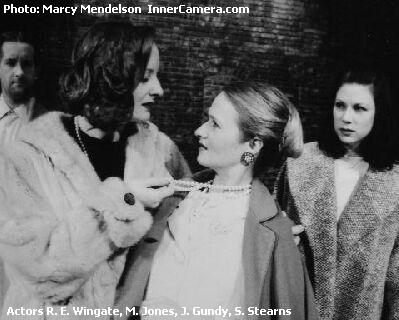
As for the L.A. Weekly, their critic wrote that the play "may contain both the most thrilling and squandered theatrical idea to come along in some time: the legendary rift between Mary McCarthy and Lillian Hellman. Here's a drama potentially straddling and smearing the chalk line between fact and fiction. Unfortunately, in Pleasants's prodigiously researched work, the monumental figures merely name-drop and cat-fight. Jennifer Gundy's McCarthy and Melissa Jones' Hellman fail to connect. Stephanie Stearns plays a narrator with more charm than either of the central characters, which encapsulates the problem of Denise Gillman’s staging."
Ironically for a "left alternate" paper, the L.A. Weekly seemed not to have appreciated that the "name-dropping" and "cat-fighting" was whatContentious Minds's playbill describes as its Russian Constructivism, a technique used by Soviet playwright Sergey Tretakov to broach ideas for discussion. Instead of advocating a single position, characters argue opposing sides, hoping that audience members continue debating after the play. Quoting Tretakov: "The theatrical show is replaced by the theatrical blow, by the immediate processing of the audience."

Pleasants dedicates Contentious Minds "to Robert Conquest, who, single-mindedly, mapped the vast terrain of Stalin's terror network, making it possible for former Soviet citizens to find out, not only the final resting places of their murdered families, but also the names of their murderers!"
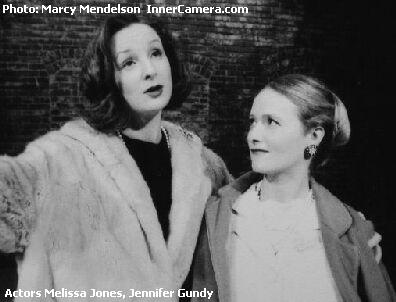
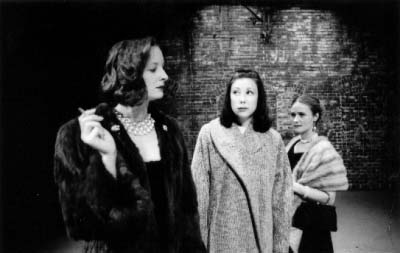
Contentious Minds's just completed production at the Lillian Theatre starred Jennifer Gundy (Star Trek: Voyager, South of Sunset) as Mary McCarthy, and Melissa Jones (Spin City, Primetime Glick) as Lillian Hellman. Also featured were Stephanie Sterns and Ronald E. Wingate.
Ben Pleasants has written for the L.A. Times, Herald-Examiner, L.A. Free Press, L.A. Vanguard, L.A. Reader, and Los Angeles Magazine. His other plays include Lenin in Love.

His novels include Spearmint Leaves and The Victory of Defeat.
Hank Willow is a Los Angeles based tabloid reporter who investigates Hollywood scams and Tinseltown's occult underbelly. Read about his adventures in tabloid journalism in Hollywood Witches.
Contentious Minds is now available on YouTube.


Monday, 14 May 2012

McCarthy V Hellman as seen by Bethune V Ackerman


Just words: Lillian Hellman, Mary McCarthy, and the failure of public conversation in America

Review: Just words: Lillian Hellman, Mary McCarthy, and the failure of public conversation in America

Book by Alan Ackerman
by Brian Bethune on Thursday, June 16, 2011 

In an episode of Dick Cavett’s PBS talk show broadcast on Jan. 25, 1980, the redoubtable writer, critic and political activist Mary McCarthy, 67, pronounced that everything Lillian Hellman, 74—another redoubtable writer, critic and political activist—ever wrote “was a lie, including ‘and’ and ‘the.’ ” Hellman sued for libel and $2.25 million. In one way it was a tempest in a teapot: whatever legal benchmark might have been set, the case died with Hellman in 1984. Yet in another sense, one Ackerman, a University of Toronto English professor, mines to subtle effect, the lawsuit was also about the U.S. failure to establish norms for public argument in a nation that is more constitutionally committed to free speech and more litigious than any other.
The two women were re-fighting battles within the American left that went back to the Spanish Civil War and Stalinist show trials of the 1930s, battles that mostly turned on whether one stuck by Communism whatever its barbarities because the end—defeating fascism—justified the means (Hellman). Or didn’t (McCarthy). But the long-simmering tensions between them were just as important. During one rare personal encounter, a 1949 cocktail party, McCarthy heard Hellman telling a sneering story about novelist John Dos Passos, who had split with former friends Ernest Hemingway and Hellman after they ignored Soviet involvement in the 1937 murder of Dos Passos’s friend, Spanish radical José Robles. McCarthy denounced her on the spot for slander and left Hellman trembling in fury.
For all its roots in the deep past, Ackerman shows the libel case, with its implicit claim that there was only one true account of past reality (all others being “lies”) and its blurring of the line between private and public, points the way forward to America’s present uncivil discourse. From denunciations of James Frey for fraud for having mixed fact and fiction, à la Hellman, in a memoir, to demanding that Barack Obama release personal documents to counter outlandish claims, U.S. public conversation is now a full-contact sport.
 Mr. Ackerman thinks that the lawsuit against Mary McCarthy, which dragged on until Hellman's death in 1984 and cost McCarthy enormous sums in legal fees, tells us something about a "crisis in American moral discourse" dating back to the 1930s.
bkrvjustwords

Just Words

By Alan Ackerman
(Yale University Press, 361 pages, $35)
There are at least two problems with Mr. Ackerman's idea. The first is that it's never clear what sort of "crisis"—or "failure of public conversation"—he is talking about. The nearest he comes to describing the "crisis" is this: The Hellman-McCarthy lawsuit "represents a clash between two models of language: one, as McCarthy saw it, that reports transparently on matters of fact, and one"—presumably as Hellman saw it—"that is self-consciously rhetorical and shaped by desire." Unless I'm mistaken, that's a highfalutin way of saying that the question of what constitutes truth in particular utterances is often disputable. I'm not convinced that we need a 300-page monograph to tell us that.
The second problem with Mr. Ackerman's idea is that, although McCarthy intended her remark to be witty rather than strictly true, it wasn't particularly witty and came awfully close to the truth. Hellman was, in fact, a chronic liar. She wrote three memoirs: "An Unfinished Woman" (1969), Pentimento (1973) and "Scoundrel Time" (1976). Reviewer after reviewer during the 1970s and 1980s—including Irving Howe in Dissent, Hilton Kramer in the New York Times, Alfred Kazin in Esquire, Martha Gellhorn in the Paris Review and most devastatingly Samuel McCracken in Commentary—showed beyond any doubt that these books were full of outrageous omissions and flagrant departures from the historical record.
In the worst instance, a story in "Pentimento," Hellman claimed that she had gone to heroic lengths to aid a young American woman named Julia in supporting anti-Nazi conspirators in Germany. In due course it emerged that the real Julia was a woman named Muriel Gardiner and that Hellman, who had heard her story from someone else, had simply stolen it and put herself in the lead role.
I say all this is a problem for Mr. Ackerman's thesis because if there is any "crisis in American political discourse," it is the nonchalance with which eminent commentators and now even politicians make accusations of dishonesty. A "liar" is now someone who simply holds a contrary opinion or who supports a policy with which one strongly disagrees. But Lillian Hellman's lies were actually lies; she based the latter half of her literary career on intentional, egregious untruths about herself and others.


Sunday, 13 May 2012

My Unholy Relics of not-so virgin Mary (lapsed roman)

I was there - fact!
'To Richard Lees with good wishes and a nice memory of his visit'.

'good luck'


Friday, 11 May 2012

Contentious Mary Quite Contrary

From Contentious Minds

Franklin FoerThe Libelous TruthJuly 13, 2011


That Hellman and McCarthy would despise one another is not surprising. Each had good reason to view the other as her evil twin. Hellman wrote plays for Broadway; McCarthy reviewed theater for Partisan Review. They were both celebrated memoirists, whose legends stemmed, in some measure, from the frankness with which they discussed their sex lives. Where McCarthy cast her lot with the Trotskyists and remained with them as they morphed into liberal cold warriors (until she broke with them over Vietnam), Hellman was a Stalinist, invited to meet Uncle Joe in Moscow. Their politics reflected their literary sensibilities. McCarthy was a tough-minded realist and unstinting in pointing out the ugly flaws in herself and in her characters. Hellman wrote melodrama, erecting villains and heroes, none of the latter larger than herself, and depicting the moral choices of the world as a series of easy answers to epic questions.
In other words, Hellman’s libel suit against McCarthy came freighted with world-historical issues. Alan Ackerman has reminded us of these stakes in his interesting and somewhat overwrought book. He rightly suggests that McCarthy’s suit against Hellman was the culmination of the irreconcilable arguments about liberalism that were implicit in their collected works and biographies. That is what lifts the story of this squabble out of the realm of gossip and into the realm of ideas.
NEITHER MCCARTHY NOR Hellman was adept at obscuring her true feelings about the libel suit: both of them perversely loved it. McCarthy sent her lawyer long memos filled with the ample evidence of Hellman’s fraudulence that she had uncovered. Even though the legal fees nearly bankrupted her—and they would have done so if not for an emergency infusion of cash from Deborah Pease, the publisher of The Paris Review—she considered confrontation central to her professional bona fides and her mission as an intellectual.
McCarthy’s tendency to fling herself into a quarrel, the more adversaries the better, was already present in her earliest writing. Two years out of Vassar, she invested herself with the authority to pillage the entire publishing establishment. In 1935, she co-wrote a series of essays for The Nation called “Our Critics, Right or Wrong.” Dead wrong, as it turned out. And McCarthy had no problem naming names—The New York columnist J. Donald Adams, the proletariat-chic reviewers of the New Masses, and a long list of other eminences. They were charged with nothing less than the “debasement of taste,” for publishing reviews that failed to judge fiction rigorously. While brushing aside the achievements of modern literature with “oracular certainty,” they reduced criticism “to a quivering jelly of uncritical emotion.” The Times dubbed the series “a St. Valentine’s Day Massacre of reviewers and critics.”
This series disclosed the sensibility that would undergird all of McCarthy’s criticism, fiction, and politics. She abhorred opinions that were withheld, or were reshaped in order to please their audience or to serve some unstated agenda. Her writing was a kind of intellectual’s muckraking, calling out the hypocrites and shaming the overrated. She venerated factuality and precision, stuffing her novels full of detailed descriptions. “The fetishism of fact” is a “splendid sickness,” she exulted.
To her critics, McCarthy’s instinct to expose and denounce seemed cruel. Even her friend Dwight Macdonald, who often defended her against those attacks, anxiously quipped, “When most pretty girls smile at you, you feel terrific. When Mary smiles at you, you look to see if your fly is open.” Indeed, like many of McCarthy’s friends, Macdonald made several veiled appearances in her fiction, although he never registered any complaints with her. To complain would have required admitting that he provided the basis for her characters, and such an admission would be far too crushing a confession of his own blemishes. McCarthy had a gift for compressing acute psychological assessments into a damning detail—for uncovering the most painful and, therefore, most telling character flaw. In the case of Macdonald, she perfectly mimicked his anxieties about his failure to write a Big Book, the way he carried around his notes for a project that everybody knew he would never finish.
When her friends and acquaintances identified themselves in McCarthy’s fiction, a task that usually required little straining, they sometimes found themselves joining Hellman in placing irate calls to their lawyers. Philip Rahv, the remarkable editor of Partisan Review, initiated (and then quickly withdrew) a suit alleging 132 violations of his rights after his thinly veiled appearance as the imperious editor Will Taub in McCarthy’s early novel The Oasis. Almost fifteen years later, the Herald Tribune quoted McCarthy’s Vassar classmates griping about how she had barely disguised them in The Group.