Sunday, 1 September 2013

Suitable Only for Adults - Ken Anderson on Sidney Lumet's 'The Group' (1966)


Friday, June 22, 2012


THE GROUP 1966

The generic Hollywood “woman’s film,” those melodramatic, get-out-your-handkerchiefs – style weepies that were once Joan Crawford’s and Bette Davis’ stock in trade, underwent a colorful (that is to say, increasingly explicit) transformation during the 50s and 60s. Reflecting the changing role of women in American culture, the once romance-centric genre transmogrified into the multi-character, hand-wringing, career-girl soap-operas of the sort typified by Rona Jaffe’s water cooler drama, The Best of Everything (1956), in which Joan Crawford’s stock 40s shopgirl character gets an executive upgrade; and that deservedly iconic ode to Broadway, booze, and barbiturates, Valley of the Dolls (1967).
Jessica Walter (Lucille Bluth on my favorite TV show, Arrested Development) looks "Joan Crawford fabulous" and almost walks away with the film as Libby, the least sympathetic but most dynamic member of "The Group"
These films dramatized, in highly glamorized fashion, the challenges facing women as they strove to balance love, friendship, and the pursuit of their dreams while navigating the patriarchally hostile waters of the American workforce. Always purporting to “blow the lid off” one taboo subject or another (in George Cukor’s The Chapman Report it was the sex lives of suburban housewives) these films offered at most a cursory nod to female independence before reverting to type and getting back to the business of subtly endorsing traditional gender roles.

Valley of the Dolls, in its exquisite awfulness, remains the gold standard by which every “sex and soap” women’s film is and should be compared. But one of my favorite forgotten examples of the genre that managed to fall through the cracks due to past unavailability (it had a brief VHS life [Thanks, Poseidon3!], was never released on Laserdisc, but is currently available on made-to-order DVD) is Sidney Lumet’s lively screen adaptation of Mary McCarthy’s 1963 bestselling novel, The Group. 
Eight is Enough
The sparkling cast of up-and-comers that comprise The Group
I don’t know who first coined the phrase “superior soap-opera” but the term uncategoricallyapplies to this expensively-mounted, surprisingly well-acted tale of the interweaving lives of eight friends—graduates of Vassar College, Class of ’33— as each sets out to “make her mark” on the world. The experiences of these economically and psychologically diverse heroines reflect, in microcosm, the emergent state of (white) American womanhood in the mid-20th century. Specifically, the Roosevelt Administration years from The Great Depression through to the earliest days of the outbreak of WW II.
As each woman embarks on the journey of realizing the American Dream their wealth, position, and privilege has practically guaranteed them, they discover that outside the protective bubble of college and "The Group," real life presents considerably greater challenges.
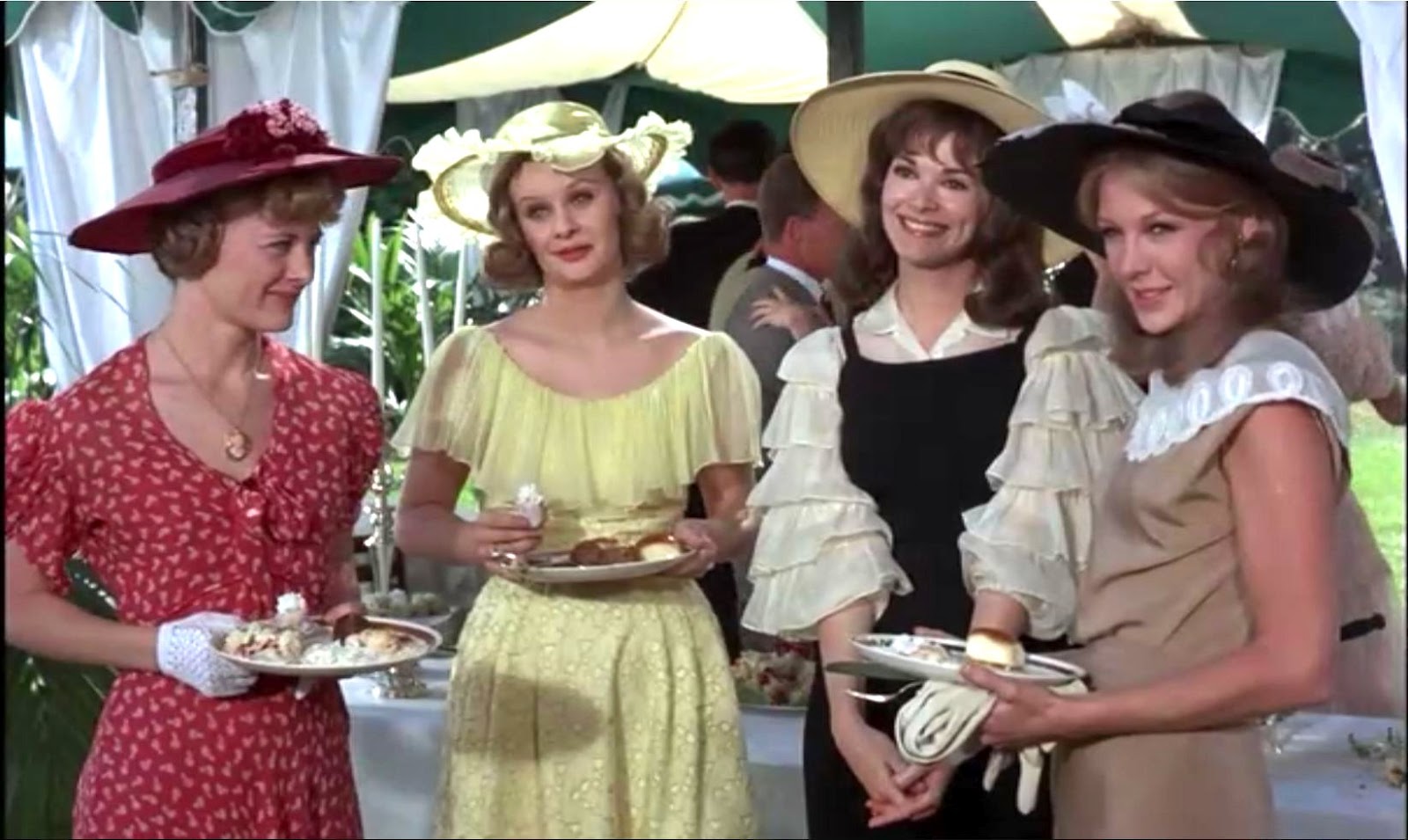
With a cast of eight beautiful women all falling histrionically in and out of love, bedrooms, and careers, The Group basically takes the usual all-girl triad formula of The Pleasure Seekersand Three Coins in the Fountain (along with the aforementioned The Best of Everything andValley of the Dolls) and merely ratchets up the stakes by moving it into territory first blazed by Clare Boothe Luce in The Women. All of which is sheer Nirvana for fans of camp cinema and movies about high-born women brought to low circumstances, but a headache for studio publicity departments and folks seeking economic ways of recounting the plot and summarizing the characters.

The challenge presented in having to promote a film with an ensemble cast of relative unknowns is revealed in the giggle-inducing tone adopted by the film’s ad campaign; the copy of which I’ll borrow to briefly introduce the members of The Group:

Lakey: The Mona Lisa of the smoking room…for women only!
Dottie: Thin women are more sensual. The nerve endings are closer to the surface.
Priss: She fell in love and lived to be an “experiment.”
Polly: No money…no glamour…no defenses…poor Cinderella.
Kay: The “outsider” at an Ivy League Ball.
Pokey: Skin plumped full of oysters…money, money, money…yum, yum, yum!
Libby: A big scar on her face called a mouth.
Helena: Many women do without sex, and thrive on it.

If I remember correctly, most, if not all of these lines come directly from the novel (a terrific read, I might add) and several are even repeated in the film. How anyone was able to resist such sleazily salacious come-ons is beyond me, but The Group didn’t fare too well at the boxoffice at the time and slipped quietly into obscurity after that. My guess is that it’s because the film at its core wasn’t really as trashy as its hard-sell. Well, more’s the pity, forThe Group, by benefit of its amazing cast and director Sidney Lumet’s deft handling of the wide-sweeping plot, is a step above the usual glossy soap opera.
Dottie (Joan Hackett) loses her virginity to emotionally remote artist Dick Brown (Richard Mulligan)
WHAT I LOVE ABOUT THIS FILM:
As a fan of both Robert Altman’s ensemble opuses and movies with overdressed women dramatically suffering in opulent surroundings, there isn’t really much to dislike about The Group. Touching on everything from politics, birth-control, lesbianism, marriage, mental illness, spousal abuse, adultery, childbirth, alcoholism, and date-rape (all in the course of 2 ½ hours) The Group has a lot of field to cover. Director Sidney Lumet (The Pawnbroker,Network, Dog Day Afternoon) keeps things moving at a rapid-fire pace that adds spark to the light comedy (Jessica Walter is a hoot as a bitchily gabby gossip) and tension to the drama. If perhaps the same tempo that spares The Group from ever being plodding or dull also undercuts the film’s overall emotional impact due to a necessary brevity (the film loses a great deal when Joan Hackett’s character disappears for a protracted time in the middle) I at least have to say it’s a flaw in the right direction. 
An example of Sidney Lumet's masterful framing and use of space in The Group 
I generally just like the propulsive feel of The Group's visual style. I can’t remember when I’ve seen a movie that handled the staging and filming of group scenes better or to greater effect, nor can I recall a cleverer employment of cinematic devices to provide plot exposition. In rewatching the film, my attention is drawn to the many subtle character interactions and small details (like the financially-struggling Kay always wearing the same hat to every wedding) easily overlooked on first viewing due to the film’s quick cutting and Lumet’s skillful use of the foregrounds and backgrounds to relay information.
When I think of what I like about The Group, the conclusion I always arrive at is, what’s not to like?

The telephone features prominently in The Group not only as a means by which the friends stay in contact but as a handy device to relate plot exposition
PERFORMANCES:
If you’ve ever harbored the notion that a film like, say, Valley of the Dolls would have been “better” with real actresses in the roles (sorry Patty Duke),seeing The Group would pretty much lay that fantasy to rest. The cast assembled for The Group couldn’t be more accomplished or better-suited to their roles, but even they can’t surmount a screenplay or the basic story construct so plot driven. The mere volume and frequency of crises and conflict in films like these reduce even exemplary performances (Hackett, Knight, Pettet, and Hartman) to “best of” moments.

Sidney Lumet cast his father, Baruch Lumet in the small role of Mr. Schneider, Polly's paternal neighbor
A standout, both appearance and character-wise, is Jessica Walter (Arrested Development’s Lucille Bluth herself!) who almost walks off with the film in a showy part that is essentially the Rosalind Russell role in The Women. Also very good is the highly appealing Shirley Knight. My personal favorite however, is Joan Hackett (making her film debut along with Bergen and Pettet) whom I never tire of watching and who never seems to hit a false note.
60s lesbians were always portrayed as severe, vaguely predatory types who stood around giving each other knowing looks under arched eyebrows. Here, an admittedly outclassed Candice Bergen introduces her sorority sisters to her "friend" the Baroness (Lidia Prochnicka)
Before I finish, special mention must to be made of the men in The Group. True to the genre, the men are a pretty odious bunch. Almost to a man they are characterized as weak, bigoted, manipulative, oppressive, brutalizing, or womanizing. Some all at the same time. This is of course to be expected and goes with the soap opera territory. What surprises me most is that there isn’t a single looker in the bunch. I know it’s a matter of taste and I'm taking into account that perhaps in 1966 these guys passed for handsome (so what was Paul Newman?) but to a most distracting degree the men at the center of The Group are like a grandmother’s wish-list of desirable males. Hal Holbrook? Larry Hagman? Richard Mulligan? James Broderick? The film features such a parade of unappetizing, daddy-fixation types that after a while I actually started to take it as some kind of personal affront.
No, this isn't an image of Polly (Shirley Knight) and her father. This is Gus (Hal Holbrook) the patently implausible object of desire of two gorgeous women and one unseen wife in The Group

THE STUFF OF DREAMS:
My older sister (whom I credit/blame for a good deal of my love of bad movies) got me to watch The Group on TV with her when I was a kid. A protofeminist if ever there was one, she tended to gravitate towards movies with female protagonists but lamented the fact that a great majority of these films tended to be vaguely masochistic soaps and cheesy exploitation films.
"The Group" was Elizabeth Hartman's follow-up to her Oscar-nominated film debut in "A Patch of Blue." As Priss, she's cast again as a victim of an oppressive relative, this time a husband.
 Sloan (her physician husband, following a miscarriage): "We'll, we can't have this again, Priss. Worst possible advertisement for a pediatrician!"
My sister (who was drawn to the bitchiness of the Libby character but identified with the self-sacrificing nobility of Polly) enjoyed the camp fun to be had at the expense of the fancy clothes, elaborate hairstyles, and frankly unsympathetic milieu of the privileged classes, but what she also responded to, and in turn helped me to appreciate, was what the film was trying to say about the challenges of maturity. The idealized vision of the world (and oneself) one can safely harbor while sheltered within the walls of youth and academia can take quite a beating when confronted by the disappointments and compromises of the real world. Is a person really failing in life if they put to rest youthful dreams in hopes of achieving some unforeseen, yet perhaps more authentic, realization of fulfillment? And how much pain does one cause oneself clinging to idealized illusions of "potential" and entitled success...all the while ignoring the possibility for happiness dressed in humbler clothing? 
Have to hand it to my sister...if she could find that kind of insight within a glossy potboiler like this, I'd say I learned about the value of "bad" films at the feet of a master.
In a role rendered considerably smaller in the film than  in the book, Carrie Nye has at least one memorable scene as Norine, a low-income Vassar classmate and outsider excluded from "The Group" 
Now, I’m not going to make out like The Group is some kind of profound, unacknowledged classic, but in light of what women's films have become over the years (they proudly proclaim themselves "chick flicks" and celebrate shopping as a valid expression of female empowerment), and in our current boomerang culture that doesn't encourage young people to seek and accept struggle as an integral part of the growing-up process; well...let's just say that there's something to be said for a 46-year-old guilty-pleasure movie that comes across as more progressive and perceptive in 2012 than it did in the year of its original release.
Halcyon Days
Helena's scandalous painting of "The Group" (that's Helena as the satyress)

‘The Group’ still has the power to unsettle. Nathaniel Rich on the novel’s lessons on the ideological life.

American Dreams, 1963: ‘The Group’ by Mary McCarthy

Even 50 years after it scandalized America with its frank sexuality, Mary McCarthy’s ‘The Group’ still has the power to unsettle. Nathaniel Rich on the novel’s lessons on the ideological life.

American readers were scandalized by The Group when it was published in 1963; for quite different reasons, The Group also scandalized Mary McCarthy’s critics—many of whom happened to be her friends, rivals, and lovers. The novel follows nine Vassar girls, class of ’33, through their 20s and into their bathrooms, bedrooms, and the bedrooms of their friends’ husbands. Libby, the ambitious English major, has a little secret: “she sometimes made love to herself, on the bath mat, after having her tub,” achieving a state that she names “Over the Top.” Dottie Renfrew has a secret too: she has been deflowered by a callous lothario named Dick Brown during which, to her astonishment, she went Over the Top herself. Norine is having an affair with her friend’s husband, in part because her own husband can manage erections only with prostitutes. Norine wonders whether it might make things easier if she allowed her husband this one indiscretion. “Supposing Put were to spend five minutes a week with a whore—the time it takes him to shave? Why should I mind?” We also learn about the sensitivity of a new mother’s nipples; the proper way to emplace a diaphragm; and the secret fear, and resentment, that young mothers harbor toward their own children.
Vassar College
“The Group.” By Mary McCarthy. $16; Mariner Books; 492 pages. (Library of Congress)
McCarthy’s candid accounts of female sexuality are accompanied by unsettlingly honest portraits of male cruelty. The men in The Group behave with glibness, condescension, and even brutality toward the Vassar grads. When Norine consults doctors about her husband’s problem, she is told that she should consider herself lucky that her husband is unable to have intercourse, and that, besides, sex isn’t necessary for a woman. Another doctor advises her to buy black chiffon underwear and cheap perfume, so that her husband will start thinking of her as a whore. Meanwhile, Libby is fired from her publishing job, even though she has done her work with exceptional diligence and passion. “Publishing’s a man’s business,” her editor informs her, “unless you marry into it. Marry a publisher, Miss MacAusland, and be his hostess.” There is an inverse correlation at play: the nicer a man appears, the greater his cruelty behind closed doors. Nils, Libby’s charming Norwegian suitor, turns violent when they are left alone in her apartment. He stops only when he discovers she’s a virgin. “It would not even be amusing to rape you,” he says, glaring down at her ruined dress. These gentlemen compare unfavorably with Dick Brown, who at least is honest about his interest in Dottie, is gentle in bed, and helpfully advises her to take birth control.
The candor of McCarthy’s treatment of these themes contributed to the novel’s enormous popular success—it was the bestselling hardcover in the country for five months and would sell nearly 300,000 copies in its first year. But those in McCarthy’s circle disapproved. Dwight Macdonald, her longtime friend and colleague, summarized the gossip: “Most of the intellectuals I’ve talked to, or read, about The Group, think it is the old Mary, cold and bitchy and superior.” Elizabeth Hardwick, one of her closest friends, wrote in The New York Review of Books under a pseudonym a nasty parody of Dottie’s defloration scene; this was a double betrayal, as McCarthy was one of the Review’s inaugural writers and close with its editorial staff. In the following issue, The Group was the subject of a snide, imperious review by Norman Mailer. It later turned out that Robert Lowell, Hardwick’s husband and a founder of the Review, had proposed Mailer for the essay; Lowell also disparaged the novel in his letters to friends. Norman Podhoretz joined in, calling the novel “flatly written and incoherently structured ... a trivial lady writer’s novel ... a well-deserved fiasco,” a comment echoed by Lillian Hellman, who called The Group the work of “a lady writer, a lady magazine writer.”
The critiques had little in common apart from their patronizing attitude, which channeled the tone used by The Group’s male characters in their dealings with the Vassar girls. Though why such vitriol? Biographers and cultural historians have blamed literary resentment. But the critical response reflected something stronger than jealousy; it had a quality of personal outrage. That is because The Group, more than exposing the largely hidden world of female sexuality, or the misogyny of the period, satirized the kind of thinking then in vogue among the intellectual set to which McCarthy belonged—the belief in the authority of ideology over personal experience. William Phillips, one of the editors of the Partisan Review, put it best when he said of McCarthy, “My main criticism is that she substituted morality for politics. She was always moralizing. She was always taking the high road. It could be annoying.”
What Phillips saw as a flaw, McCarthy considered a virtue. While McCarthy was deeply involved in the political questions of her time, she understood the danger in living a life too slavishly devoted to theory. This, after all, is The Group’s the dominant theme: the greatest tragedies befall those characters, both male and female, who pursue ideological obsessions at the expense of their own desires. This is true of Norine, who remains committed to a loveless and sexless marriage out of a sense of duty to her husband’s political activism, which has won him notoriety in their social set. “We’ve come to stand for something meaningful to other people,” says Norine, when explaining her determination to stand by him. Kay endures an equally excruciating marriage out of a conviction that her playwright husband is a genius, despite that all his plays fail to attract audiences or critical praise. Her suffering will be justified, she believes, if one day she will be seen as the woman behind a great man; when the couple finally separates, her life loses meaning, and she enters a terminal depression. Priss, meanwhile, forces herself to disobey her maternal instincts in order to satisfy the doctrine of her domineering husband—a decision that causes her to revile her own child. Only the aristocratic Lakey follows her private passion, taking a lesbian lover—though even then she exiles herself to Europe to avoid censure. From a remove of 50 years, the novel’s luridness seems quaint. But McCarthy’s evocation of the ways in which intellectual narcissism can ruin a life remains vivid and surprising.
The greatest tragedies befall those characters, both male and female, who pursue ideological obsessions at the expense of their own desires.
“You really feel our education was a mistake?” asks one Vassar grad, panicked, near the end of the novel.
“Oh, completely,” says Norine. “I’ve been crippled for life.”
But the problem, suggests McCarthy, isn’t too much education. The problem is not enough life.

Thursday, 29 August 2013

irish pov on the group

The sex lives of modern women ... fifty years on

FIFTY years ago Mary McCarthy’s novel shed light on http://exa.mn/mv. It shocked readers then, but today it seems almost tame.

Allison Williams as Marnie Michaels, Zosia Mamet as Shoshanna, Lena Dunham as Hannah and Jemima Kirke as Jessa in Girls. Picture: Home Box Office Inc.
×
1 / 2


When McCarthy published The Group in Aug 1963, just six months after Betty Friedan’s The Feminine Mystique, it painted a very different picture of the women of that generation.

The fictional group of eight best friends — graduates of Vassar College’s class of 1933, McCarthy’s own alma mater and graduating class — would have come of age right before Friedan’s peers from Smith College. Unlike the stifled housewives of Westchester, the women of McCarthy’s novel are trailblazers professionally, but most memorably, sexually. From love affairs to contraception to masturbation, sex drives the narrative of their fictional lives. 

The media panned one of their own as a cheap pornographer. (McCarthy was a respected writer for publications like The Partisan Review, The New Republic, The Nation, and Harper’s.) In The New York Review of Books, to whose first issue McCarthy contributed, Norman Mailer wrote that the “little book so full of promise and quiver ends up soggy and damp.” The public, by contrast, gobbled it up: it stayed on the New York Times bestseller list for nearly two years. 

Fifty years on, the sexual narrative remains a crutch for exploring women’s progress. Take the girls of Girls, whose awkward sex lives are highlighted more frequently than their frustrated professional ambitions. Or a recent New York Timesarticle that raised an eyebrow at young women at the University of Pennsylvania who’d rather hook up than date because their focus is on schoolwork and career ambitions. And for every Lean In [Lean In: Women, Work, and the Will to Lead by Facebook’s Sheryl Sandberg], there’s a handful of Fifty Shades of Greys. The Grouphelps illuminate the roots of this imbalance of attention: while it skewers the political notions of “progress” that leave its protagonists unfulfilled, it’s the erotic parts that dramatise their true struggle. As McCarthy’s women are among the first to pursue careers, the society around them asks not how quickly they’ll be promoted but how their jobs might help them find lovers and husbands. Sure, they can get jobs, but can they keep a man happy in bed?

The protagonists, almost all virgins when they graduate, lose their virginity with varying degrees of conventionality. While some wait until marriage, Kay (based in part on McCarthy) is intimate with her fiancĂ© while in college. One friend loses hers to a married man who is separated; another, Dottie, to a rouĂ© who tells her that love will never enter the equation. Still another, Libby, thinks her Norwegian baron beau will propose and invites him back to her apartment only to find herself being forced upon, dress ripped, wrists pinned to the couch, “his lips drawn back across his teeth like a wild animal about to charge.” Right before the pivotal moment, he asks if she’s a virgin; she says yes, and he retreats. “Oh, what a bore!” he admonishes her. “It would not even be amusing to rape you.” This riposte, and the women’s love lives, doesn’t seem so out of place on HBO or in the real world today. And tragic or otherwise, these women’s romantic exploits define them. 

McCarthy was writing fiction, but it was hardly a stretch from the true sex lives of women, so often swept under the rug in her day. She would know. Decades before the legalisation of contraception, McCarthy confessed in her autobiography,Intellectual Memoirs, “I realised one day that in 24 hours I had slept with three different men. And one morning I was in bed with somebody while over his head I talked on the telephone with somebody else.” She didn’t consider herself an exception to the rule. “I did not feel promiscuous. Maybe no one does. And maybe more girls sleep with more men than you would ever think to look at.” 

But sex is less liberation and more a Catch-22 in McCarthy’s vision. Sexual exploration in The Group rarely leads to happiness — even when men aren’t part of the equation. Lakey, the most glamorous, beautiful, and aloof girl of the group, is absent after the first chapter, away studying art in Europe. One wonders when we’ll be rewarded with tales of her romantic pursuits, surely more riveting than any of the others. When she finally returns, her companion is a swarthy, stocky baroness. At first, the group worries Lakey will “look down on them for not being lesbians.” When that’s clearly not the case, they begin to feel that “what had happened to Lakey was a tragedy,” and they imagine the intimacies of the relationship as “something of which they would not approve.” Ultimately, Lakey is defined by her sexual orientation. 


Not every aspect of the women’s stories still rings true, though, and some of it dates McCarthy’s novel. Dottie, the one with the uncommitted lover, is shocked when she climaxes on her first time and her lover, aptly named Dick, explains to her the birds and the bees. “Appearances to the contrary,” he says, “you’re probably highly sexed.” Dick also schools Dottie in several methods of contraception. When he tells her to get a pessary, she has no clue what he means.

As much as McCarthy showed great daring in pulling back the curtain on sex, she was troubled by the possibility of fetishising her characters. In a 1971 Q&A with theTimes, she said writing the book “became a terrible problem — partly a moral problem — not about sex of course. But I began to feel as though I was persecuting those girls.” She knew she couldn’t write a novel with sexual elements without it being perceived as a book about sex, and she knew her characters would be judged as harshly as their real-world counterparts. As Emily Nussbaum ofThe New Yorker recently pointed out about the legacy of Sex and the City, we still operate under “the assumption that anything stylised (or formulaic, or pleasurable, or funny, or feminine, or explicit about sex rather than about violence, or made collaboratively) must be inferior.” 

Il Grupo is 50! A Spanish celebration of Book & Film, inimitably translated by Google - 'Speak with tranquility...'

The Group / The Group

Note: ★★★½
The Group is thus a kind of precursor film about a generation, their world, their values, their dreams, their fears - About Last Night ... / About Last Night ..., The First Year of the Rest of Our Lives / St. Elmo's Fire , The Big Chill / The Big Chill, For the Rest of Our New / Peter 's Friends, What We All Loved Each Other in Either / Both C'eravamo Amati .
It is a beautiful, deep, serious, passionate, sometimes wry, sarcastic portrait of the generation of American (mostly, but also Americans, of course) who reached adulthood in the 1930s, amid the Great Depression, in the years leading up to Spanish Civil War, the rise of Nazism and the outbreak of the Second World War, and that much of the intelligentsia flirted with the dream of socialism.
Speak with tranquility, topics that were not yet discussed very openly in film at the time the film was made, in 1966, much less the time that action takes place: the loss of virginity, the lack of knowledge about sex and methods contraception, lesbianism.Besides all the references to the involvement of several characters with the Communist Party.
It is based on a magnificent, extraordinary novel - which has the same title as the film, both in the original and in Portuguese - authored by Mary McCarthy (1912-1989), great writer, one of the most fascinating figures of the literary universe of the twentieth century . And the novel has a lot of reality in autobiographical confessions, although, of course, a beautiful work of fiction, with remarkable characters, well designed - basically eight young women in 1933, to 22 or 23 years, Vassar graduate, expensive and prestigious university who at the time was exclusively for women.
Just like its eight characters, Mary McCarthy graduated from Vassar in 1933. Exactly how Strong Kay (Joanna Pettet), one of eight women who make up the South Tower Group, Mary McCarthy would marry soon after graduation, with a young actor would-playwright.
The novel was released in 1963 when Mary McCarthy, age 41 and has published eight books, was a writer and critic recognized and respected. Grupo stayed for nearly two consecutive years on the bestseller list of the New York Times .
The film production in 1966, was directed by one of the greatest American filmmakers, Sidney Lumet , who started his film career in 1957, after successes in TV and theater, with the beautiful Twelve Men and a Sentence / Twelve Angry Men .
Lumet and production chose to interpret several of the eight girls in the group and the men who were around them, a lot of beginners: was the screen debut of Candice Bergen , Joan Hackett, Joanna Pettet, Kathleen Widdoes, Hal Holbrook .
It was the second film by Elizabeth Hartman. And the third of Jessica Walter .
The gorgeous and great Shirley Knight , then 30 years and eight films in the curriculum, including Sweet Bird of Youth , was, it seems, the more veteran cast.
As it turns out, many of the names of the cast, none of them is someone who would be a big star - with the exception of Candice Bergen. Are good, great actresses - but not stars.
A movie now little known in Brazil, an author out of print
I may well be wrong, but the Group - both the book and the film - is now much less known than it should. It is perhaps one of the less heralded films of Sidney Lumet. Not available on DVD in Brazil, according to a quick search on the internet shows, and also had not been released on VHS, I see the Videobook of 2001, a publication absolutely reputable and reliable.
The film has now reappeared, however, thanks to the good taste of some programmer Telecine Cult. It was through this channel that I could review the film I had seen at the time of the launch in late Cine Lido de Curitiba, in 1/8/1967, as reported by my notebook. (If noted, beauty, if not noted, danced.)
However, much more still strange what happened with the film, is what happened with the work of the writer: for a sociological phenomenon which any explanation entirely unaware, Mary McCarthy disappeared from bookstores - at least the Brazilian.
The site's Bookstore Culture, for example, shows that there is available in Portuguese even a book author. Even Group , considered his masterpiece, was reissued in recent years.
I'll talk from Mary McCarthy later.
At the beginning of the narrative, while much information about the eight characters
From what you can tell, the writer (who was also the producer) Sidney Buchman tried to be very faithful to the book, the spirit of the book. To tell about the lives of eight young women over six years between 1933, the year of their graduation from Vassar, and 1939, the year of the beginning of World War II, the writer and producer Buchman and director Sidney Lumet made ​​a long movie, 150 minutes, two hours and a half in length. Although the duration much larger than many of the productions of the time, and today, however, the Group does not seem long. On the contrary: as all that is good, seems to be short lived.
But it is very easy for the viewer to capture very well at the beginning of the narrative, who's who in that great group of girls. Over time, the unfolding of the narrative, the figures of each are becoming clearer, but in the beginning we suffer.
The opening is extraordinary. Even before the special credits, the film gives us a general group of girls at university rich, well established, in which everything has the appearance of something that is not solid melts into air. Each has a vocation to an area - and we see each involved in some activity that is related to your area of ​​interest.
Lakey (Candice Bergen, with a beauty that loose sparks on the screen, to the left in the photo ), for example, is geared towards the arts. It is one of the two most millionaires group. Shortly after graduation, will embark on a trip to Europe to pursue his studies of art history - and will be there for several years.
The other more absolutely millionaire those years when the country plunged into misery of the Great Depression is Pokey (Mary Robin Redd). Like animals, horses, riding, wants to be a veterinarian, and wins the parents' little airplane to get around to the location of the school.
Libby (Jessica Walter) has literary ambitions. It's snobby, gossipy, finds special and want to work as a book editor.
Who else writes in practice, however, is Helena (Kathleen Widdoes), aims to be an instructor in kindergarten, but it is one of the group who writes endlessly about what is happening to each of the eight. Is it also the speech as speaker of the firm - a speech full of hope, speaking on the role of women in all areas of American society, a country, she says, that while mired in the economic downturn, has a glorious future for front.
Polly (Shirley Knight) comes from a family impoverished by the Depression. Shy, discreet, opted for medical sciences, will work as a laboratory technician in a large hospital in New York.
Kay Strong (Joanna Pettet) is another whose family impoverished. It is fickle, merely an interest to another; flirted with theater - where he met Harald Peterson (Larry Hagman), who will marry the very beginning of the narrative, shortly after graduating from Vassar in July 1933 - but will work at Macy's, a large department store, and develop a career in commerce.
Always open to new experiences, Kay is the first group to have sex. Harald fucks before marriage - something quite unusual for the customs of the families of the girls in the group.
Dottie (Joan Hackett, beautiful, great actress in the photo ), the traditionalist Boston, strictly religious family, who planned to work as a social worker, will be the second to decide to lose their virginity.And to choose a subject that absolutely imbecile, a painter friend Harald, named Dick (Richard Mulligan).
Priss (Elizabeth Hartman) is an idealist; vigorously supports the government of Franklin D. Roosevelt - had the parents of most of the group as too interventionist, almost socialist.
Socialist ideals, communism, the struggle against fascism are recurring themes in the conversations of the girls in the group, throughout the narrative.
The choice of the actresses did not take into account the physical description of the characters in the book
Sidney Lumet and his cinematographer Boris Kaufman use and abuse of traveling shots, the camera follows this large number of characters who frequent the large rooms on rails placed on the ground, cranes. Wonderful camera.
The entire cast is good, but in my opinion, Shirley Knight and Joan Hackett shine even more, an octave above the others.
I found it interesting the small detail that Lumet and his team the casting did not bother with the physical descriptions that Mary McCarthy does in the book. Thus, for example, in the book Libby is blonde, and film, the skin of Jessica Walter, have long black hair. Lakey, unlike in the book has black hair, and is played by Candice Bergen lourĂ­ssima.
Here, the opinion of three critical
"Sidney Lumet transforms the novel by Mary McCarthy about girls in the class of 1933 at Vassar film carelessly handled, pleasant and full of energy," defined Pauline Kael, the first lady of American criticism, then to quote the names of actresses the great cast.
Leonard Maltin gave 3 stars to 4: "Uneven, but overall good adaptation of the novel by Mary McCarthy notch over eight graduates of a university type Vassar. (Shirley) and Knight (Joan) Hackett tower in excellent cast. "
The Guide des Films of Jean Tulard does, after a synopsis that this time it is not necessary, an analysis of long, thoughtful, bright, as almost always in French master guide. I'll report what he says text collaborator Guy Bellinger, without the worry of being literal, and therefore without quotes:
Lumet's film is not without flaws. It is very talkative, with its eight heroines who talk nonstop. In this he is no more than a condensation of the novel dense, long, Mary McCarthy, who designed hundreds of pages to describe the fate of eight young women over seven years. The film goes too fast, the scenes collide and barely have time to breathe in and begin a new dialogue on the field and reverse shot. What causes the viewer to lose a bit between all the characters. But Le Groupe, while not a perfect movie, is a work no less than seductive, first of all by the choice of its eight actresses: Lumet had hand particularly happy to gather a beautiful bouquet of talented beginners. The most beautiful is undoubtedly Candice Bergen, full of charm clever in his first role on screen. The most impressive is Shirley Knight ( pictured below ), which passes over two hours, and convincingly, the shy virgin young women mature and complete. The most exciting is Joanna Pettet, pathetically trying to compensate for the failure of his life. Another quality of Groupe is there are not removed disenchanted tone of the novel by Mary McCarthy.
Grand Guide des Films . What a beautiful analysis in a single paragraph.
Go ahead.
The first Brazilian edition, the ear was none other than Otto Maria Carpeaux
The Group , the book was released in Brazil in 1965, two years after leaving the United States, a year after the military coup.Out the Brazilian Civilization, at the time that the publisher threw all that milicos not like to see in bookstores. I won this book, a copy of the first Brazilian edition, February 1966.
The text of the ear is signed by none other than the great Otto Maria Carpeaux. It is a fascinating text that is hard not to transcribe entire:
"Mary McCarthy is now one of the first names, but the first name of American literature, and the Group is, for now, his masterpiece. Anyone opening this volume will soon find some of the pages boldest of all world literature, pages that would not only blushing a friar of stone, but the actual DH Lawrence: the scene of deflowering a girl, described with details of a merciless realism . But make no mistake: this work, which had huge success in the United States and worldwide, there is a pornographic novel, far from it. It is a profoundly serious study of American society today and all that is in it is rotten and alive, intelligence and stupidity, despair and hope. (...)
"It is a serious novel. So is a tragic romance. But the actors of this tragedy are not fully aware of the roles they play. Are struggling in their financial difficulties in their intellectual doubts in his amorous adventures or just sex as Mary McCarthy fish caught in the net of his creative imagination and can not find the exit. Their lives are tragic, but his gestures are unintentionally comical. No page, almost unbootable the reader a strong understanding and healthy laugh. (...) This is the hallmark of this highly intelligent Mary McCarthy sometimes seems the American sister of Simone de Beauvoir, and sometimes, a companion or Pratolini Moravia, the great Italian neo-realists. "
I can not understand how there are no books of Mary McCarthy in Brazilian bookstores
How to explain that Mary McCarthy has not one of his works in Portuguese available in bookstores?
I really wish I had an answer to that question.
Mary McCarthy did not belong to the party, but had sympathies for communism, in the second half of the 30s, however, went on to repudiate Stalinism after the Moscow trials that led to the purge of Old Bolsheviks. Was insistent defense of Leon Trotsky, and in polemics with American intellectuals and writers she considered sympathetic to Stalinism.
(The Moscow Trials, the persecution of Trotsky are themes of the book and movie references are made to it.)
Entered history its clashes with another grand dame of American letters, Lillian Hellmann, Mrs. eternal. Dashiell Hammett (though, as well as another couple of brilliant arts of the United States, Spencer Tracy-Katharine Hepburn ever been married).
Dashiell Hammett and Lillian Hellmann remained faithful to communism until their deaths - he in 1961, she in 1984. Mary McCarthy whenever he could brave the lioness poked with a short stick. Once, on television, said: "Every word she (Lillian) writes a liar, including 'and' and 'the.'"
Lillian Hellmann went to court against Mary McCarthy demanding compensation for moral damages of $ 2.5 million. The cause crawled years in the courts, until the death of Lillian. Mary died only five years later in 1989.
The speech dreamy youth, repeated at the end of the narrative, shows immense disillusionment
The revolt against Mary McCarthy Stalinist purges against the Gulags beginning to undo the dream of a fairer society, is present with all the letters in the film. The sweet Polly falls for Gus Leroy (Hol Holbrook), a publisher of books communist.The neighbor from her, Schneider is a German refugee, he also communist but anti-Stalinist sympathizer internationalism Trotsky. When the relationship with Gus is already about to crumble, and Gus talks on the possibility of talking to Schneider, Polly warns that surely there would be much discussion among them about the Moscow trials.
Eight years after Sidney Lumet led the Group to the cinema, the eternal socialist Ettore Scola in his masterpiece In Which We All Loved Each Other So much, put in the mouth of one of his characters the phrase that sums up perfectly the disenchantment of who was watching Your idealism of young crumble over time: "We thought we would change the world, but it was the world that has changed."
Lumet and screenwriter Buchman synthesized disenchantment expressed on the novel by Mary McCarthy to the encore, after a journey of five years shown in 150 minutes of good cinema, speech full of hope Helena, the valedictorian:
"We, the class of 1933 are going ahead. In a time of economic crisis, in a time that demands that every woman of America plays a role in every sphere of national life. For this we prepare. In the arts, sciences, industry, the creation of our laws. And in politics, we believe all sorts of opinions should be heard. We believe, as we go our separate ways, it is only through our complete fulfillment we will achieve the goal of our education, and each of us will give their contribution to our emerging America. "
Great Mary McCarthy. Great Sidney Lumet.
Note in December 2011
The Group / The Group
Sidney Lumet, USA, 1966.
With Candice Bergen (Lakey Eastlake), Joan Hackett (Dottie Renfrew), Elizabeth Hartman (Priss Hartshorn), Shirley Knight (Polly Andrews), Joanna Pettet (Kay Strong), Mary Robin Redd (Pokey Prothero), Jessica Walter (Libby MacAusland) , Kathleen Widdoes (Helena Davison), James Broderick (Dr. Ridgeley), James Congdon (Sloan Crockett), Larry Hagman (Harald Peterson), Hal Holbrook (Gus Leroy), Richard Mulligan (Dick Brown), Carrie Nye (Norine)
Screenplay Sidney Buchman
Based on the novel The Group, Mary McCarthy
Boris Kaufman Photography
Music Charles Gross
Production Sidney Buchman, Famartists Productions
Color, 150 min
*** 1/2